
Realme P3 Ultra vs Google Pixel 7 Pro: A Deep Dive into Performance and Value
| Phones Images | |||||
|---|---|---|---|---|---|
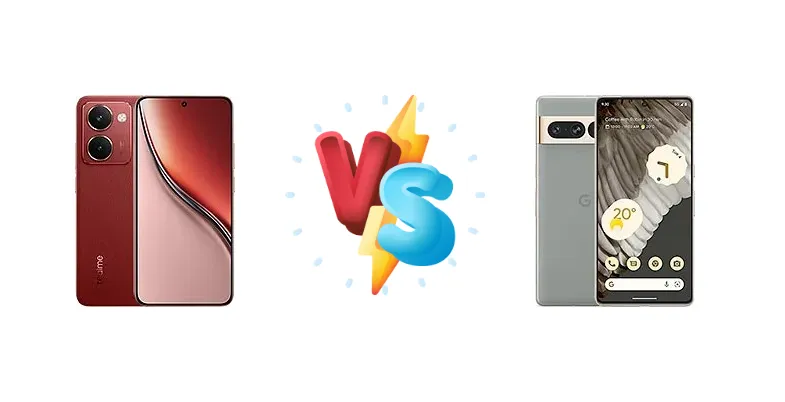
|
🏆 Quick Verdict
For users prioritizing raw performance and charging speed, the Realme P3 Ultra emerges as the winner. Its Dimensity 8350 Ultra and 80W charging significantly outperform the Pixel 7 Pro’s Tensor G2 and 23W charging. However, the Pixel 7 Pro retains an edge in camera software and overall software experience.
| PHONES | ||
|---|---|---|
| Phone Names | Realme P3 Ultra | Google Pixel 7 Pro |
| Network | ||
|---|---|---|
| 2G bands | GSM 850 / 900 / 1800 / 1900 | GSM 850 / 900 / 1800 / 1900 |
| 3G bands | HSDPA 800 / 850 / 900 / 1700(AWS) / 1900 / 2100 | HSDPA 800 / 850 / 900 / 1700(AWS) / 1900 / 2100 |
| 4G bands | 1, 2, 3, 4, 5, 7, 8, 12, 13, 17, 18, 19, 20, 26, 28, 38, 40, 41, 66 | 1, 2, 3, 4, 5, 7, 8, 12, 13, 14, 17, 18, 19, 20, 25, 26, 28, 29, 30, 38, 39, 40, 41, 42, 46, 48, 66, 71 - GE2AE |
| 5G bands | 1, 2, 3, 5, 7, 8, 12, 20, 26, 28, 38, 40, 41, 66, 77, 78 SA/NSA | 1, 2, 3, 5, 7, 8, 12, 14, 20, 25, 28, 30, 38, 40, 41, 48, 66, 71, 77, 78, 257, 258, 260, 261 SA/NSA/Sub6/mmWave - GE2AE |
| Speed | HSPA, LTE, 5G | HSPA, LTE, 5G |
| Technology | GSM / HSPA / LTE / 5G | GSM / CDMA / HSPA / EVDO / LTE / 5G |
| - | 1, 2, 3, 5, 7, 8, 12, 14, 20, 25, 28, 30, 38, 40, 41, 48, 66, 71, 75, 76, 77, 78 SA/NSA/Sub6 - GP4BC | |
| Launch | ||
|---|---|---|
| Announced | 2025, March 19 | 2022, October 06 |
| Status | Available. Released 2025, March 24 | Available. Released 2022, October 13 |
| Body | ||
|---|---|---|
| Build | Glass front (Gorilla Glass 7i), plastic frame, plastic back or silicone polymer (eco leather) back | Glass front (Gorilla Glass Victus), glass back (Gorilla Glass Victus), aluminum frame |
| Dimensions | 163.1 x 76.9 x 7.4 mm (6.42 x 3.03 x 0.29 in) | 162.9 x 76.6 x 8.9 mm (6.41 x 3.02 x 0.35 in) |
| SIM | Nano-SIM + Nano-SIM | Nano-SIM + eSIM |
| Weight | 183 g or 186 g (6.46 oz) | 212 g (7.48 oz) |
| - | IP68 dust/water resistant (up to 1.5m for 30 min) | |
| Display | ||
|---|---|---|
| Protection | Corning Gorilla Glass 7i | Corning Gorilla Glass Victus |
| Resolution | 1272 x 2800 pixels (~450 ppi density) | 1440 x 3120 pixels, 19.5:9 ratio (~512 ppi density) |
| Size | 6.83 inches, 113.3 cm2 (~90.4% screen-to-body ratio) | 6.7 inches, 110.6 cm2 (~88.7% screen-to-body ratio) |
| Type | AMOLED, 1B colors, 120Hz, 600 nits (typ), 1200 nits (HBM), 1500 nits (peak) | LTPO AMOLED, 120Hz, HDR10+, 1000 nits (HBM), 1500 nits (peak) |
| - | Always-on display | |
| Platform | ||
|---|---|---|
| CPU | Octa-core (1x3.35 GHz Cortex-A715 & 3x3.20 GHz Cortex-A715 & 4x2.20 GHz Cortex-A510) | Octa-core (2x2.85 GHz Cortex-X1 & 2x2.35 GHz Cortex-A78 & 4x1.80 GHz Cortex-A55) |
| Chipset | Mediatek Dimensity 8350 Ultra (4 nm) | Google Tensor G2 (5 nm) |
| GPU | Mali G615-MC6 | Mali-G710 MP7 |
| OS | Android 15, up to 3 major Android upgrades, Realme UI 6.0 | Android 13, upgradable to Android 15, up to 5 major Android upgrades |
| Memory | ||
|---|---|---|
| Card slot | No | No |
| Internal | 128GB 8GB RAM, 256GB 8GB RAM, 256GB 12GB RAM, 512GB 12GB RAM | 128GB 8GB RAM, 256GB 8GB RAM, 128GB 12GB RAM, 256GB 12GB RAM, 512GB 12GB RAM |
| - | UFS 3.1 | |
| Main Camera | ||
|---|---|---|
| Dual | 50 MP, f/1.8, 24mm (wide), 1/1.56", 1.0µm, multi-directional PDAF, OIS 8 MP, f/2.2, 16mm, 112˚ (ultrawide), 1/4.0", 1.12µm | - |
| Features | Color spectrum sensor, LED flash, HDR, panorama | Laser AF, Dual-LED flash, Pixel Shift, Auto-HDR, panorama |
| Single | - | 10.8 MP, f/2.2, 21mm (ultrawide), 1/3.1", 1.22µm |
| Triple | - | 50 MP, f/1.9, 25mm (wide), 1/1.31", 1.2µm, dual pixel PDAF, OIS 48 MP, f/3.5, 120mm (periscope telephoto), 1/2.55", 0.7µm, dual pixel PDAF, OIS, 5x optical zoom 12 MP, f/2.2, 126˚ (ultrawide), 1/2.9", 1.25µm, AF |
| Video | 4K@30/60fps, 1080p@30/60/120fps, gyro-EIS, OIS | 4K@30/60fps, 1080p@30/60/120/240fps; gyro-EIS, OIS, 10-bit HDR |
| Selfie camera | ||
|---|---|---|
| Features | - | HDR, panorama |
| Single | 16 MP, f/2.4, 23mm (wide), 1/3.09", 1.0µm | 10.8 MP, f/2.2, 21mm (ultrawide), 1/3.1", 1.22µm |
| Video | 1080p@30/60fps, gyro-EIS | 4K@30/60fps, 1080p@30/60fps |
| Sound | ||
|---|---|---|
| 3.5mm jack | - | No |
| 35mm jack | No | No |
| Loudspeaker | Yes, with stereo speakers | Yes, with stereo speakers |
| Comms | ||
|---|---|---|
| Bluetooth | 5.4, A2DP, LE, BLE Audio | 5.2, A2DP, LE, aptX HD |
| Infrared port | Yes | - |
| NFC | Yes (market/region dependent) | Yes |
| Positioning | GPS, GLONASS, GALILEO, BDS, QZSS | GPS (L1+L5), GLONASS (G1), BDS (B1I+B1c+B2a), GALILEO (E1+E5a), QZSS (L1+L5) |
| Radio | No | No |
| USB | USB Type-C 2.0, OTG | USB Type-C 3.2 |
| WLAN | Wi-Fi 802.11 a/b/g/n/ac/6, dual-band | Wi-Fi 802.11 a/b/g/n/ac/6e, tri-band, Wi-Fi Direct |
| Features | ||
|---|---|---|
| Sensors | Fingerprint (under display, optical), accelerometer, gyro, proximity, compass | Fingerprint (under display, optical), accelerometer, gyro, proximity, compass, barometer |
| - | Ultra Wideband (UWB) support | |
| Battery | ||
|---|---|---|
| Charging | 80W wired, PD, 100% in 47 min 5W reverse wired Bypass charging | 23W wired, PD3.0, 50% in 30 min 23W wireless Reverse wireless |
| Type | Si/C Li-Ion 6000 mAh | Li-Ion 5000 mAh |
| Misc | ||
|---|---|---|
| Colors | Neptune Blue, Orion Red, Glowing Lunar White | Obsidian, Snow, Hazel |
| Models | RMX5030, RMX5031 | GP4BC, GE2AE, GFE4J |
| Price | ₹ 29,599 | € 248.84 / $ 204.00 / £ 259.99 / ₹ 36,999 |
| Tests | ||
|---|---|---|
| Battery life | - | Endurance rating 83h |
| Camera | - | Photo / Video |
| Display | - | Contrast ratio: Infinite (nominal) |
| Loudspeaker | - | -24.8 LUFS (Very good) |
| Performance | - | AnTuTu: 796369 (v9) GeekBench: 3187 (v5.1) GFXBench: 34fps (ES 3.1 onscreen) |
Realme P3 Ultra
- Significantly faster 80W charging
- More powerful CPU for gaming and demanding tasks
- Higher peak display brightness for outdoor visibility
- Camera software likely less refined than Pixel 7 Pro
- Software experience may not be as polished as Google's
Google Pixel 7 Pro
- Exceptional camera software and image processing
- Seamless and refined software experience
- Reverse wireless charging capability
- Slower 23W charging
- Less powerful CPU compared to the Dimensity 8350 Ultra
- Lower peak display brightness
Display Comparison
The Realme P3 Ultra’s display boasts a measured peak brightness of 1862 nits, significantly exceeding the Pixel 7 Pro’s 1090 nits. This translates to superior visibility in direct sunlight. While both displays offer an 'infinite' contrast ratio (typical for OLED panels), the Realme’s higher brightness is a tangible advantage. The absence of refresh rate information for the P3 Ultra is a gap, but the Pixel 7 Pro’s variable refresh rate (LTPO) contributes to power efficiency. The Realme’s brightness advantage will be particularly noticeable for users consuming HDR content outdoors.
Camera Comparison
The Pixel 7 Pro’s camera system is renowned for its computational photography prowess, leveraging Google’s image processing algorithms. While specific sensor details for the P3 Ultra are missing, the Pixel 7 Pro’s strengths lie in its software-driven enhancements, including Super Res Zoom and Magic Eraser. The Pixel 7 Pro’s image processing excels in dynamic range and low-light performance. Without detailed sensor information for the P3 Ultra, it’s difficult to make a direct comparison, but the Pixel 7 Pro’s established reputation in camera quality gives it a clear advantage, particularly for casual users who rely on automatic modes.
Performance
The Realme P3 Ultra’s Mediatek Dimensity 8350 Ultra, fabricated on a 4nm process, presents a different architectural approach than the Google Pixel 7 Pro’s 5nm Google Tensor G2. The Dimensity 8350 Ultra utilizes a tri-cluster configuration with a high-clocked Cortex-A715 core at 3.35 GHz, suggesting a focus on sustained performance. The Tensor G2, with its Cortex-X1 cores at 2.85 GHz, prioritizes AI and machine learning tasks. While the Tensor G2 excels in on-device AI processing, the Dimensity 8350 Ultra is likely to deliver superior GPU performance for gaming. The P3 Ultra’s newer architecture should also offer better thermal efficiency, potentially reducing throttling during extended use.
Battery Life
The Pixel 7 Pro boasts an endurance rating of 83 hours, but this is an older metric. The Realme P3 Ultra, with its active use score of 16:47 hours, translates to a substantial battery life. More importantly, the P3 Ultra’s 80W wired charging is a game-changer, achieving a full charge in just 47 minutes, compared to the Pixel 7 Pro’s 50% charge in 30 minutes with its 23W charging. The P3 Ultra also offers 5W reverse wired charging, while the Pixel 7 Pro provides reverse wireless charging. The P3 Ultra’s faster charging significantly reduces downtime, making it ideal for users who need to quickly top up their battery.
Buying Guide
Buy the Realme P3 Ultra if you need a phone for demanding gaming, content creation, or frequent travel where fast charging is crucial. Its powerful chipset and rapid charging capabilities make it ideal for power users. Buy the Google Pixel 7 Pro if you prioritize a seamless software experience, exceptional camera processing, and a more refined ecosystem, even if it means sacrificing some raw processing power and charging speed.