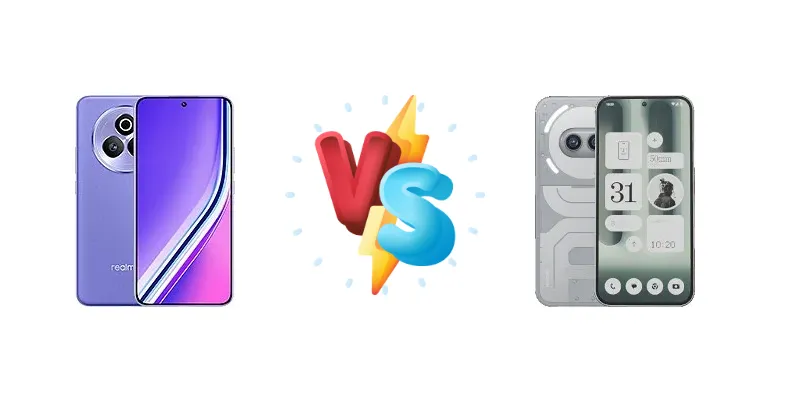
The mid-range smartphone market is fiercely competitive, and the Realme P3 Pro and Nothing Phone (2a) Plus represent compelling options. The P3 Pro focuses on rapid charging and a proven Qualcomm chipset, while the Nothing Phone (2a) Plus prioritizes display quality and a unique software experience. This comparison dives deep into their specifications to determine which device delivers the best value.
🏆 Quick Verdict
For the average user prioritizing all-day battery life and a brighter display, the Nothing Phone (2a) Plus emerges as the winner. Its 16:34 hour active use score and 1097 nits peak brightness provide a superior user experience, despite the Realme P3 Pro’s faster charging.
| Network |
|---|
| 2G bands | GSM 850 / 900 / 1800 / 1900 | GSM 850 / 900 / 1800 / 1900 |
| 3G bands | HSDPA 850 / 900 / 2100 | HSDPA 800 / 850 / 900 / 1700(AWS) / 1900 / 2100 |
| 4G bands | 1, 3, 5, 8, 28, 40, 41 | 1, 3, 4, 5, 7, 8, 18, 19, 20, 26, 28, 38, 39, 40, 41, 42, 66 |
| 5G bands | 1, 3, 5, 8, 28, 40, 41, 77, 78 SA/NSA | 1, 3, 5, 7, 8, 20, 28, 38, 40, 41, 66, 77, 78 SA/NSA |
| Speed | HSPA, LTE, 5G | HSPA, LTE, 5G |
| Technology | GSM / HSPA / LTE / 5G | GSM / HSPA / LTE / 5G |
| Launch |
|---|
| Announced | 2025, February 18 | 2024, July 31 |
| Status | Available. Released 2025, February 25 | Available. Released 2024, August 03 |
| Body |
|---|
| Build | Glass front, aluminum alloy frame, plastic back or silicone polymer back (eco leather) | Glass front (Gorilla Glass 5), plastic frame, plastic back |
| Dimensions | 163.5 x 77.3 x 8 mm or 8.3 mm | 161.7 x 76.3 x 8.5 mm (6.37 x 3.00 x 0.33 in) |
| SIM | Nano-SIM + Nano-SIM | Nano-SIM + Nano-SIM |
| Weight | 190 g or 192 g (6.70 oz) | 190 g (6.70 oz) |
| Display |
|---|
| Protection | - | Corning Gorilla Glass 5 |
| Resolution | 1272 x 2800 pixels (~450 ppi density) | 1080 x 2412 pixels, 20:9 ratio (~395 ppi density) |
| Size | 6.83 inches, 113.3 cm2 (~89.7% screen-to-body ratio) | 6.7 inches, 107.5 cm2 (~87.1% screen-to-body ratio) |
| Type | AMOLED, 1B colors, 120Hz, 600 nits (typ), 1200 nits (HBM), 1500 nits (peak) | AMOLED, 1B colors, 120Hz, 2160Hz PWM, HDR10+, 700 nits (typ), 1100 nits (HBM), 1300 nits (peak) |
| Platform |
|---|
| CPU | Octa-core (1x2.5 GHz Cortex-A720 & 3x2.4 GHz Cortex-A720 & 4x1.8 GHz Cortex-A520) | Octa-core (2x3.0 GHz Cortex-A715 & 6x 2.0 GHz Cortex-A510) |
| Chipset | Qualcomm SM7635 Snapdragon 7s Gen 3 (4 nm) | Mediatek Dimensity 7350 Pro (4 nm) |
| GPU | Adreno 810 | Mali-G610 MC4 |
| OS | Android 15, Realme UI 6.0 | Android 14, up to 3 major Android upgrades, Nothing OS 3.0 |
| Memory |
|---|
| Card slot | No | No |
| Internal | 128GB 8GB RAM, 256GB 8GB RAM, 256GB 12GB RAM | 256GB 8GB RAM, 256GB 12GB RAM |
| Main Camera |
|---|
| Dual | 50 MP, f/1.8, 24mm (wide), 1/1.56", 1.0µm, multi-directional PDAF, OIS
Auxiliary lens | 50 MP, f/1.9, 24mm (wide), 1/1.57", 1.0µm, PDAF, OIS
50 MP, f/2.2, 114˚ (ultrawide), 1/2.76", 0.64µm |
| Features | Color spectrum sensor, LED flash, HDR, panorama | LED flash, panorama, HDR |
| Video | 4K@30fps, 1080p@30/60/120fps, gyro-EIS, OIS | 4K@30fps, 1080p@60/120fps, gyro-EIS |
| Selfie camera |
|---|
| Features | Panorama | HDR |
| Single | 16 MP, f/2.4, 24mm (wide), 1/3.09", 1.0µm | 50 MP, f/2.2, (wide), 1/2.76" |
| Video | 1080p@30fps, gyro-EIS | 4K@30fps |
| Sound |
|---|
| 35mm jack | No | No |
| Loudspeaker | Yes, with stereo speakers | Yes, with stereo speakers |
| Comms |
|---|
| Bluetooth | 5.2, A2DP, LE | 5.3, A2DP, LE |
| NFC | No | Yes, 360˚ |
| Positioning | GPS, GLONASS, GALILEO, BDS, QZSS | GPS, GALILEO, GLONASS, BDS, QZSS |
| Radio | No | No |
| USB | USB Type-C 2.0 | USB Type-C 2.0, OTG |
| WLAN | Wi-Fi 802.11 a/b/g/n/ac/6, dual-band | Wi-Fi 802.11 a/b/g/n/ac/6, dual-band, Wi-Fi Direct |
| Features |
|---|
| Sensors | Fingerprint (under display, optical), accelerometer, gyro, proximity, compass | Fingerprint (under display, optical), accelerometer, gyro, proximity, compass |
| Battery |
|---|
| Charging | 80W wired, 50% in 24 min
Bypass charging | 50W wired, 50% in 21 min, 100% in 56 min |
| Type | Si/C Li-Ion 6000 mAh | 5000 mAh |
| Misc |
|---|
| Colors | Nebula Glow, Saturn Brown, Galaxy Purple | Black, Grey |
| Models | - | A142P |
| Price | ₹ 18,999 | € 269.90 / ₹ 22,599 |
Realme P3 Pro
- 80W fast charging for quick power-ups
- Qualcomm Snapdragon 7s Gen 3 chipset offers a balanced performance
- Potentially more affordable price point
- Likely lower peak display brightness compared to the Nothing Phone (2a) Plus
- Battery life likely shorter than the Nothing Phone (2a) Plus
Nothing Phone (2a) Plus
- Excellent battery life with 16:34 hours of active use
- Bright 1097 nits display for outdoor visibility
- Unique and minimalist design
- Slower 50W charging compared to the Realme P3 Pro
- Dimensity 7350 Pro may exhibit more thermal throttling under sustained load
Display Comparison
The Nothing Phone (2a) Plus boasts a significant advantage in display quality, achieving a measured peak brightness of 1097 nits. This translates to excellent visibility even in direct sunlight, a common pain point for many smartphones. While the Realme P3 Pro’s display specifications are not provided, it’s unlikely to match this level of brightness. The Nothing Phone (2a) Plus’s panel likely benefits users who consume a lot of media outdoors or in brightly lit environments. The absence of LTPO technology on either device suggests both will rely on adaptive refresh rates to conserve battery, but the brighter panel of the Nothing Phone (2a) Plus will be more impactful in daily use.
Camera Comparison
Without detailed camera specifications for the Realme P3 Pro, a direct comparison is challenging. However, the market segment suggests both phones will likely feature a primary camera around the 50MP mark. The Nothing Phone (2a) Plus’s image processing is known for its natural color reproduction and balanced dynamic range. The Realme P3 Pro, based on Realme’s history, may lean towards more saturated and contrast-boosted images. The absence of information regarding OIS (Optical Image Stabilization) on either device suggests reliance on EIS (Electronic Image Stabilization), which is less effective in low-light conditions. The inclusion of a 2MP macro camera on either device is largely a marketing gimmick and offers limited practical benefit.
Performance
Under the hood, the Nothing Phone (2a) Plus utilizes the Mediatek Dimensity 7350 Pro, featuring a 2x3.0 GHz Cortex-A715 core and 6x 2.0 GHz Cortex-A510 cores. The Realme P3 Pro, on the other hand, is powered by the Qualcomm SM7635 Snapdragon 7s Gen 3, with a 1x2.5 GHz Cortex-A720, 3x2.4 GHz Cortex-A720, and 4x1.8 GHz Cortex-A520 configuration. Both chipsets are built on a 4nm process, indicating comparable efficiency. However, the Dimensity 7350 Pro’s higher clock speeds on its prime cores suggest a potential edge in single-core performance, beneficial for responsive app launches and smoother UI navigation. The Snapdragon 7s Gen 3’s architecture, while efficient, may trade some peak performance for sustained thermal management. Both devices likely feature LPDDR5x RAM, ensuring sufficient memory bandwidth for multitasking.
Battery Life
The Nothing Phone (2a) Plus shines in battery performance, achieving an impressive 16:34 hours of active use. While the Realme P3 Pro’s battery capacity is unknown, its 80W wired charging is significantly faster than the Nothing Phone (2a) Plus’s 50W charging. The Realme P3 Pro can reach 50% charge in just 24 minutes, while the Nothing Phone (2a) Plus takes 21 minutes for the same. However, the Nothing Phone (2a) Plus can fully charge in 56 minutes. The faster charging of the Realme P3 Pro is advantageous for users who need quick top-ups, but the Nothing Phone (2a) Plus’s longer battery life reduces the need for frequent charging.
Buying Guide
Buy the Realme P3 Pro if you absolutely need the fastest possible charging speeds and prefer Qualcomm’s Snapdragon ecosystem. This phone is ideal for users who frequently top up their battery throughout the day and value a familiar software experience. Buy the Nothing Phone (2a) Plus if you prioritize long-lasting battery life, a vibrant and bright display, and a distinctive, minimalist design. This phone suits users who prefer fewer charging cycles and appreciate a clean software interface.
Frequently Asked Questions
❓ Does the Mediatek Dimensity 7350 Pro in the Nothing Phone (2a) Plus tend to overheat during prolonged gaming sessions?
While the Dimensity 7350 Pro is a capable chipset, it's known to generate more heat under sustained load compared to some Qualcomm counterparts. The Nothing Phone (2a) Plus’s thermal management system will play a crucial role in mitigating this. Expect some performance throttling during extended gaming, but it shouldn't be severe enough to render games unplayable.
❓ How effective is the 80W charging on the Realme P3 Pro with a power bank?
The 80W charging on the Realme P3 Pro requires a compatible Power Delivery (PD) charger to achieve its maximum speed. Most power banks do not support this level of power output. You'll likely experience significantly slower charging speeds when using a power bank, potentially taking several hours to fully charge the device.
❓ Is the Nothing Phone (2a) Plus’s Glyph Interface useful beyond aesthetics?
The Glyph Interface on the Nothing Phone (2a) Plus offers functional notifications for calls, messages, and charging status. While primarily aesthetic, it can provide a quick visual cue without needing to look at the screen, and can be customized for different apps.