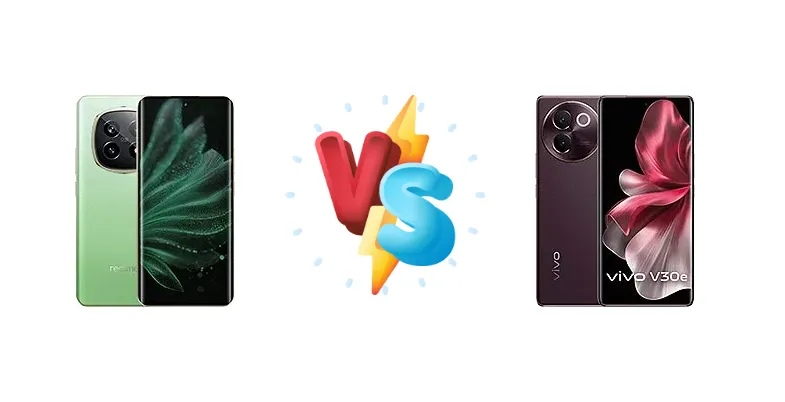
The Realme P2 Pro and vivo V30e both target the competitive mid-range smartphone market, but they take different approaches. The P2 Pro emphasizes raw processing power with the Snapdragon 7s Gen 2, while the V30e opts for the more efficiency-focused Snapdragon 6 Gen 1. This comparison dissects these choices, revealing which phone delivers the best experience for your needs.
🏆 Quick Verdict
For users prioritizing performance and faster charging, the Realme P2 Pro is the clear winner. Its Snapdragon 7s Gen 2 offers a noticeable step up in CPU and GPU capabilities, and the 80W charging significantly reduces downtime. However, the vivo V30e remains a compelling option for those seeking a balanced experience with reverse wireless charging.
| Network |
|---|
| 2G bands | GSM 850 / 900 / 1800 / 1900 | GSM 850 / 900 / 1800 / 1900 |
| 3G bands | HSDPA 850 / 900 / 2100 | HSDPA 850 / 900 / 1700(AWS) / 1900 / 2100 - Malaysia |
| 4G bands | 1, 3, 5, 8, 28, 40, 41 | 1, 2, 3, 4, 5, 7, 8, 18, 19, 20, 26, 28, 38, 39, 40, 41 - Malaysia |
| 5G bands | 1, 3, 5, 8, 28, 40, 41, 77, 78 SA/NSA | 1, 3, 5, 7, 8, 20, 28, 38, 40, 41, 77, 78 SA/NSA - Malaysia |
| Speed | HSPA, LTE, 5G | HSPA, LTE, 5G |
| Technology | GSM / HSPA / LTE / 5G | GSM / HSPA / LTE / 5G |
| Launch |
|---|
| Announced | 2024, September 13 | 2024, May 02 |
| Status | Available. Released 2024, September 17 | Available. Released 2024, May 09 |
| Body |
|---|
| Build | - | Glass front, plastic frame, glass back or plastic back |
| Dimensions | 161.3 x 73.9 x 8.2 mm (6.35 x 2.91 x 0.32 in) | 164.4 x 74.8 x 7.7 mm (6.47 x 2.94 x 0.30 in) |
| SIM | Nano-SIM + Nano-SIM | Nano-SIM + Nano-SIM |
| Weight | 180 g (6.35 oz) | 179 g or 188 g (6.31 oz) |
| Display |
|---|
| Protection | - | Schott Xensation |
| Resolution | 1080 x 2412 pixels, 20:9 ratio (~394 ppi density) | 1080 x 2400 pixels, 20:9 ratio (~388 ppi density) |
| Size | 6.7 inches, 108.0 cm2 (~90.6% screen-to-body ratio) | 6.78 inches, 111.0 cm2 (~90.3% screen-to-body ratio) |
| Type | OLED, 1B colors, 120Hz, 600 nits (typ), 1200 nits (HBM), 2000 nits (peak) | AMOLED, 1B colors, 120Hz, 1300 nits (peak) |
| Platform |
|---|
| CPU | Octa-core (4x2.40 GHz Cortex-A78 & 4x1.95 GHz Cortex-A55) | Octa-core (4x2.2 GHz Cortex-A78 & 4x1.8 GHz Cortex-A55) |
| Chipset | Qualcomm SM7435-AB Snapdragon 7s Gen 2 (4 nm) | Qualcomm SM6450 Snapdragon 6 Gen 1 (4 nm) |
| GPU | Adreno 710 | Adreno 710 |
| OS | Android 14, Realme UI 5.0 | Android 14, Funtouch 14 |
| Memory |
|---|
| Card slot | No | microSDXC (uses shared SIM slot) |
| Internal | 128GB 8GB RAM, 256GB 12GB RAM, 512GB 12GB RAM | 128GB 8GB RAM, 256GB 8GB RAM, 256GB 12GB RAM |
| Main Camera |
|---|
| Dual | 50 MP, f/1.9, 26mm (wide), 1/1.95", PDAF, OIS
8 MP, f/2.2, 16mm, 112˚ (ultrawide), 1/4.0", 1.12µm | 50 MP, f/1.8, 26mm (wide), 1/1.95", 0.8µm, PDAF, OIS (India only)
8 MP, f/2.2, 120˚ (ultrawide), 1/4.0", 1.12µm |
| Features | LED flash, HDR, panorama | Ring-LED flash, panorama, HDR |
| Video | 4K@30fps, 1080p@30/60/120fps, gyro-EIS, OIS | 4K@30fps, 1080p@30fps |
| Selfie camera |
|---|
| Single | 32 MP, f/2.5, 21mm (wide), 1/2.74", 0.8µm | 50 MP, f/2.5, 25mm (wide), AF - India
32 MP, f/2.0, 24mm (wide) - Malaysia |
| Video | 4K@30fps, 1080p@30fps | 4K@30fps (India only), 1080p@30fps |
| Sound |
|---|
| 35mm jack | No | No |
| Loudspeaker | Yes, with stereo speakers | Yes |
| Comms |
|---|
| Bluetooth | 5.2, A2DP, LE | 5.1, A2DP, LE |
| NFC | No | Yes (market/region dependent) |
| Positioning | GPS, GLONASS, GALILEO, BDS, QZSS | GPS, GLONASS, GALILEO, BDS, QZSS, NavIC |
| Radio | No | No |
| USB | USB Type-C 2.0 | USB Type-C 2.0, OTG |
| WLAN | Wi-Fi 802.11 a/b/g/n/ac/6, dual-band | Wi-Fi 802.11 a/b/g/n/ac, dual-band |
| Features |
|---|
| Sensors | Fingerprint (under display, optical), accelerometer, gyro, proximity, compass | Fingerprint (under display, optical), accelerometer, gyro, proximity, compass |
| Battery |
|---|
| Charging | 80W wired, 50% in 19 min, 100% in 49 min | 44W wired, PD
Reverse wired |
| Type | 5200 mAh | Li-Ion 5500 mAh |
| Misc |
|---|
| Colors | Parrot Green, Eagle Grey | Velvet Red (Coco Brown), Silk Blue, Sky Mirror |
| Models | - | V2339 |
| Price | About 240 EUR | ₹ 23,999 |
Realme P2 Pro
- Significantly faster charging (80W)
- More powerful Snapdragon 7s Gen 2 processor
- Potentially better camera image processing
- Lacks reverse wireless charging
- May generate more heat under sustained load
vivo V30e
- Reverse wired charging for topping up other devices
- Potentially better battery efficiency
- More balanced power consumption
- Slower charging speed (44W)
- Less powerful Snapdragon 6 Gen 1 processor
Display Comparison
Neither device's display specifications are provided, so a direct comparison is limited. However, given the P2 Pro's focus on performance, it's reasonable to expect a display geared towards higher refresh rates and potentially higher peak brightness. The V30e, leaning towards efficiency, might prioritize color accuracy and power saving. Both likely utilize AMOLED panels, common in this price bracket, but the P2 Pro may have a slight edge in overall visual fidelity.
Camera Comparison
Without detailed camera specs, analysis is limited. However, the chipset difference suggests the P2 Pro will have a more capable image signal processor (ISP), enabling faster image processing and potentially better low-light performance. The Snapdragon 7s Gen 2’s superior processing power allows for more complex computational photography algorithms. While both phones likely feature a multi-camera setup, the P2 Pro is expected to deliver more detailed and dynamic range in photos and videos.
Performance
The Realme P2 Pro’s Qualcomm SM7435-AB Snapdragon 7s Gen 2 (4nm) is the key differentiator. Its octa-core CPU, with 4x2.40 GHz Cortex-A78 cores, provides a significant performance advantage over the vivo V30e’s Snapdragon 6 Gen 1 (4nm) and its 4x2.2 GHz Cortex-A78 cores. The higher clock speeds on the P2 Pro translate to faster app loading, smoother multitasking, and improved gaming performance. While both chips are built on a 4nm process for efficiency, the 7s Gen 2’s architecture is more powerful. This means the P2 Pro will likely maintain higher frame rates in graphically intensive games and handle demanding applications more effectively.
Battery Life
The Realme P2 Pro’s 80W wired charging is a major advantage, achieving 50% charge in just 19 minutes and a full charge in 49 minutes. This drastically reduces downtime compared to the vivo V30e’s 44W wired charging, which, while still respectable and featuring PD support, will take considerably longer to fully replenish the battery. The V30e does offer reverse wired charging, a feature absent on the P2 Pro, allowing it to top up other devices. However, the P2 Pro’s faster charging speed is likely to be more valuable for most users.
Buying Guide
Buy the Realme P2 Pro if you need a phone for demanding tasks like gaming, video editing, or heavy multitasking. Its superior chipset will handle these workloads with greater ease. Buy the vivo V30e if you prioritize a smooth, efficient experience for everyday tasks, value the convenience of reverse wireless charging, and prefer a slightly more balanced power consumption profile.
Frequently Asked Questions
❓ Will the Snapdragon 6 Gen 1 in the vivo V30e struggle with graphically demanding games like Genshin Impact?
While the Snapdragon 6 Gen 1 is capable, it will likely require lower graphics settings and potentially experience frame drops in demanding titles like Genshin Impact. The Realme P2 Pro’s Snapdragon 7s Gen 2 offers a significantly smoother gaming experience with higher settings and more consistent frame rates.
❓ How much faster is the 80W charging on the Realme P2 Pro compared to the 44W charging on the vivo V30e in real-world use?
The Realme P2 Pro’s 80W charging can add a substantial amount of battery life in a short period. Expect a full charge in approximately 49 minutes, while the vivo V30e will likely take over an hour and fifteen minutes. This difference is particularly noticeable when you need a quick top-up before leaving the house.
❓ Is the reverse wired charging on the vivo V30e useful for everyday scenarios?
Reverse wired charging is a convenient feature for topping up accessories like wireless earbuds or smartwatches. However, it's a relatively slow process and isn't ideal for quickly charging larger devices like another smartphone. It's a niche feature that will appeal to users who frequently rely on these accessories.