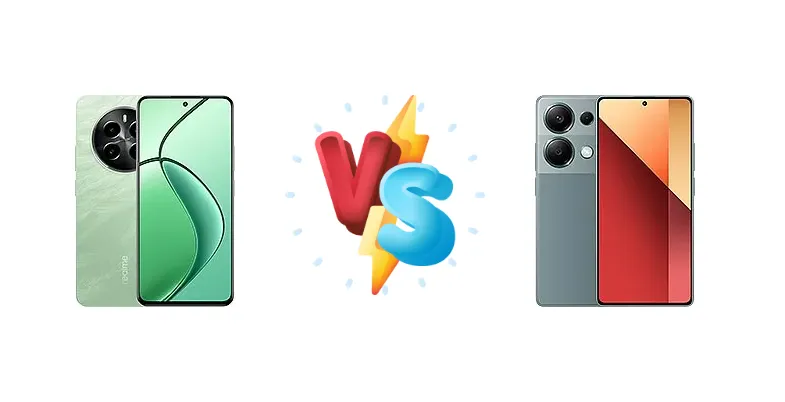
The Realme P1 and Xiaomi Redmi Note 13 Pro 4G represent compelling options in the increasingly competitive mid-range smartphone market. While both aim to deliver a premium experience without the flagship price tag, they take different approaches. The P1 prioritizes processing power with the Dimensity 7050, while the Redmi Note 13 Pro 4G focuses on a balanced package with a bright display and rapid charging.
🏆 Quick Verdict
For users prioritizing raw performance and responsiveness, the Realme P1 emerges as the winner. Its Dimensity 7050 chipset offers a noticeable advantage in CPU-intensive tasks and gaming. However, the Redmi Note 13 Pro 4G counters with significantly faster charging and a brighter display, making it a strong contender for those valuing convenience and media consumption.
| Network |
|---|
| 2G bands | GSM 850 / 900 / 1800 / 1900 | GSM 850 / 900 / 1800 / 1900 |
| 3G bands | HSDPA 850 / 900 / 2100 | HSDPA 850 / 900 / 1700(AWS) / 1900 / 2100 |
| 4G bands | 1, 3, 5, 8, 28, 40, 41 | 1, 2, 3, 4, 5, 7, 8, 12, 13, 17, 18, 19, 20, 26, 28, 38, 40, 41, 66 |
| 5G bands | 1, 3, 5, 8, 28, 40, 41, 77, 78 SA/NSA | - |
| Speed | HSPA, LTE, 5G | HSPA, LTE |
| Technology | GSM / HSPA / LTE / 5G | GSM / HSPA / LTE |
| Launch |
|---|
| Announced | 2024, April 15 | 2024, January 15 |
| Status | Available. Released 2024, April 15 | Available. Released 2024, January 15 |
| Body |
|---|
| Build | - | Glass front (Gorilla Glass 5), plastic frame, plastic back |
| Dimensions | 163 x 75.5 x 8 mm (6.42 x 2.97 x 0.31 in) | 161.1 x 75 x 8 mm (6.34 x 2.95 x 0.31 in) |
| SIM | Nano-SIM + Nano-SIM | Nano-SIM + Nano-SIM |
| Weight | 188 g (6.63 oz) | 188 g (6.63 oz) |
| Display |
|---|
| Protection | - | Corning Gorilla Glass 5 |
| Resolution | 1080 x 2400 pixels, 20:9 ratio (~395 ppi density) | 1080 x 2400 pixels, 20:9 ratio (~395 ppi density) |
| Size | 6.67 inches, 107.4 cm2 (~87.3% screen-to-body ratio) | 6.67 inches, 107.4 cm2 (~88.9% screen-to-body ratio) |
| Type | AMOLED, 120Hz, 600 nits (HBM), 1200 nits (peak) | AMOLED, 1B colors, 120Hz, 500 nits (typ), 1000 nits (HBM), 1300 nits (peak) |
| Platform |
|---|
| CPU | Octa-core (2x2.6 GHz Cortex-A78 & 6x2.0 GHz Cortex-A55) | Octa-core (2x2.2 GHz Cortex-A76 & 6x2.0 GHz Cortex-A55) |
| Chipset | Mediatek Dimensity 7050 (6 nm) | Mediatek Helio G99 Ultra |
| GPU | Mali-G68 MC4 | Mali-G57 MC2 |
| OS | Android 14, Realme UI 5.0 | Android 13, up to 3 major Android upgrades, HyperOS |
| Memory |
|---|
| Card slot | No | microSDXC (uses shared SIM slot) |
| Internal | 128GB 6GB RAM, 128GB 8GB RAM, 256GB 8GB RAM | 128GB 8GB RAM, 256GB 8GB RAM, 256GB 12GB RAM, 512GB 8GB RAM, 512GB 12GB RAM |
| Main Camera |
|---|
| Dual | 50 MP, f/1.8, 27mm (wide), 1/2.76", 0.64µm, PDAF
Auxiliary lens | - |
| Features | LED flash, HDR, panorama | LED flash, HDR, panorama |
| Triple | - | 200 MP, f/1.7, 23mm (wide), 1/1.4", 0.56µm, multi-directional PDAF, OIS
8 MP, f/2.2, 15mm, 120˚ (ultrawide), 1/4.4", 1.0µm
2 MP (macro) |
| Video | 1080p@30/60/120/480fps, 720p@960fps, gyro-EIS | 1080p@30/60fps |
| Selfie camera |
|---|
| Single | 16 MP, f/2.5, 24mm (wide), 1/3.0", 1.0µm | 16 MP, f/2.4, (wide), 1/3.0", 1.0µm |
| Video | 1080p@30fps | 1080p@30/60fps |
| Sound |
|---|
| 35mm jack | Yes | Yes |
| Loudspeaker | Yes, with stereo speakers | Yes, with dual speakers |
| Comms |
|---|
| Bluetooth | 5.2, A2DP, LE | 5.2, A2DP, LE |
| Infrared port | - | Yes |
| NFC | No | Yes (market/region dependent) |
| Positioning | GPS, GLONASS, GALILEO, BDS, QZSS | GPS, GLONASS, GALILEO, BDS |
| Radio | No | FM radio |
| USB | USB Type-C 2.0, OTG | USB Type-C 2.0, OTG |
| WLAN | Wi-Fi 802.11 a/b/g/n/ac, dual-band | Wi-Fi 802.11 a/b/g/n/ac, dual-band |
| Features |
|---|
| Sensors | Fingerprint (under display, optical), accelerometer, gyro, proximity, compass | Fingerprint (under display, optical), accelerometer, gyro, compass |
| Battery |
|---|
| Charging | 45W wired, 50% in 27 min | 67W wired, 50% in 16 min, 100% in 46 min |
| Type | Li-Ion 5000 mAh | 5000 mAh |
| Misc |
|---|
| Colors | Phoenix Red, Peacock Green | Midnight Black, Lavender Purple, Forest Green |
| Models | RMX3870 | 23117RA68G, 2312FPCA6G |
| Price | ₹ 13,999 | € 92.00 / $ 269.99 / £ 299.99 |
| SAR | - | 1.09 W/kg (head) 1.09 W/kg (body) |
| SAR EU | - | 0.99 W/kg (head) 0.99 W/kg (body) |
Realme P1
- More powerful processor for gaming and multitasking
- Efficient 6nm Dimensity 7050 chipset
- Potentially better long-term software support
- Slower charging speed compared to the Redmi Note 13 Pro 4G
- Display brightness likely lower than the Redmi Note 13 Pro 4G
Xiaomi Redmi Note 13 Pro 4G
- Significantly faster 67W charging
- Brighter display for outdoor visibility
- Excellent battery life (11:36h active use)
- Less powerful processor than the Realme P1
- Helio G99 Ultra may struggle with demanding games
Display Comparison
The Xiaomi Redmi Note 13 Pro 4G boasts a significantly brighter display, reaching a measured peak of 1047 nits. This is a substantial advantage for outdoor visibility compared to the Realme P1, which lacks published brightness data but is likely lower. While both likely utilize AMOLED panels (based on market segment), the Redmi Note 13 Pro 4G’s higher brightness makes it the clear winner for users who frequently use their phones outdoors. Bezels are expected to be similar on both devices, typical of this price range, and color accuracy will likely require calibration on both.
Camera Comparison
Both phones are expected to feature multi-camera systems, but detailed sensor information is limited. The Redmi Note 13 Pro 4G likely features a higher resolution main sensor, a common trend in this segment, but sensor size and lens aperture are critical factors. Without specific details, it’s difficult to definitively declare a winner. However, the Redmi Note 13 Pro 4G’s image processing algorithms are likely tuned for vibrant, social media-ready photos, while the P1 may lean towards a more natural look. The presence of OIS (Optical Image Stabilization) on either device would be a significant advantage for video recording and low-light photography.
Performance
The Realme P1’s Mediatek Dimensity 7050, built on a 6nm process, represents a clear step up in processing power compared to the Redmi Note 13 Pro 4G’s Helio G99 Ultra. The Dimensity 7050 features two Cortex-A78 cores clocked at 2.6 GHz, versus the G99 Ultra’s Cortex-A76 cores at 2.2 GHz. This architectural difference, combined with the more efficient 6nm node, translates to faster application loading times and smoother multitasking on the P1. While the G99 Ultra is a capable chip, the P1 will handle graphically intensive games with higher and more stable frame rates. The P1's CPU architecture will also benefit AI tasks.
Battery Life
The Redmi Note 13 Pro 4G excels in charging speed, achieving a 50% charge in just 16 minutes and a full charge in 46 minutes with its 67W wired charging. The Realme P1, with 45W charging, takes 27 minutes to reach 50%. While the Redmi Note 13 Pro 4G’s active use score of 11:36h is impressive, the P1’s battery capacity is unknown. The faster charging of the Redmi Note 13 Pro 4G is a significant convenience factor, especially for users who frequently find themselves needing a quick power boost.
Buying Guide
Buy the Realme P1 if you need a phone for demanding applications, frequent multitasking, or mobile gaming, and are willing to trade off slightly slower charging. Buy the Xiaomi Redmi Note 13 Pro 4G if you prioritize all-day battery life, quick top-ups with its 67W charging, and a vibrant, easily viewable display, even in bright sunlight. This phone is ideal for media consumers and everyday users.
Frequently Asked Questions
❓ Will the Helio G99 Ultra in the Redmi Note 13 Pro 4G struggle with graphically intensive games like Genshin Impact?
The Helio G99 Ultra is a capable chip, but it's not designed for the highest settings in demanding games like Genshin Impact. You'll likely need to lower graphics settings to achieve a playable frame rate. The Realme P1's Dimensity 7050 will provide a smoother experience at higher settings.
❓ How much faster is the 67W charging on the Redmi Note 13 Pro 4G in real-world use compared to the Realme P1's 45W?
The Redmi Note 13 Pro 4G's 67W charging significantly reduces downtime. Reaching 50% charge in 16 minutes versus 27 minutes on the P1 is a substantial difference, especially for users who need a quick top-up before heading out. A full charge takes 46 minutes versus an unstated, but longer, time on the P1.
❓ Does the Realme P1's Dimensity 7050 chipset offer any advantages for 5G connectivity, even though both phones are 4G?
While both phones are 4G devices, the Dimensity 7050's modem is more advanced and future-proof. This could translate to slightly better 4G+ performance and potentially smoother transitions to 5G if you upgrade to a 5G-enabled SIM and network in the future.