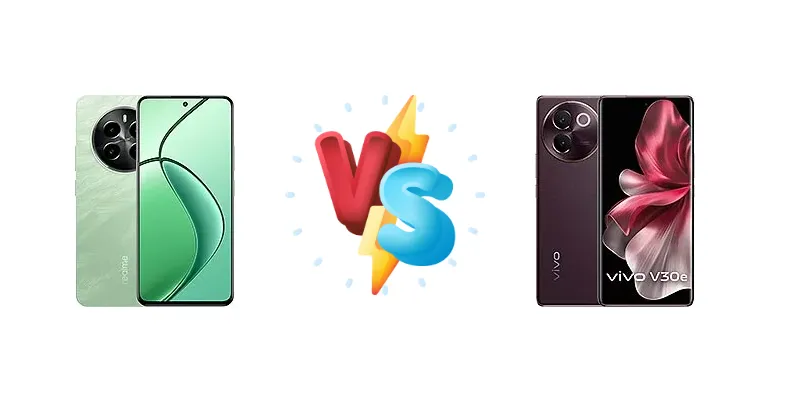
The Realme P1 and vivo V30e represent compelling options in the increasingly competitive mid-range smartphone market. While both aim to deliver a balanced experience, they take different approaches to achieving it. The P1 prioritizes raw processing power with the Dimensity 7050, while the V30e focuses on efficiency with the Snapdragon 6 Gen 1. This comparison will dissect their key differences to determine which device best suits your needs.
🏆 Quick Verdict
For the average user prioritizing performance and gaming, the Realme P1 is the better choice. Its Dimensity 7050 chipset offers a noticeable performance advantage over the Snapdragon 6 Gen 1 in the vivo V30e. However, the V30e’s 4nm process and reverse charging capabilities offer compelling alternatives for efficiency-focused users.
| Network |
|---|
| 2G bands | GSM 850 / 900 / 1800 / 1900 | GSM 850 / 900 / 1800 / 1900 |
| 3G bands | HSDPA 850 / 900 / 2100 | HSDPA 850 / 900 / 1700(AWS) / 1900 / 2100 - Malaysia |
| 4G bands | 1, 3, 5, 8, 28, 40, 41 | 1, 2, 3, 4, 5, 7, 8, 18, 19, 20, 26, 28, 38, 39, 40, 41 - Malaysia |
| 5G bands | 1, 3, 5, 8, 28, 40, 41, 77, 78 SA/NSA | 1, 3, 5, 7, 8, 20, 28, 38, 40, 41, 77, 78 SA/NSA - Malaysia |
| Speed | HSPA, LTE, 5G | HSPA, LTE, 5G |
| Technology | GSM / HSPA / LTE / 5G | GSM / HSPA / LTE / 5G |
| Launch |
|---|
| Announced | 2024, April 15 | 2024, May 02 |
| Status | Available. Released 2024, April 15 | Available. Released 2024, May 09 |
| Body |
|---|
| Build | - | Glass front, plastic frame, glass back or plastic back |
| Dimensions | 163 x 75.5 x 8 mm (6.42 x 2.97 x 0.31 in) | 164.4 x 74.8 x 7.7 mm (6.47 x 2.94 x 0.30 in) |
| SIM | Nano-SIM + Nano-SIM | Nano-SIM + Nano-SIM |
| Weight | 188 g (6.63 oz) | 179 g or 188 g (6.31 oz) |
| Display |
|---|
| Protection | - | Schott Xensation |
| Resolution | 1080 x 2400 pixels, 20:9 ratio (~395 ppi density) | 1080 x 2400 pixels, 20:9 ratio (~388 ppi density) |
| Size | 6.67 inches, 107.4 cm2 (~87.3% screen-to-body ratio) | 6.78 inches, 111.0 cm2 (~90.3% screen-to-body ratio) |
| Type | AMOLED, 120Hz, 600 nits (HBM), 1200 nits (peak) | AMOLED, 1B colors, 120Hz, 1300 nits (peak) |
| Platform |
|---|
| CPU | Octa-core (2x2.6 GHz Cortex-A78 & 6x2.0 GHz Cortex-A55) | Octa-core (4x2.2 GHz Cortex-A78 & 4x1.8 GHz Cortex-A55) |
| Chipset | Mediatek Dimensity 7050 (6 nm) | Qualcomm SM6450 Snapdragon 6 Gen 1 (4 nm) |
| GPU | Mali-G68 MC4 | Adreno 710 |
| OS | Android 14, Realme UI 5.0 | Android 14, Funtouch 14 |
| Memory |
|---|
| Card slot | No | microSDXC (uses shared SIM slot) |
| Internal | 128GB 6GB RAM, 128GB 8GB RAM, 256GB 8GB RAM | 128GB 8GB RAM, 256GB 8GB RAM, 256GB 12GB RAM |
| Main Camera |
|---|
| Dual | 50 MP, f/1.8, 27mm (wide), 1/2.76", 0.64µm, PDAF
Auxiliary lens | 50 MP, f/1.8, 26mm (wide), 1/1.95", 0.8µm, PDAF, OIS (India only)
8 MP, f/2.2, 120˚ (ultrawide), 1/4.0", 1.12µm |
| Features | LED flash, HDR, panorama | Ring-LED flash, panorama, HDR |
| Video | 1080p@30/60/120/480fps, 720p@960fps, gyro-EIS | 4K@30fps, 1080p@30fps |
| Selfie camera |
|---|
| Single | 16 MP, f/2.5, 24mm (wide), 1/3.0", 1.0µm | 50 MP, f/2.5, 25mm (wide), AF - India
32 MP, f/2.0, 24mm (wide) - Malaysia |
| Video | 1080p@30fps | 4K@30fps (India only), 1080p@30fps |
| Sound |
|---|
| 35mm jack | Yes | No |
| Loudspeaker | Yes, with stereo speakers | Yes |
| Comms |
|---|
| Bluetooth | 5.2, A2DP, LE | 5.1, A2DP, LE |
| NFC | No | Yes (market/region dependent) |
| Positioning | GPS, GLONASS, GALILEO, BDS, QZSS | GPS, GLONASS, GALILEO, BDS, QZSS, NavIC |
| Radio | No | No |
| USB | USB Type-C 2.0, OTG | USB Type-C 2.0, OTG |
| WLAN | Wi-Fi 802.11 a/b/g/n/ac, dual-band | Wi-Fi 802.11 a/b/g/n/ac, dual-band |
| Features |
|---|
| Sensors | Fingerprint (under display, optical), accelerometer, gyro, proximity, compass | Fingerprint (under display, optical), accelerometer, gyro, proximity, compass |
| Battery |
|---|
| Charging | 45W wired, 50% in 27 min | 44W wired, PD
Reverse wired |
| Type | Li-Ion 5000 mAh | Li-Ion 5500 mAh |
| Misc |
|---|
| Colors | Phoenix Red, Peacock Green | Velvet Red (Coco Brown), Silk Blue, Sky Mirror |
| Models | RMX3870 | V2339 |
| Price | ₹ 13,999 | ₹ 23,999 |
Realme P1
- More powerful Dimensity 7050 chipset
- Faster charging speed (45W)
- Potentially better gaming performance
- Likely less battery efficient
- May run warmer under heavy load
vivo V30e
- More efficient Snapdragon 6 Gen 1 (4nm)
- Reverse wired charging capability
- Power Delivery (PD) support for wider charger compatibility
- Less powerful processor
- Potentially slower performance in demanding tasks
Display Comparison
Neither device’s display specifications are provided, so a direct comparison is limited. However, given the price bracket, we can assume both utilize AMOLED panels. The key differentiator will likely be peak brightness and color accuracy. Realme historically leans towards vibrant, saturated colors, while vivo often aims for more natural tones. The absence of LTPO technology suggests neither phone will offer adaptive refresh rates for significant power savings.
Camera Comparison
Without detailed camera specs, analysis is limited. Both phones likely feature a multi-camera system with a primary sensor, ultrawide, and potentially a macro lens. The image processing style will be a key differentiator. Realme tends towards more aggressive sharpening and contrast, while vivo often prioritizes natural-looking images. Sensor size and aperture are critical factors, but absent that data, it’s difficult to declare a clear winner. We can assume both will perform adequately in good lighting conditions, but low-light performance will heavily depend on sensor size and image stabilization.
Performance
The core difference lies in the chipsets. The Realme P1’s Mediatek Dimensity 7050 (6nm) features a 2x2.6 GHz Cortex-A78 and 6x2.0 GHz Cortex-A55 configuration. This contrasts with the vivo V30e’s Qualcomm Snapdragon 6 Gen 1 (4nm) with a 4x2.2 GHz Cortex-A78 and 4x1.8 GHz Cortex-A55 setup. While the Snapdragon 6 Gen 1 benefits from a more efficient 4nm process, the Dimensity 7050’s higher clock speeds on the prime cores suggest superior single-core performance, crucial for responsiveness. The 6nm process of the Dimensity 7050 will likely result in higher thermal output under sustained load, but the performance gains are likely worth it for power users. The Snapdragon 6 Gen 1’s efficiency will translate to better battery life during typical usage.
Battery Life
The Realme P1 supports 45W wired charging, claiming a 50% charge in 27 minutes. The vivo V30e offers 44W wired charging with Power Delivery (PD) and adds the convenience of reverse wired charging. While the wattage difference is minimal, the inclusion of PD on the V30e ensures compatibility with a wider range of chargers. The reverse charging feature is a significant advantage for users who frequently need to top up accessories like earbuds or smartwatches. Battery capacity is not specified for either device, but the Snapdragon 6 Gen 1’s efficiency may offset a potentially smaller battery in the V30e.
Buying Guide
Buy the Realme P1 if you need a phone for demanding tasks like gaming, video editing, or running multiple apps simultaneously. Its more powerful processor will provide a smoother and more responsive experience. Buy the vivo V30e if you prioritize battery efficiency, appreciate the convenience of reverse wireless charging, and prefer a slightly more streamlined user experience. It’s a solid all-rounder for everyday use.
Frequently Asked Questions
❓ Will the Dimensity 7050 in the Realme P1 overheat during prolonged gaming sessions?
The Dimensity 7050, built on a 6nm process, is likely to generate more heat than the Snapdragon 6 Gen 1. However, Realme typically implements thermal management solutions to mitigate overheating. Expect some throttling during extended gaming, but the P1 should still offer a playable experience. The V30e will likely maintain lower temperatures but at the cost of performance.
❓ Is the 44W charging on the vivo V30e significantly slower than the 45W on the Realme P1?
The 1W difference in charging wattage is unlikely to be noticeable in real-world usage. Both phones should provide reasonably fast charging speeds. The V30e’s inclusion of Power Delivery (PD) is more significant, ensuring compatibility with a wider range of chargers and potentially faster charging with compatible adapters.
❓ Does the Snapdragon 6 Gen 1 in the vivo V30e support 5G connectivity?
Yes, the Qualcomm Snapdragon 6 Gen 1 does support 5G connectivity. This allows the vivo V30e to connect to 5G networks where available, providing faster download and upload speeds.