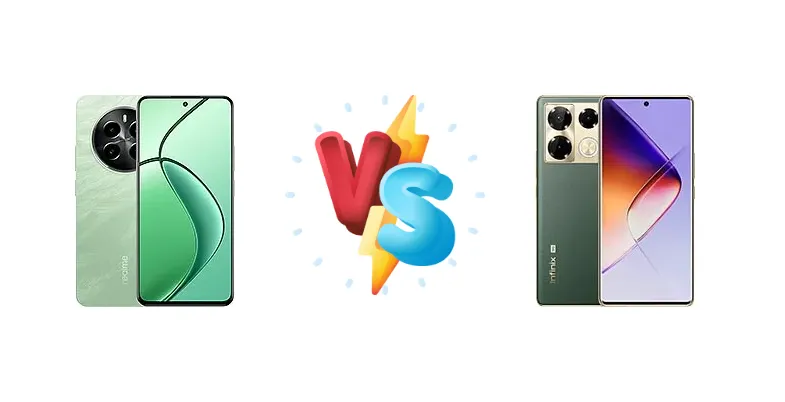
The Realme P1 and Infinix Note 40 Pro represent a compelling battle in the increasingly competitive mid-range smartphone market. Both devices leverage MediaTek's Dimensity 7000 series, but subtle differences in chipset implementation and feature sets create distinct user experiences. This comparison dissects these nuances to determine which phone delivers the most value.
🏆 Quick Verdict
For the average user prioritizing raw performance and slightly faster charging, the Realme P1 emerges as the winner. Its Dimensity 7050, with its higher clocked Cortex-A78 cores, provides a noticeable edge in demanding tasks. However, the Infinix Note 40 Pro’s inclusion of 20W MagCharge and reverse charging capabilities makes it a strong contender for users valuing wireless convenience.
| Network |
|---|
| 2G bands | GSM 850 / 900 / 1800 / 1900 | GSM 850 / 900 / 1800 / 1900 |
| 3G bands | HSDPA 850 / 900 / 2100 | HSDPA 850 / 900 / 1700(AWS) / 1900 / 2100 |
| 4G bands | 1, 3, 5, 8, 28, 40, 41 | 1, 2, 3, 4, 5, 7, 8, 12, 17, 20, 28, 38, 40, 41, 42, 66 |
| 5G bands | 1, 3, 5, 8, 28, 40, 41, 77, 78 SA/NSA | 1, 3, 5, 7, 8, 12, 20, 28, 38, 40, 41, 66, 77, 78 SA/NSA |
| Speed | HSPA, LTE, 5G | HSPA, LTE, 5G |
| Technology | GSM / HSPA / LTE / 5G | GSM / HSPA / LTE / 5G |
| Launch |
|---|
| Announced | 2024, April 15 | 2024, March 18 |
| Status | Available. Released 2024, April 15 | Available. Released 2024, March 19 |
| Body |
|---|
| Dimensions | 163 x 75.5 x 8 mm (6.42 x 2.97 x 0.31 in) | 164.3 x 74.5 x 8.1 mm (6.47 x 2.93 x 0.32 in) |
| SIM | Nano-SIM + Nano-SIM | Nano-SIM + Nano-SIM |
| Weight | 188 g (6.63 oz) | 190 g or 196 g (6.70 oz) |
| Display |
|---|
| Protection | - | Corning Gorilla Glass |
| Resolution | 1080 x 2400 pixels, 20:9 ratio (~395 ppi density) | 1080 x 2436 pixels (~393 ppi density) |
| Size | 6.67 inches, 107.4 cm2 (~87.3% screen-to-body ratio) | 6.78 inches, 109.9 cm2 (~89.8% screen-to-body ratio) |
| Type | AMOLED, 120Hz, 600 nits (HBM), 1200 nits (peak) | AMOLED, 1B colors, 120Hz, 2160Hz PWM, 1300 nits (peak) |
| Platform |
|---|
| CPU | Octa-core (2x2.6 GHz Cortex-A78 & 6x2.0 GHz Cortex-A55) | Octa-core (2x2.2 GHz Cortex-A78 & 6x2.0 GHz Cortex-A55) |
| Chipset | Mediatek Dimensity 7050 (6 nm) | Mediatek Dimensity 7020 (6 nm) |
| GPU | Mali-G68 MC4 | IMG BXM-8-256 |
| OS | Android 14, Realme UI 5.0 | Android 14, XOS 14 |
| Memory |
|---|
| Card slot | No | Unspecified |
| Internal | 128GB 6GB RAM, 128GB 8GB RAM, 256GB 8GB RAM | 256GB 8GB RAM |
| Main Camera |
|---|
| Dual | 50 MP, f/1.8, 27mm (wide), 1/2.76", 0.64µm, PDAF
Auxiliary lens | - |
| Features | LED flash, HDR, panorama | Dual-LED flash, HDR, panorama |
| Triple | - | 108 MP, f/1.8, (wide), PDAF, OIS
2 MP, f/2.4
2 MP, f/2.4 |
| Video | 1080p@30/60/120/480fps, 720p@960fps, gyro-EIS | 1440p@30fps, 1080p@30/60fps |
| Selfie camera |
|---|
| Features | - | Dual-LED flash |
| Single | 16 MP, f/2.5, 24mm (wide), 1/3.0", 1.0µm | 32 MP, f/2.2, (wide), 1/3.1" |
| Video | 1080p@30fps | 1080p@30fps |
| Sound |
|---|
| 35mm jack | Yes | No |
| Loudspeaker | Yes, with stereo speakers | Yes, with stereo speakers |
| Comms |
|---|
| Bluetooth | 5.2, A2DP, LE | Yes |
| Infrared port | - | Yes |
| NFC | No | Yes (market/region dependent) |
| Positioning | GPS, GLONASS, GALILEO, BDS, QZSS | GPS |
| Radio | No | FM radio |
| USB | USB Type-C 2.0, OTG | USB Type-C 2.0, OTG |
| WLAN | Wi-Fi 802.11 a/b/g/n/ac, dual-band | Wi-Fi 802.11 a/b/g/n/ac, dual-band |
| Features |
|---|
| Sensors | Fingerprint (under display, optical), accelerometer, gyro, proximity, compass | Fingerprint (under display, optical), accelerometer, gyro, proximity, compass |
| Battery |
|---|
| Charging | 45W wired, 50% in 27 min | 45W wired, 50% in 26 min
20W wireless MagCharge
Reverse wired
Reverse wireless |
| Type | Li-Ion 5000 mAh | 5000 mAh |
| Misc |
|---|
| Colors | Phoenix Red, Peacock Green | Vintage Green, Titan Gold, Racing Edition |
| Models | RMX3870 | X6851 |
| Price | ₹ 13,999 | About 280 EUR |
Realme P1
- Slightly faster CPU performance due to Dimensity 7050
- Potentially more responsive gaming experience
- Faster wired charging (marginally)
- Lacks wireless charging capabilities
- No reverse charging functionality
Infinix Note 40 Pro
- Convenient 20W MagCharge wireless charging
- Versatile reverse wired and wireless charging
- Potentially better battery life optimization
- Slightly slower CPU performance
- May exhibit more throttling under sustained load
Display Comparison
Both devices are expected to feature 6.67-inch AMOLED displays, a common standard in this price bracket. However, detailed specifications regarding peak brightness, color gamut coverage, and PWM dimming frequency are currently unavailable. Given Realme’s history with vibrant displays, the P1 might lean towards a more saturated color profile, while Infinix often aims for color accuracy. The absence of LTPO technology on either device suggests a standard 60Hz or 120Hz refresh rate, impacting smoothness during scrolling and animations.
Camera Comparison
Without detailed camera sensor information, a direct comparison is challenging. However, the market segment suggests both phones will feature a primary camera in the 50MP-108MP range. The aperture and sensor size of the main sensor will be critical determinants of low-light performance. Optical Image Stabilization (OIS), if present on either device, would provide a significant advantage in capturing sharp photos and stable videos. The inclusion of a dedicated macro lens on both is likely, but its 2MP resolution suggests limited utility. Image processing algorithms will also play a key role in differentiating the final image quality.
Performance
The core difference lies in the chipsets: the Realme P1 utilizes the Mediatek Dimensity 7050, featuring a 2x2.6 GHz Cortex-A78 CPU configuration, while the Infinix Note 40 Pro employs the Dimensity 7020 with a slightly lower 2x2.2 GHz Cortex-A78 setup. This 0.4 GHz difference, while seemingly small, translates to a measurable performance advantage for the P1 in CPU-bound workloads. Both chips are built on a 6nm process, ensuring reasonable power efficiency. The impact of RAM configuration (LPDDR4x vs LPDDR5x, if different) is unknown but could further influence multitasking performance. Thermal management will be crucial; sustained performance will depend on how effectively each phone dissipates heat.
Battery Life
Both the Realme P1 and Infinix Note 40 Pro feature 45W wired charging, achieving 50% charge in approximately 27 and 26 minutes respectively – a negligible difference. The Infinix Note 40 Pro distinguishes itself with the addition of 20W MagCharge wireless charging, offering a convenient alternative to wired charging. Furthermore, the inclusion of reverse wired and wireless charging allows the Note 40 Pro to function as a power bank for other devices, a feature absent on the Realme P1. Battery capacity is currently unknown, but the charging speed suggests a battery size in the 5000mAh range for both devices.
Buying Guide
Buy the Realme P1 if you need a phone that prioritizes CPU-intensive tasks like gaming and app responsiveness, and if you don't require wireless charging. Buy the Infinix Note 40 Pro if you prefer the convenience of wireless charging, especially MagCharge compatibility, and appreciate the added functionality of reverse wired and wireless charging for accessories.
Frequently Asked Questions
❓ Will the Dimensity 7020 in the Infinix Note 40 Pro struggle with graphically demanding games like Genshin Impact?
The Dimensity 7020 is capable of running Genshin Impact, but you'll likely need to lower the graphics settings to medium or low to maintain a stable frame rate. The chipset's thermal performance will also be a factor; prolonged gaming sessions may lead to some throttling, reducing sustained performance.
❓ How practical is the 20W MagCharge on the Infinix Note 40 Pro compared to standard wireless charging?
20W MagCharge offers a faster and more reliable wireless charging experience than standard Qi wireless charging, as the magnetic alignment ensures optimal coil positioning. While not as fast as 45W wired charging, it provides a convenient top-up option and is particularly useful with compatible accessories.
❓ Does the Realme P1 support any form of fast charging for accessories?
No, the Realme P1 only supports 45W wired charging for itself and does not offer reverse charging capabilities, meaning it cannot be used to charge other devices.
❓ Is the difference in CPU clock speed between the Dimensity 7050 and 7020 noticeable in everyday tasks?
In everyday tasks like browsing, social media, and messaging, the difference in CPU clock speed is unlikely to be noticeable. However, in CPU-intensive applications like video editing or running complex spreadsheets, the Realme P1's Dimensity 7050 will offer a slight performance advantage.