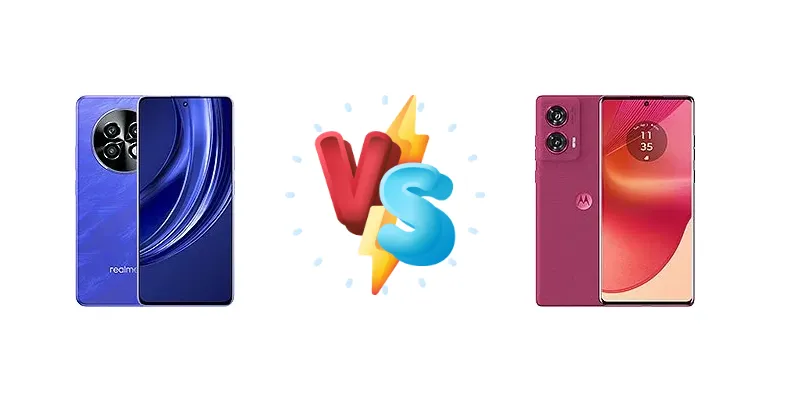
The Realme P1 Speed and Motorola Edge 50 Fusion represent compelling options in the increasingly competitive mid-range smartphone market. The P1 Speed aims for a performance-first experience, leveraging Mediatek’s latest efficiency-focused chipset. Conversely, the Edge 50 Fusion prioritizes a balanced package with a focus on display quality and rapid charging, though chipset variations exist depending on the region.
🏆 Quick Verdict
For users prioritizing raw processing power and responsiveness, the Realme P1 Speed is the better choice, thanks to its Dimensity 7300 Energy. However, the Motorola Edge 50 Fusion wins for those who value all-day battery life and significantly faster charging speeds, making it ideal for heavy users.
| Network |
|---|
| 2G bands | GSM 850 / 900 / 1800 / 1900 | GSM 850 / 900 / 1800 / 1900 |
| 3G bands | HSDPA 850 / 900 / 2100 | HSDPA 850 / 900 / 1900 / 2100 |
| 4G bands | 1, 3, 5, 8, 28, 40, 41 | 1, 2, 3, 5, 7, 8, 18, 19, 20, 26, 28, 32, 38, 40, 41, 42, 71 - International |
| 5G bands | 1, 3, 5, 8, 28, 40, 41, 77, 78 SA/NSA | 1, 3, 5, 7, 8, 20, 26, 28, 38, 40, 41, 77, 78 SA/NSA |
| Speed | HSPA, LTE, 5G | HSPA, LTE, 5G |
| Technology | GSM / HSPA / LTE / 5G | GSM / HSPA / LTE / 5G |
| Launch |
|---|
| Announced | 2024, October 15 | 2024, April 16 |
| Status | Available. Released 2024, October 20 | Available. Released 2024, May 15 |
| Body |
|---|
| Build | - | Glass front, silicone polymer back (eco leather), plastic frame |
| Dimensions | 161.7 x 74.7 x 7.6 mm (6.37 x 2.94 x 0.30 in) | 161.9 x 73.1 x 7.9 mm (6.37 x 2.88 x 0.31 in) |
| SIM | Nano-SIM + Nano-SIM | · Nano-SIM + eSIM· Nano-SIM + Nano-SIM |
| Weight | 185 g (6.53 oz) | 174.9 g (6.17 oz) |
| Display |
|---|
| Protection | - | Corning Gorilla Glass 5 |
| Resolution | 1080 x 2400 pixels, 20:9 ratio (~395 ppi density) | 1080 x 2400 pixels, 20:9 ratio (~393 ppi density) |
| Size | 6.67 inches, 107.4 cm2 (~88.9% screen-to-body ratio) | 6.7 inches, 108.4 cm2 (~91.6% screen-to-body ratio) |
| Type | OLED, 120Hz, 600 nits (typ), 2000 nits (peak) | P-OLED, 1B colors, 120Hz (LATAM), 144Hz (INT), 1600 nits (peak) |
| Platform |
|---|
| CPU | Octa-core (4x2.5 GHz Cortex-A78 & 4x2.0 GHz Cortex-A55) | Octa-core (4x2.40 GHz Cortex-A78 & 4x1.95 GHz Cortex-A55) - InternationalOcta-core (4x2.2 GHz Cortex-A78 & 4x1.8 GHz Cortex-A55) - LATAM |
| Chipset | Mediatek Dimensity 7300 Energy (4 nm) | Qualcomm SM7435-AB Snapdragon 7s Gen 2 (4 nm) - InternationalQualcomm SM6450 Snapdragon 6 Gen 1 (4 nm) - LATAM |
| GPU | Mali-G615 MC2 | Adreno 710 |
| OS | Android 14, Realme UI 5.0 | Android 14, upgradable to Android 15, up to 3 major Android upgrades |
| Memory |
|---|
| Card slot | microSDXC (uses shared SIM slot) | No |
| Internal | 128GB 8GB RAM, 256GB 8GB RAM, 256GB 12GB RAM | 128GB 8GB RAM, 256GB 8GB RAM, 256GB 12GB RAM, 512GB 8GB RAM, 512GB 12GB RAM |
| Main Camera |
|---|
| Dual | 50 MP, f/1.8, 27mm (wide), 1/1.95", PDAF
Auxiliary lenses | 50 MP, f/1.9, (wide), 1/1.56", 1.0µm, multi-directional PDAF, OIS
13 MP, f/2.2, 120˚ (ultrawide), 1/3.0", 1.12µm, AF |
| Features | LED flash, HDR, panorama | LED flash, HDR, panorama |
| Video | 4K@30fps, 1080p@30/60/120fps, gyro-EIS | 4K@30fps, 1080p@30/60/120fps, gyro-EIS |
| Selfie camera |
|---|
| Features | - | HDR |
| Single | 16 MP, f/2.4, 24mm (wide), 1/3.0" | 32 MP, f/2.5, (wide), 1/3.14", 0.7µm |
| Video | 1080p@30fps | 4K@30fps, 1080p@30fps |
| Sound |
|---|
| 35mm jack | Yes | No |
| Loudspeaker | Yes, with stereo speakers | Yes, with stereo speakers |
| Comms |
|---|
| Bluetooth | 5.4, A2DP, LE | 5.2, A2DP, LE |
| NFC | No | Yes |
| Positioning | GPS, GLONASS, GALILEO, BDS, QZSS | GPS, GLONASS, GALILEO |
| Radio | No | No |
| USB | USB Type-C 2.0 | USB Type-C 2.0, OTG |
| WLAN | Wi-Fi 802.11 a/b/g/n/ac/6, dual-band | Wi-Fi 802.11 a/b/g/n/ac, dual-band |
| Features |
|---|
| Sensors | Fingerprint (under display, optical), accelerometer, gyro, proximity, compass | Fingerprint (under display, optical), accelerometer, gyro, proximity, compass |
| Battery |
|---|
| Charging | 45W wired, 50% in 30 min | 68W wired, 50% in 15 min |
| Type | 5000 mAh | 5000 mAh |
| Misc |
|---|
| Colors | Brushed Blue, Textured Titanium | Forest Blue, Marshmallow Blue, Hot Pink |
| Models | - | XT2429-1 |
| Price | ₹ 19,998 | € 208.99 / $ 245.00 / ₹ 18,667 |
Realme P1 Speed
- Potentially faster CPU performance with Dimensity 7300 Energy
- 4nm chipset for improved efficiency
- Likely more affordable price point
- Unknown display specifications
- Slower charging speed (45W)
- Battery life likely inferior to Edge 50 Fusion
Motorola Edge 50 Fusion
- Excellent battery life (12:40h active use)
- Very fast 68W charging (50% in 15 min)
- Bright 1322 nit display
- Regional chipset variation (Snapdragon 6 Gen 1 in LATAM)
- Potentially lower single-core CPU performance
- May be more expensive than the Realme P1 Speed
Display Comparison
The Motorola Edge 50 Fusion boasts a significantly brighter display, reaching a measured 1322 nits, which translates to excellent outdoor visibility. While the Realme P1 Speed’s display specifications are not provided, the Edge 50 Fusion’s brightness advantage is substantial. The Edge 50 Fusion’s panel likely benefits from a higher peak brightness setting, enhancing HDR content viewing. The lack of detailed display specs for the P1 Speed makes a direct comparison difficult, but the Fusion clearly leads in this area.
Camera Comparison
Detailed camera specifications are absent for both devices, making a comprehensive comparison challenging. However, focusing on the chipsets, the Snapdragon 7s Gen 2 (found in the international Edge 50 Fusion) typically offers superior image signal processing capabilities compared to the Dimensity 7300 Energy. This could result in better dynamic range and noise reduction in photos and videos. Without sensor size or aperture information, it’s difficult to assess low-light performance. The presence of a 2MP macro lens on either device is unlikely to significantly impact image quality, serving primarily as a marketing feature.
Performance
The Realme P1 Speed’s Mediatek Dimensity 7300 Energy (4nm) and the Motorola Edge 50 Fusion’s Snapdragon 7s Gen 2 (4nm) are both efficient chipsets, but differ in CPU architecture and regional availability. The P1 Speed’s Cortex-A78 cores clock slightly higher (2.5 GHz vs 2.40/2.2 GHz), suggesting a potential edge in single-core performance. However, the Snapdragon 7s Gen 2 benefits from Qualcomm’s optimized ISP and AI engine. The Edge 50 Fusion has a regional split, with LATAM models receiving the older Snapdragon 6 Gen 1, a significant performance downgrade compared to the international 7s Gen 2. The 4nm process node on both chips ensures good thermal efficiency, but the P1 Speed’s CPU clock speed advantage may translate to smoother performance in demanding applications.
Battery Life
The Motorola Edge 50 Fusion demonstrates a clear advantage in battery performance, achieving 12:40h of active use. While the Realme P1 Speed’s battery capacity is unknown, the Fusion’s longevity is impressive. Furthermore, the Edge 50 Fusion’s 68W charging allows for a 50% charge in just 15 minutes, significantly faster than the P1 Speed’s 45W charging (50% in 30 minutes). This faster charging is crucial for users who need to quickly top up their battery throughout the day. The Fusion’s combination of battery life and charging speed makes it the more convenient option for power users.
Buying Guide
Buy the Realme P1 Speed if you need a phone for demanding tasks like mobile gaming, video editing, or frequent multitasking. Its Dimensity 7300 Energy chipset provides a noticeable performance edge. Buy the Motorola Edge 50 Fusion if you prefer a phone that can comfortably last a full day on a single charge and quickly replenish its battery with 68W charging – perfect for travelers or those constantly on the go.
Frequently Asked Questions
❓ Does the Snapdragon 7s Gen 2 in the Motorola Edge 50 Fusion experience throttling during extended gaming sessions?
The Snapdragon 7s Gen 2 is a relatively efficient chipset, and the Motorola Edge 50 Fusion’s thermal design should prevent significant throttling during typical gaming sessions. However, sustained, high-intensity gaming may lead to some performance reduction over time, as with any smartphone. The 4nm process node helps mitigate this issue.
❓ Is the regional chipset difference between the international and LATAM versions of the Motorola Edge 50 Fusion substantial?
Yes, the difference is significant. The international version with the Snapdragon 7s Gen 2 offers considerably better performance than the LATAM version with the Snapdragon 6 Gen 1. The 7s Gen 2 provides a noticeable upgrade in CPU, GPU, and AI processing capabilities, making it the preferred choice if available.
❓ How does the Mediatek Dimensity 7300 Energy compare to the Snapdragon 7s Gen 2 in terms of gaming performance?
The Dimensity 7300 Energy and Snapdragon 7s Gen 2 are closely matched in gaming performance. The Dimensity 7300 Energy's slightly higher CPU clock speeds may give it a small edge in some titles, while the Snapdragon 7s Gen 2 benefits from Qualcomm's Adreno GPU optimizations. Both chipsets are capable of handling most mobile games at high settings.