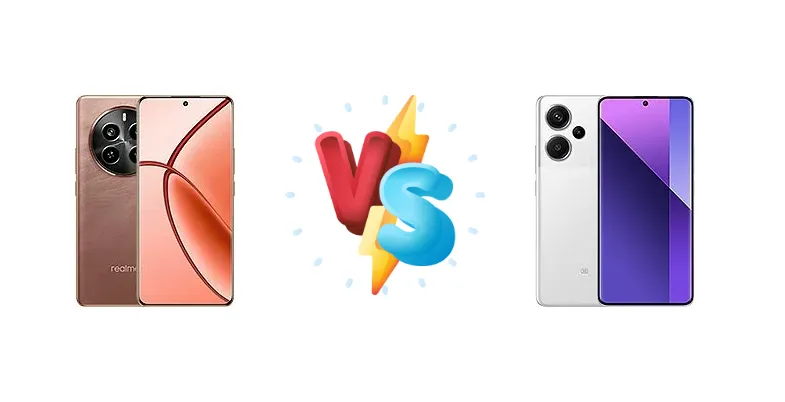
The mid-range smartphone market is fiercely competitive, and the Realme P1 Pro and Xiaomi Redmi Note 13 Pro+ represent compelling options. The P1 Pro aims for a balance of efficiency with its Snapdragon 6 Gen 1, while the Redmi Note 13 Pro+ aggressively targets speed with the Dimensity 7200 Ultra and its blazing-fast 120W charging. This comparison dissects their strengths and weaknesses to help you choose.
🏆 Quick Verdict
For the average user prioritizing rapid charging and a brighter display, the Xiaomi Redmi Note 13 Pro+ is the clear winner. Its 120W charging and 1283 nits peak brightness offer tangible benefits. However, the Realme P1 Pro provides a solid, efficient experience for those less concerned with absolute speed.
| Network |
|---|
| 2G bands | GSM 850 / 900 / 1800 / 1900 | GSM 850 / 900 / 1800 / 1900 |
| 3G bands | HSDPA 850 / 900 / 2100 | HSDPA 800 / 850 / 900 / 1700(AWS) / 1900 / 2100 - International |
| 4G bands | 1, 3, 5, 8, 28, 40, 41 | 1, 2, 3, 4, 5, 7, 8, 12, 13, 17, 18, 19, 20, 26, 28, 32, 38, 40, 41, 66 - International |
| 5G bands | 1, 3, 5, 8, 28, 40, 41, 77, 78 SA/NSA | 1, 3, 5, 7, 8, 20, 28, 38, 40, 41, 66, 77, 78 SA/NSA- International |
| Speed | HSPA, LTE, 5G | HSPA, LTE, 5G |
| Technology | GSM / HSPA / LTE / 5G | GSM / CDMA / HSPA / EVDO / LTE / 5G |
| Launch |
|---|
| Announced | 2024, April 15 | 2023, September 21 |
| Status | Available. Released 2024, April 22 | Available. Released 2023, September 21 |
| Body |
|---|
| Build | - | Glass front (Gorilla Glass Victus), glass back or silicone polymer back (eco leather) |
| Dimensions | 161.5 x 74 x 8.4 mm (6.36 x 2.91 x 0.33 in) | 161.4 x 74.2 x 8.9 mm (6.35 x 2.92 x 0.35 in) |
| SIM | Nano-SIM + Nano-SIM | · Nano-SIM + eSIM· Nano-SIM + Nano-SIM |
| Weight | 217 g (7.65 oz) | 199 g or 204.5 g (7.02 oz) |
| Display |
|---|
| Protection | - | Corning Gorilla Glass Victus |
| Resolution | 1080 x 2412 pixels, 20:9 ratio (~394 ppi density) | 1220 x 2712 pixels, 20:9 ratio (~446 ppi density) |
| Size | 6.7 inches, 108.0 cm2 (~90.4% screen-to-body ratio) | 6.67 inches, 107.4 cm2 (~89.7% screen-to-body ratio) |
| Type | AMOLED, 1B colors, 120Hz, 800 nits (HBM), 950 nits (peak) | AMOLED, 68B colors, 120Hz, 1920Hz PWM, Dolby Vision, HDR10+, 1800 nits (peak) |
| Platform |
|---|
| CPU | Octa-core (4x2.2 GHz Cortex-A78 & 4x1.8 GHz Cortex-A55) | Octa-core (2x2.8 GHz Cortex-A715 & 6x2.0 GHz Cortex-A510) |
| Chipset | Qualcomm SM6450 Snapdragon 6 Gen 1 (4 nm) | Mediatek Dimensity 7200 Ultra (4 nm) |
| GPU | Adreno 710 | Mali-G610 MC4 |
| OS | Android 14, Realme UI 5.0 | Android 13, up to 3 major Android upgrades, HyperOS |
| Memory |
|---|
| Card slot | No | No |
| Internal | 128GB 8GB RAM, 256GB 8GB RAM, 256GB 12GB RAM | 256GB 8GB RAM, 256GB 12GB RAM, 512GB 8GB RAM, 512GB 12GB RAM, 512GB 16GB RAM |
| Main Camera |
|---|
| Dual | 50 MP, f/1.8, 26mm (wide), 1/1.95", 0.8µm, PDAF, OIS
8 MP, f/1.7, 16mm, 112˚ (ultrawide), 1/4.0", 1.12µm | - |
| Features | LED flash, HDR, panorama | Dual-LED dual-tone flash, HDR, panorama |
| Triple | - | 200 MP, f/1.7, 23mm (wide), 1/1.4", 0.56µm, multi-directional PDAF, OIS
8 MP, f/2.2, 16mm, 120˚ (ultrawide), 1/4.0", 1.12µm
2 MP (macro) |
| Video | 4K@30fps, 1080p@30/60/120fps, gyro-EIS | 4K@24/30fps, 1080p@30/60/120fps, gyro-EIS |
| Selfie camera |
|---|
| Features | - | HDR, panorama |
| Single | 16 MP, f/2.4, 24mm (wide), 1/3.0", 1.0µm | 16 MP, f/2.4, (wide) |
| Video | 1080p@30fps | 1080p@30/60fps |
| Sound |
|---|
| 35mm jack | No | No |
| Loudspeaker | Yes, with stereo speakers | Yes, with stereo speakers |
| Comms |
|---|
| Bluetooth | 5.2, A2DP, LE | 5.3, A2DP, LE |
| Infrared port | - | Yes |
| NFC | No | Yes (market/region dependent) |
| Positioning | GPS, GLONASS, GALILEO, BDS, QZSS | GPS, GLONASS, BDS, GALILEO, QZSS |
| Radio | No | No |
| USB | USB Type-C 2.0, OTG | USB Type-C 2.0, OTG |
| WLAN | Wi-Fi 802.11 a/b/g/n/ac/6, dual-band | Wi-Fi 802.11 a/b/g/n/ac/6, dual-band, Wi-Fi Direct |
| Features |
|---|
| Sensors | Fingerprint (under display, optical), accelerometer, gyro, proximity, compass | Fingerprint (under display, optical), accelerometer, gyro, proximity, compass |
| Battery |
|---|
| Charging | 45W wired | 120W wired, PD3.0, 100% in 19 min |
| Type | Li-Ion 5000 mAh | Li-Po 5000 mAh |
| Misc |
|---|
| Colors | Phoenix Red, Parrot Blue | Midnight Black (Fushion Black), Moonlight White (Fushion White), Aurora Purple, Fushion Purple, Camo Green |
| Models | RMX3844 | 23090RA98C, 23090RA98G, 23090RA98I |
| Price | ₹ 22,999 | $ 299.98 / £ 299.00 / € 208.98 / ₹ 24,999 |
| SAR | - | 1.09 W/kg (head) 0.85 W/kg (body) |
| SAR EU | - | 0.98 W/kg (head) 1.00 W/kg (body) |
Realme P1 Pro
- Efficient Snapdragon 6 Gen 1 chipset
- Potentially cleaner software experience
- Competitive price point
- Slower charging speed (45W)
- Less powerful processor compared to the Redmi Note 13 Pro+
Xiaomi Redmi Note 13 Pro+
- Ultra-fast 120W charging (19 minutes to full)
- Brighter display (1283 nits)
- More powerful Dimensity 7200 Ultra processor
- Potentially more aggressive software customization
- May run warmer under sustained load
Display Comparison
The Redmi Note 13 Pro+ immediately stands out with its measured peak brightness of 1283 nits, significantly exceeding what we’d expect in this price bracket. This translates to excellent outdoor visibility. While the Realme P1 Pro’s display specs are not provided, the Redmi’s brightness advantage is substantial. The Redmi Note 13 Pro+ likely utilizes an AMOLED panel, common in this segment, offering vibrant colors and deep blacks. The absence of LTPO technology on either device suggests both will rely on adaptive refresh rate switching to conserve battery, but the Redmi’s higher peak brightness is a key differentiator.
Camera Comparison
Without detailed camera specifications for the Realme P1 Pro, it’s difficult to make a direct comparison. However, the Redmi Note 13 Pro+ is expected to feature a high-resolution main sensor (likely 200MP, based on market trends for this model), potentially with optical image stabilization (OIS). The Dimensity 7200 Ultra’s image signal processor (ISP) will contribute to improved image processing capabilities. We can assume the Realme P1 Pro will have a capable camera system, but the Redmi Note 13 Pro+ is likely to offer superior image quality, particularly in low-light conditions, and more versatile shooting options.
Performance
The Xiaomi Redmi Note 13 Pro+ leverages the Mediatek Dimensity 7200 Ultra, built on a 4nm process, featuring a prime core clocked at 2.8 GHz (Cortex-A715). This architecture is a step up from the Realme P1 Pro’s Qualcomm Snapdragon 6 Gen 1 (also 4nm) with its Cortex-A78 cores peaking at 2.2 GHz. The Dimensity 7200 Ultra’s newer core design and higher clock speed will result in noticeably faster performance in CPU-intensive tasks and gaming. The Realme P1 Pro will still handle everyday tasks smoothly, but the Redmi Note 13 Pro+ offers headroom for more demanding applications. RAM speed (LPDDR5x) is not specified for either, but the chipset difference is the primary performance indicator.
Battery Life
The Redmi Note 13 Pro+ boasts a significant advantage in charging speed with its 120W wired charging, capable of a full charge in just 19 minutes. The Realme P1 Pro’s 45W charging is considerably slower. While the Redmi Note 13 Pro+’s battery capacity isn’t specified, its active use score of 10:38h demonstrates excellent battery life. The Realme P1 Pro’s efficiency with the Snapdragon 6 Gen 1 may partially offset the charging speed difference, but the convenience of the Redmi’s ultra-fast charging is a major benefit.
Buying Guide
Buy the Realme P1 Pro if you need a dependable daily driver with a focus on efficient power consumption and a clean software experience. It’s ideal for users who prioritize longevity and aren’t heavy gamers. Buy the Xiaomi Redmi Note 13 Pro+ if you prefer a phone that can rapidly recharge, boasts a vibrant, bright display, and offers a more powerful processor for demanding tasks and gaming.
Frequently Asked Questions
❓ Is the Dimensity 7200 Ultra in the Redmi Note 13 Pro+ prone to overheating during extended gaming sessions?
While the Dimensity 7200 Ultra is a powerful chip, Mediatek has made strides in thermal management. The 4nm process helps, but sustained gaming will likely generate heat. The Redmi Note 13 Pro+ likely incorporates cooling solutions, but performance throttling is possible during prolonged, demanding gameplay. The Realme P1 Pro's Snapdragon 6 Gen 1 will likely run cooler, but at the cost of overall performance.
❓ How does the 45W charging on the Realme P1 Pro compare to typical charging speeds in this price range?
45W charging is respectable for a mid-range phone, but it's significantly slower than the 120W charging on the Redmi Note 13 Pro+. A full charge will take considerably longer on the P1 Pro, potentially over an hour, compared to the Redmi’s 19-minute timeframe. This difference is a key consideration for users who prioritize convenience and minimal downtime.
❓ Does the Redmi Note 13 Pro+ support features like HDR10+ for enhanced video playback?
While not explicitly stated in the provided data, the Redmi Note 13 Pro+ is highly likely to support HDR10+ given its high-end display specifications and the trend in this price segment. This would deliver a wider color gamut and improved contrast for compatible streaming services and video content.