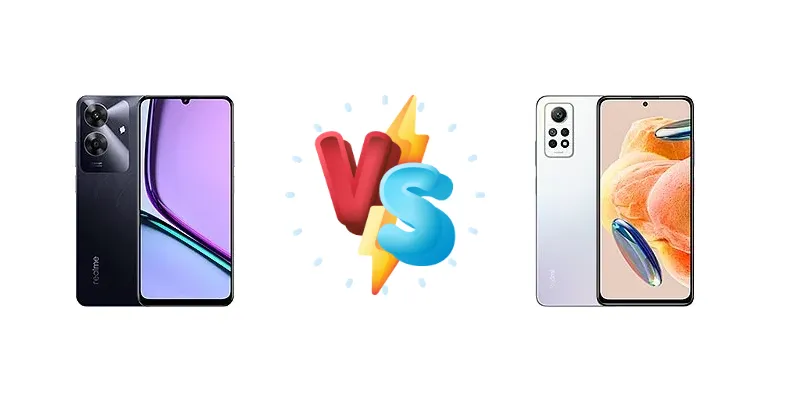
The sub-$200 smartphone market is fiercely competitive. The Realme Note 60 and Xiaomi Redmi Note 12 Pro 4G both aim to deliver a compelling experience without breaking the bank, but they take different approaches. The Realme focuses on a newer, if less powerful, chipset, while the Xiaomi leverages a more mature platform with a key advantage in charging speed. This comparison dives deep into the specs to determine which phone offers the best value.
🏆 Quick Verdict
For the average user prioritizing fast charging and a more responsive experience, the Xiaomi Redmi Note 12 Pro 4G is the clear winner. Its Snapdragon 732G chipset and 67W charging significantly outperform the Realme Note 60’s Unisoc T612 and 10W charging, making it a more practical daily driver.
| Network |
|---|
| 2G bands | GSM 850 / 900 / 1800 / 1900 | GSM 850 / 900 / 1800 / 1900 |
| 3G bands | HSDPA 900 / 2100 | HSDPA 850 / 900 / 1700(AWS) / 1900 / 2100 |
| 4G bands | 1, 3, 5, 8, 40 | 1, 2, 3, 4, 5, 7, 8, 20, 28, 38, 40, 41, 66 |
| Speed | HSPA, LTE | HSPA, LTE |
| Technology | GSM / HSPA / LTE | GSM / HSPA / LTE |
| Launch |
|---|
| Announced | 2024, August 30 | 2023, March 03 |
| Status | Available. Released 2024, August 30 | Available. Released 2023, April 11 |
| Body |
|---|
| Build | Glass front, plastic frame, plastic back | - |
| Dimensions | 167.3 x 76.7 x 7.8 mm (6.59 x 3.02 x 0.31 in) | 164.2 x 76.1 x 8.1 mm (6.46 x 3.00 x 0.32 in) |
| SIM | Nano-SIM + Nano-SIM | Nano-SIM + Nano-SIM |
| Weight | 187 g (6.60 oz) | 201.8 g (7.13 oz) |
| Display |
|---|
| Protection | Reinforced glass | - |
| Resolution | 720 x 1600 pixels, 20:9 ratio (~260 ppi density) | 1080 x 2400 pixels, 20:9 ratio (~395 ppi density) |
| Size | 6.74 inches, 109.7 cm2 (~85.5% screen-to-body ratio) | 6.67 inches, 107.4 cm2 (~86.0% screen-to-body ratio) |
| Type | IPS LCD, 90Hz, 450 nits (typ), 560 nits (HBM) | AMOLED, 120Hz, Dolby Vision, 700 nits (HBM), 1100 nits (peak) |
| Platform |
|---|
| CPU | Octa-core (2x1.8 GHz Cortex-A75 & 6x1.8 GHz Cortex-A55) | Octa-core (2x2.2 GHz Kryo 470 Gold & 6x1.8 GHz Kryo 470 Silver) |
| Chipset | Unisoc Tiger T612 (12 nm) | Qualcomm SM7150 Snapdragon 732G (8 nm) |
| GPU | Mali-G57 | Adreno 618 |
| OS | Android 14, Realme UI | Android 11, MIUI 13 |
| Memory |
|---|
| Card slot | microSDXC (dedicated slot) | microSDXC (uses shared SIM slot) |
| Internal | 64GB 3GB RAM, 64GB 4GB RAM, 128GB 4GB RAM, 128GB 6GB RAM, 128GB 8GB RAM, 256GB 4GB RAM, 256GB 8GB RAM | 128GB 6GB RAM, 128GB 8GB RAM, 256GB 8GB RAM |
| | - | UFS 2.2 |
| Main Camera |
|---|
| Features | LED flash, panorama | LED flash, HDR, panorama |
| Quad | - | 108 MP, f/1.9, (wide), 1/1.52", 0.7µm, PDAF
8 MP, 120˚, (ultrawide)
2 MP (macro)
Auxiliary lens |
| Single | 32 MP, f/1.8, (wide), PDAF
Auxiliary lens | - |
| Video | 1080p@30fps | 4K@30fps, 1080p@30/60fps |
| Selfie camera |
|---|
| Single | 5 MP, (wide) | 16 MP, f/2.4, (wide) |
| Video | 720p@30fps | 1080p@30fps |
| Sound |
|---|
| 3.5mm jack | - | Yes |
| 35mm jack | Yes | Yes |
| Loudspeaker | Yes | Yes, with stereo speakers |
| Comms |
|---|
| Bluetooth | 5.0, A2DP, LE | 5.0, A2DP, LE |
| Infrared port | - | Yes |
| NFC | No | Yes (market/region dependent) |
| Positioning | GPS, GALILEO, GLONASS, BDS | GPS, GLONASS, GALILEO, BDS |
| Radio | Unspecified | Unspecified |
| USB | USB Type-C 2.0 | USB Type-C 2.0, OTG |
| WLAN | Wi-Fi 802.11 a/b/g/n/ac, dual-band | Wi-Fi 802.11 a/b/g/n/ac, dual-band |
| Features |
|---|
| Sensors | Fingerprint (side-mounted), accelerometer, proximity, compass | Fingerprint (side-mounted), accelerometer, gyro, compass |
| Battery |
|---|
| Charging | 10W wired | 67W wired |
| Type | 5000 mAh | Li-Po 5000 mAh |
| Misc |
|---|
| Colors | Voyage Blue, Marble Black | Star Blue, Graphite Gray, Polar White, Ice blue |
| Models | RMX3933 | 2209116AG, 2209116AG |
| Price | $ 165.00 / £ 77.00 / € 143.00 | About 150 EUR |
Realme Note 60
- Potentially newer software support from Realme.
- May be slightly more affordable.
- Unisoc chipset offers decent efficiency for basic tasks.
- Significantly slower 10W charging.
- Less powerful Unisoc Tiger T612 chipset.
- Likely inferior camera performance.
Xiaomi Redmi Note 12 Pro 4G
- 67W fast charging for quick top-ups.
- More powerful Qualcomm Snapdragon 732G chipset.
- Likely better camera performance with a larger sensor.
- Smoother overall user experience.
- May receive fewer software updates compared to Realme.
- Potentially slightly higher price.
Display Comparison
Neither device boasts a flagship-level display. While specific panel details (like peak brightness or color gamut coverage) are absent, the focus here is on the underlying processing power impacting UI smoothness. Both likely utilize LCD panels given the price point. The Redmi Note 12 Pro 4G’s Snapdragon 732G will contribute to a more fluid scrolling experience and faster app loading times, indirectly enhancing the perceived display quality.
Camera Comparison
Without detailed camera specs, a direct comparison is difficult. However, the Redmi Note 12 Pro 4G, being a 'Pro' model, likely features a larger main sensor and potentially optical image stabilization (OIS) – features absent or less refined in the Realme Note 60. While both phones likely include standard features like portrait mode and night mode, the Snapdragon 732G’s image signal processor (ISP) will provide faster image processing and potentially better low-light performance. The Realme Note 60 will likely rely more heavily on software processing to compensate for a potentially less capable sensor.
Performance
The core difference lies in the chipsets. The Xiaomi Redmi Note 12 Pro 4G’s Qualcomm Snapdragon 732G (8nm) is built on a smaller fabrication process than the Realme Note 60’s Unisoc Tiger T612 (12nm). This 8nm process translates to better power efficiency and thermal performance, allowing the Snapdragon 732G to sustain higher clock speeds for longer periods. The Snapdragon’s Kryo 470 Gold cores, clocked at 2.2 GHz, also offer a performance advantage over the Unisoc’s Cortex-A75 cores at 1.8 GHz. This means faster app launches, smoother multitasking, and a more enjoyable gaming experience on the Redmi Note 12 Pro 4G.
Battery Life
The Realme Note 60’s 10W charging is a significant drawback compared to the Xiaomi Redmi Note 12 Pro 4G’s 67W charging. While battery capacity isn’t specified, the charging speed difference is substantial. The Redmi Note 12 Pro 4G can likely charge from 0-100% in under an hour, while the Realme Note 60 will take several hours. This makes the Redmi Note 12 Pro 4G far more convenient for users who frequently need to top up their battery quickly.
Buying Guide
Buy the Realme Note 60 if you need a phone primarily for basic tasks like calls, messaging, and light social media, and are willing to sacrifice performance and charging speed for potential future software updates from Realme. Buy the Xiaomi Redmi Note 12 Pro 4G if you prefer a smoother, more responsive experience for multitasking, gaming, and content consumption, and value the convenience of incredibly fast charging – a crucial feature for busy users.
Frequently Asked Questions
❓ Will the Unisoc Tiger T612 in the Realme Note 60 struggle with demanding games like PUBG Mobile?
Yes, the Unisoc Tiger T612 is a budget-focused chipset. While it can run PUBG Mobile, you’ll likely need to lower the graphics settings significantly to achieve a playable frame rate. The Snapdragon 732G in the Redmi Note 12 Pro 4G offers a much smoother gaming experience at higher settings.
❓ How long does it *actually* take to charge the Realme Note 60 with its 10W charger?
Expect a full charge from 0% to 100% to take approximately 3-4 hours with the included 10W charger. This is a significant inconvenience compared to the Redmi Note 12 Pro 4G, which can fully charge in under an hour with its 67W charger.
❓ Is the difference in chipset performance noticeable in everyday tasks like browsing and social media?
Yes, the Snapdragon 732G’s faster processing speeds will result in snappier app launches, smoother scrolling, and quicker multitasking. While the Realme Note 60 will handle basic tasks, the Redmi Note 12 Pro 4G provides a more responsive and fluid user experience.