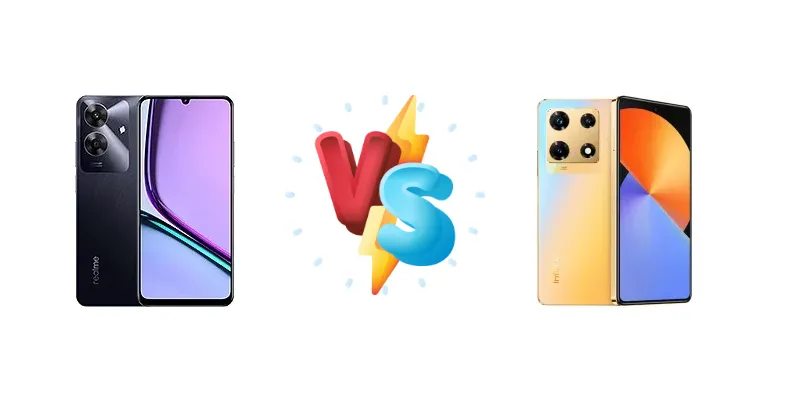
The sub-$200 smartphone market is fiercely competitive, and the Realme Note 60 and Infinix Note 30 Pro are two contenders vying for dominance. While both aim to deliver essential features at an accessible price, they take drastically different approaches to achieving this, particularly in chipset choice and charging technology. This comparison dissects these differences to determine which phone best suits your needs.
🏆 Quick Verdict
For the average user prioritizing fast charging and smoother performance, the Infinix Note 30 Pro is the clear winner. Its Mediatek Helio G99 chipset and 68W charging significantly outperform the Realme Note 60’s Unisoc Tiger T612 and 10W charging, making it a more future-proof and convenient option.
| Network |
|---|
| 2G bands | GSM 850 / 900 / 1800 / 1900 | GSM 850 / 900 / 1800 / 1900 |
| 3G bands | HSDPA 900 / 2100 | HSDPA 850 / 900 / 1700(AWS) / 1900 / 2100 |
| 4G bands | 1, 3, 5, 8, 40 | 1, 2, 3, 4, 5, 7, 8, 12, 17, 20, 28, 38, 40, 41, 66 |
| Speed | HSPA, LTE | HSPA, LTE |
| Technology | GSM / HSPA / LTE | GSM / HSPA / LTE |
| Launch |
|---|
| Announced | 2024, August 30 | 2023, May 22 |
| Status | Available. Released 2024, August 30 | Available. Released 2023, May 22 |
| Body |
|---|
| Build | Glass front, plastic frame, plastic back | Glass front, plastic frame, glass back |
| Dimensions | 167.3 x 76.7 x 7.8 mm (6.59 x 3.02 x 0.31 in) | 162.7 x 76 x 8.2 mm (6.41 x 2.99 x 0.32 in) |
| SIM | Nano-SIM + Nano-SIM | Nano-SIM + Nano-SIM |
| Weight | 187 g (6.60 oz) | 203 g (7.16 oz) |
| | - | IP53 |
| Display |
|---|
| Protection | Reinforced glass | - |
| Resolution | 720 x 1600 pixels, 20:9 ratio (~260 ppi density) | 1080 x 2400 pixels, 20:9 ratio (~395 ppi density) |
| Size | 6.74 inches, 109.7 cm2 (~85.5% screen-to-body ratio) | 6.67 inches, 107.4 cm2 (~86.9% screen-to-body ratio) |
| Type | IPS LCD, 90Hz, 450 nits (typ), 560 nits (HBM) | AMOLED, 1B colors, 120Hz, 900 nits (peak) |
| | - | * the display diagonal size and resolution is unconfirmed |
| Platform |
|---|
| CPU | Octa-core (2x1.8 GHz Cortex-A75 & 6x1.8 GHz Cortex-A55) | Octa-core (2x2.2 GHz Cortex-A76 & 6x2.0 GHz Cortex-A55) |
| Chipset | Unisoc Tiger T612 (12 nm) | Mediatek Helio G99 (6 nm) |
| GPU | Mali-G57 | Mali-G57 MC2 |
| OS | Android 14, Realme UI | Android 13, XOS 13 |
| Memory |
|---|
| Card slot | microSDXC (dedicated slot) | microSDXC (dedicated slot) |
| Internal | 64GB 3GB RAM, 64GB 4GB RAM, 128GB 4GB RAM, 128GB 6GB RAM, 128GB 8GB RAM, 256GB 4GB RAM, 256GB 8GB RAM | 256GB 8GB RAM |
| Main Camera |
|---|
| Features | LED flash, panorama | Quad-LED flash, HDR, panorama |
| Single | 32 MP, f/1.8, (wide), PDAF
Auxiliary lens | - |
| Triple | - | 108 MP, (wide), 1/1.67", PDAF
2 MP (macro)
Auxiliary lens |
| Video | 1080p@30fps | 1440p@30fps, 1080p@30fps |
| Selfie camera |
|---|
| Features | - | LED flash, HDR |
| Single | 5 MP, (wide) | 32 MP, f/2.0, (wide), 1/2.8" |
| Video | 720p@30fps | 1080p@30fps |
| Sound |
|---|
| 3.5mm jack | - | Yes |
| 35mm jack | Yes | Yes |
| Loudspeaker | Yes | Yes, with dual speakers |
| | - | Sound by JBL
24-bit/192kHz audio |
| Comms |
|---|
| Bluetooth | 5.0, A2DP, LE | Yes |
| NFC | No | Yes (market/region dependent) |
| Positioning | GPS, GALILEO, GLONASS, BDS | GPS |
| Radio | Unspecified | FM radio |
| USB | USB Type-C 2.0 | USB Type-C 2.0, OTG |
| WLAN | Wi-Fi 802.11 a/b/g/n/ac, dual-band | Wi-Fi 802.11 a/b/g/n/ac, dual-band, Wi-Fi Direct |
| Features |
|---|
| Sensors | Fingerprint (side-mounted), accelerometer, proximity, compass | Fingerprint (side-mounted), accelerometer, gyro, proximity, compass |
| Battery |
|---|
| Charging | 10W wired | 68W wired, PD3.0, 80% in 30 min
15W wireless
Reverse wireless |
| Type | 5000 mAh | 5000 mAh |
| Misc |
|---|
| Colors | Voyage Blue, Marble Black | Magic Black, Variable Gold |
| Models | RMX3933 | X678B |
| Price | $ 165.00 / £ 77.00 / € 143.00 | - |
Realme Note 60
- Potentially lower price point
- Reliable for basic tasks
- Simple and straightforward user experience
- Extremely slow 10W charging
- Less powerful Unisoc Tiger T612 chipset
- Limited gaming capabilities
Infinix Note 30 Pro
- 68W wired and 15W wireless charging
- More powerful Mediatek Helio G99 chipset
- Better performance for gaming and multitasking
- Reverse wireless charging capability
- Potentially higher price
- May require more frequent software updates for optimization
Display Comparison
Neither device’s display specifications are provided, so a direct comparison is limited. However, given the price bracket, both likely utilize LCD panels. The Infinix Note 30 Pro, benefiting from a more modern chipset, may have a slightly higher display refresh rate, potentially offering smoother scrolling. Bezels are likely comparable, and color accuracy will be dependent on software calibration, a common area for optimization in this segment.
Camera Comparison
Without detailed camera specifications, a precise comparison is difficult. However, it’s reasonable to assume both phones will feature a multi-camera setup with a primary sensor and supporting lenses. The Infinix Note 30 Pro, given its more powerful chipset, likely benefits from more advanced image signal processing (ISP) capabilities, potentially resulting in better dynamic range and low-light performance. The Realme Note 60 will likely focus on basic image capture, while the Infinix Note 30 Pro may offer more features and refinement.
Performance
The core difference lies in the chipsets. The Infinix Note 30 Pro’s Mediatek Helio G99, fabricated on a 6nm process, offers a significant advantage over the Realme Note 60’s Unisoc Tiger T612 (12nm). The G99’s Cortex-A76 cores, clocked at 2.2 GHz, are architecturally superior to the T612’s Cortex-A75 cores (1.8 GHz), translating to faster application loading and smoother multitasking. The 6nm process also contributes to better thermal efficiency, reducing the likelihood of performance throttling during extended gaming sessions. While both utilize an octa-core configuration with similar Cortex-A55 efficiency cores, the G99’s overall performance will be noticeably higher.
Battery Life
The charging disparity is massive. The Realme Note 60’s 10W charging is painfully slow in 2024, requiring several hours for a full charge. The Infinix Note 30 Pro, with its 68W wired charging, can reach 80% charge in just 30 minutes – a game-changer for users who need a quick power boost. Furthermore, the Note 30 Pro adds 15W wireless charging and reverse wireless charging, offering unparalleled convenience. While battery capacity isn’t specified, the faster charging of the Infinix Note 30 Pro effectively mitigates any potential capacity disadvantage.
Buying Guide
Buy the Realme Note 60 if you need a basic, reliable smartphone for everyday tasks like calls, messaging, and light social media use, and are willing to compromise on charging speed and gaming performance. Buy the Infinix Note 30 Pro if you prioritize faster performance for gaming and multitasking, and value the convenience of incredibly fast 68W wired and 15W wireless charging, making it ideal for power users and those on the go.
Frequently Asked Questions
❓ Will the Infinix Note 30 Pro’s Helio G99 overheat during prolonged gaming sessions?
The Helio G99’s 6nm process and optimized thermal design are intended to mitigate overheating. While some throttling is possible during extremely demanding games, it’s less likely to occur compared to the Realme Note 60’s 12nm Unisoc Tiger T612, which is more prone to thermal throttling.
❓ How long does it realistically take to fully charge the Realme Note 60 with its 10W charger?
Expect a full charge from 0% to 100% on the Realme Note 60 to take approximately 3-4 hours with the included 10W charger. This is a significant drawback compared to the Infinix Note 30 Pro’s 68W fast charging.
❓ Is the reverse wireless charging on the Infinix Note 30 Pro useful for accessories like earbuds?
Yes, the 15W reverse wireless charging is quite practical for topping up accessories like true wireless earbuds or smartwatches. While not as fast as dedicated chargers, it provides a convenient solution when a power outlet isn't readily available.
❓ Can the Infinix Note 30 Pro handle demanding games like PUBG Mobile at high settings?
The Helio G99 is capable of running PUBG Mobile at medium to high settings with playable frame rates. While it won't deliver a flagship-level gaming experience, it offers a significantly better gaming performance than the Realme Note 60’s Unisoc Tiger T612.