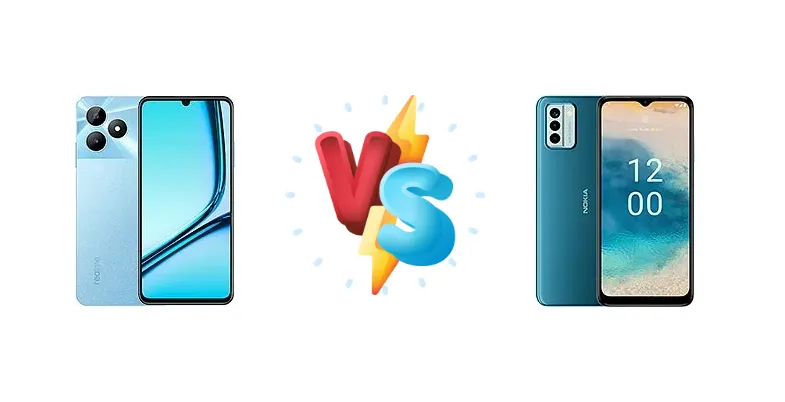
The Realme Note 50 and Nokia G22 represent two distinct approaches to the ultra-budget smartphone market. The Realme focuses on delivering a slightly more powerful processor, while the Nokia emphasizes repairability and faster charging. This comparison dissects the key differences to help you determine which device best suits your needs.
🏆 Quick Verdict
For most users, the Nokia G22 emerges as the more practical choice. While the Realme Note 50’s Unisoc T612 offers a marginal CPU clock speed advantage, the Nokia G22’s 20W charging with PD3.0 support significantly reduces downtime, making it better for daily use.
| Network |
|---|
| 2G bands | GSM 850 / 900 / 1800 / 1900 | GSM 850 / 900 / 1800 / 1900 |
| 3G bands | HSDPA 850 / 900 / 2100 | HSDPA 850 / 900 / 2100 |
| 4G bands | 1, 3, 5, 7, 8, 20, 28, 38, 40, 41 | 1, 3, 5, 7, 8, 20, 28, 38, 39, 40, 41 |
| Speed | HSPA, LTE | HSPA, LTE |
| Technology | GSM / HSPA / LTE | GSM / HSPA / LTE |
| Launch |
|---|
| Announced | 2024, January 23 | 2023, February 25 |
| Status | Available. Released 2024, January 23 | Available. Released 2023, February 25 |
| Body |
|---|
| Build | Glass front, plastic frame, plastic back | Glass front (Gorilla Glass 3), plastic frame, plastic back |
| Dimensions | 167.2 x 76.7 x 8 mm (6.58 x 3.02 x 0.31 in) | 165 x 76.2 x 8.5 mm (6.50 x 3.00 x 0.33 in) |
| SIM | Nano-SIM + Nano-SIM | Nano-SIM + Nano-SIM |
| Weight | 186 g (6.56 oz) | 196.2 g (6.91 oz) |
| | - | Dust and splash resistant
QuickFix user-reparable design |
| Display |
|---|
| Protection | - | Corning Gorilla Glass 3 |
| Resolution | 720 x 1600 pixels, 20:9 ratio (~260 ppi density) | 720 x 1600 pixels, 20:9 ratio (~270 ppi density) |
| Size | 6.74 inches, 109.7 cm2 (~85.5% screen-to-body ratio) | 6.5 inches, 102.0 cm2 (~81.1% screen-to-body ratio) |
| Type | IPS LCD, 90Hz, 560 nits (peak) | IPS LCD, 90Hz, 500 nits (typ) |
| Platform |
|---|
| CPU | Octa-core (2x1.8 GHz Cortex-A75 & 6x1.8 GHz Cortex-A55) | Octa-core (2x1.6 GHz Cortex-A75 & 6x1.6 GHz Cortex-A55) |
| Chipset | Unisoc Tiger T612 (12 nm) | Unisoc T606 (12 nm) |
| GPU | Mali-G57 | Mali-G57 MP1 |
| OS | Android 13, Realme UI T | Android 12 |
| Memory |
|---|
| Card slot | microSDXC (dedicated slot) | microSDXC (uses shared SIM slot) |
| Internal | 64GB 3GB RAM, 64GB 4GB RAM, 128GB 4GB RAM, 256GB 4GB RAM | 64GB 4GB RAM, 128GB 4GB RAM, 256GB 6GB RAM |
| | - | UFS 2.2 |
| Main Camera |
|---|
| Features | LED flash, HDR, panorama | LED flash, HDR, panorama |
| Single | 13 MP, f/2.2, 25mm (wide), PDAF
Auxiliary lens | - |
| Triple | - | 50 MP, f/1.8, (wide), 1/2.76", 0.64µm, PDAF
2 MP (macro)
Auxiliary lens |
| Video | 1080p@30fps | 1080p@30fps |
| Selfie camera |
|---|
| Features | HDR | - |
| Single | 5 MP, f/2.2, 27mm (wide) | 8 MP, f/2.0, (wide) |
| Video | 720p@30fps | 1080p@30fps |
| Sound |
|---|
| 3.5mm jack | - | Yes |
| 35mm jack | Yes | Yes |
| Loudspeaker | Yes | Yes |
| Comms |
|---|
| Bluetooth | 5.0, A2DP, LE | 5.0, A2DP, LE |
| NFC | No | Yes (market/region dependent) |
| Positioning | GPS, GLONASS, GALILEO | GPS, GLONASS, GALILEO |
| Radio | Unspecified | FM radio, RDS |
| USB | USB Type-C 2.0 | USB Type-C 2.0, OTG |
| WLAN | Wi-Fi 802.11 a/b/g/n/ac, dual-band | Wi-Fi 802.11 a/b/g/n/ac, dual-band |
| Features |
|---|
| Sensors | Fingerprint (side-mounted), accelerometer, proximity, compass | Fingerprint (side-mounted), accelerometer, proximity |
| Battery |
|---|
| Charging | 10W wired | 20W wired, PD3.0 |
| Type | 5000 mAh | Li-Po 5050 mAh |
| Misc |
|---|
| Colors | Sky Blue, Midnight Black | Lagoon Blue, Meteor Gray, So Peach |
| Models | RMX3834 | - |
| Price | € 95.83 | About 120 EUR |
Realme Note 50
- Slightly faster CPU clock speed (Unisoc T612)
- Potentially lower price (depending on retailer)
- Realme UI offers customization options
- Significantly slower 10W charging
- Likely less durable build quality
- Software update support may be limited
Nokia G22
- Faster 20W charging with PD3.0
- Nokia’s commitment to repairability (easy to replace parts)
- Potentially longer software support
- Slightly slower CPU clock speed (Unisoc T606)
- May be slightly more expensive
- Stock Android can feel basic for some users
Display Comparison
Neither device boasts a standout display. Both utilize 12nm chipsets, suggesting a focus on cost optimization over premium display features. Details regarding panel type (IPS vs. TFT), resolution, and brightness are absent, but given the price point, expect 720p displays. Bezels are likely to be substantial on both, and color accuracy will be standard for this segment. The lack of high refresh rates is expected.
Camera Comparison
Camera performance is likely to be similar on both devices, relying heavily on software processing. Details regarding sensor sizes and lens apertures are missing, but given the price bracket, expect a primary sensor around 13-50MP paired with basic auxiliary lenses (likely a 2MP macro and depth sensor on both). Image quality will be acceptable in good lighting conditions, but struggle in low light. The Nokia G22’s image processing may lean towards more natural colors, while Realme often boosts saturation for a more vibrant look. The absence of Optical Image Stabilization (OIS) on either device means shaky hands will result in blurry photos.
Performance
The core difference lies in the chipsets: the Realme Note 50 features the Unisoc Tiger T612, while the Nokia G22 uses the Unisoc T606. Both are octa-core CPUs with the same core configuration (2x Cortex-A75 and 6x Cortex-A55), but the T612 is clocked slightly higher at 1.8 GHz versus the T606’s 1.6 GHz. This 200 MHz difference translates to a modest performance boost in CPU-bound tasks for the Realme, but the real-world impact will be minimal for everyday apps. The GPU performance is likely similar, limiting both phones’ gaming capabilities to low-medium settings in most titles. RAM configurations are not specified, but LPDDR4X is the likely standard, impacting multitasking responsiveness.
Battery Life
Battery capacity is not specified for either device, but both likely house around a 5000mAh battery, typical for this price range. However, the charging capabilities are significantly different. The Realme Note 50 is limited to 10W wired charging, resulting in a lengthy charge time. The Nokia G22, on the other hand, supports 20W wired charging with Power Delivery 3.0 (PD3.0). This faster charging significantly reduces downtime, allowing users to quickly top up their battery when needed. While a larger battery capacity is desirable, the faster charging of the Nokia G22 provides a more convenient user experience.
Buying Guide
Buy the Realme Note 50 if you prioritize raw CPU performance for light gaming and multitasking, and are willing to accept slower charging speeds. Buy the Nokia G22 if you value faster charging, potential for longer software support (typical of Nokia), and the unique benefit of easy self-repair, which could save money in the long run.
Frequently Asked Questions
❓ Does the Nokia G22's repairability actually save money, or is it just a gimmick?
Nokia's partnership with iFixit provides genuine replacement parts and detailed repair guides. Replacing a cracked screen or battery yourself can be significantly cheaper than professional repair, potentially saving you $50-$100 or more over the phone's lifespan. This is a major advantage for users prone to accidents.
❓ Will the Unisoc T612 in the Realme Note 50 handle popular games like PUBG Mobile or Call of Duty?
While the Unisoc T612 is capable of running these games, expect to play at low to medium settings with frame rate limitations. The GPU isn't powerful enough for a smooth, high-fidelity gaming experience. The Nokia G22 will offer a similar gaming performance.
❓ How long will it take to fully charge the Realme Note 50 with its 10W charger?
Given the likely 5000mAh battery capacity, a full charge with the 10W charger will likely take between 3.5 to 5 hours. This is a significant drawback compared to the Nokia G22's 20W charging.
❓ What kind of software updates can I expect from Nokia for the G22?
Nokia typically provides at least 2 years of software updates and 3 years of security patches for its smartphones. This is a significant advantage over many other brands in this price range, ensuring your phone remains secure and up-to-date.