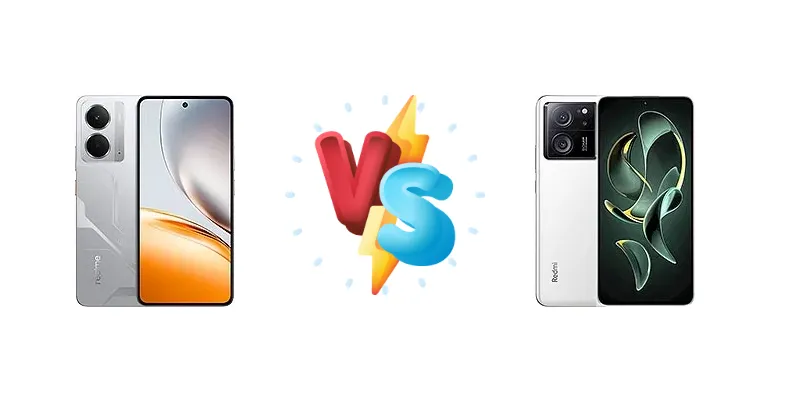
The Realme Neo7x and Xiaomi Redmi K60 Ultra represent compelling options in the increasingly competitive mid-range smartphone market. The Neo7x aims for efficiency with Qualcomm’s latest 6-series chip, while the K60 Ultra swings for the fences with the flagship-level Dimensity 9200+. This comparison dissects their key differences to determine which device delivers the best experience for your needs.
🏆 Quick Verdict
For users prioritizing raw performance and incredibly fast charging, the Xiaomi Redmi K60 Ultra is the clear winner. Its Dimensity 9200+ chipset offers a substantial performance leap over the Snapdragon 6 Gen 4, and the 120W charging is a game-changer. However, the Realme Neo7x provides a solid, efficient experience at a potentially lower price point.
| Network |
|---|
| 2G bands | GSM 850 / 900 / 1800 / 1900 | GSM 850 / 900 / 1800 / 1900 |
| 3G bands | HSDPA 850 / 900 / 2100 | HSDPA 800 / 850 / 900 / 1700(AWS) / 2100 |
| 4G bands | 1, 3, 5, 8, 28, 34, 38, 39, 40, 41 | 1, 3, 4, 5, 8, 18, 19, 26, 34, 38, 39, 40, 41, 42, 66 |
| 5G bands | 1, 5, 8, 28, 41, 77, 78 SA/NSA | 1, 3, 5, 8, 28, 38, 41, 66, 77, 78 SA/NSA |
| Speed | HSPA, LTE, 5G | HSPA, LTE, 5G |
| Technology | GSM / HSPA / LTE / 5G | GSM / CDMA / HSPA / CDMA2000 / LTE / 5G |
| Launch |
|---|
| Announced | 2025, February 25 | 2023, August 15 |
| Status | Available. Released 2025, February 25 | Available. Released 2023, August 15 |
| Body |
|---|
| Dimensions | 163.2 x 75.7 x 8 mm (6.43 x 2.98 x 0.31 in) | 162.2 x 75.7 x 8.5 mm (6.39 x 2.98 x 0.33 in) |
| SIM | Nano-SIM + Nano-SIM | Nano-SIM + Nano-SIM |
| Weight | 194 g (6.84 oz) | 204 g (7.20 oz) |
| Display |
|---|
| Protection | - | Unspecified |
| Resolution | 1080 x 2400 pixels, 20:9 ratio (~395 ppi density) | 1220 x 2712 pixels, 20:9 ratio (~446 ppi density) |
| Size | 6.67 inches, 107.4 cm2 (~86.9% screen-to-body ratio) | 6.67 inches, 107.4 cm2 (~87.5% screen-to-body ratio) |
| Type | AMOLED, 120Hz, 2000 nits (peak) | OLED, 68B colors, 144Hz, Dolby Vision, HDR10+, 2600 nits (peak) |
| Platform |
|---|
| CPU | Octa-core (1x2.3 GHz Cortex-A720s & 3x2.2 GHz Cortex-A720s & 4x1.8 GHz Cortex-A520s) | Octa-core (1x3.35 GHz Cortex-X3 & 3x3.0 GHz Cortex-A715 & 4x2.0 GHz Cortex-A510) |
| Chipset | Qualcomm Snapdragon 6 Gen 4 (4 nm) | Mediatek Dimensity 9200+ (4 nm) |
| GPU | Adreno 810 | Immortalis-G715 MC11 |
| OS | Android 15, Realme UI 6.0 | Android 13, MIUI 14 |
| Memory |
|---|
| Card slot | No | No |
| Internal | 128GB 8GB RAM, 256GB 8GB RAM, 512GB 12GB RAM | 256GB 12GB RAM, 256GB 16GB RAM, 512GB 16GB RAM, 1TB 16GB RAM, 1TB 24GB RAM |
| Main Camera |
|---|
| Features | LED flash, HDR, panorama | Color spectrum sensor, Dual-LED dual-tone flash, HDR, panorama |
| Single | 50 MP, f/1.8, 27mm (wide), 1/2.88", 0.61µm, PDAF | - |
| Triple | - | 50 MP, f/1.7, (wide), 1/1.49", 1.0µm, PDAF, OIS
8 MP, 119˚ (ultrawide), 1/4.0", 1.12µm
2 MP (macro) |
| Video | 4K@30fps, 1080p@30/60/120fps, gyro-EIS | 8K@24fps, 4K@30/60fps, 1080p@30/60/120/240/960fps, gyro-EIS, HDR10+, 10-bit |
| Selfie camera |
|---|
| Features | - | HDR |
| Single | 16 MP, f/2.4, 23mm (wide), 1/3.09", 1.0µm | 20 MP, (wide), 1/2.0", 0.8µm |
| Video | 1080p@30fps | 1080p@30/120fps |
| Sound |
|---|
| 35mm jack | Yes | No |
| Loudspeaker | Yes, with stereo speakers | Yes, with stereo speakers |
| Comms |
|---|
| Bluetooth | 5.2, A2DP, LE | 5.4, A2DP, LE |
| Infrared port | Yes | Yes |
| NFC | Yes | Yes |
| Positioning | GPS, GLONASS, GALILEO, BDS, QZSS | GPS (L1+L5), GLONASS (G1), BDS (B1I+B1C+B2a+B2b), GALILEO (E1+E5a), QZSS (L1+L5), NavIC |
| Radio | No | Unspecified |
| USB | USB Type-C | USB Type-C, OTG |
| WLAN | Wi-Fi 802.11 a/b/g/n/ac, dual-band | Wi-Fi 802.11 a/b/g/n/ac/6e, dual-band, Wi-Fi Direct |
| Features |
|---|
| Sensors | Fingerprint (under display, optical), accelerometer, gyro, proximity, compass | Fingerprint (under display, optical), accelerometer, gyro, proximity, compass |
| Battery |
|---|
| Charging | 45W wired, 50% in 30 min | 120W wired, PD3.0, 100% in 19 min |
| Type | Si/C Li-Ion 6000 mAh | Li-Po 5000 mAh |
| Misc |
|---|
| Colors | Gray, White | Black, White, Green |
| Models | - | 23078RKD5C |
| Price | About 170 EUR | About 330 EUR |
Realme Neo7x
- More power-efficient chipset (Snapdragon 6 Gen 4)
- Potentially lower price point
- Reliable daily driver experience
- Significantly lower performance compared to the K60 Ultra
- Slower charging speed (45W)
- Likely less capable camera system
Xiaomi Redmi K60 Ultra
- Flagship-level performance (Dimensity 9200+)
- Ultra-fast 120W charging
- Likely superior camera system
- Potentially higher price
- May experience more heat under sustained load
- Potentially lower battery life due to higher power consumption
Display Comparison
While display specifications are absent from the provided data, both devices likely feature LCD panels given their price segments. The Redmi K60 Ultra, historically, has prioritized high refresh rates, potentially offering a 120Hz or 144Hz panel for smoother scrolling and gaming. The Neo7x, focusing on efficiency, might opt for a 60Hz or 90Hz panel. Color accuracy and peak brightness will be key differentiators, with the K60 Ultra likely having an edge due to its higher-end positioning.
Camera Comparison
Without specific camera specs, it’s difficult to make definitive claims. However, the Redmi K60 Ultra, being a more premium device, is likely to feature a larger main sensor with optical image stabilization (OIS), resulting in better low-light performance and sharper images. The Neo7x will likely rely on software processing to compensate for a potentially smaller sensor. Lens apertures will also play a role; wider apertures (lower f-number) allow more light to reach the sensor, improving image quality in challenging conditions. We anticipate the K60 Ultra offering a more versatile and capable camera system.
Performance
The core difference lies in the chipsets. The Xiaomi Redmi K60 Ultra’s MediaTek Dimensity 9200+ (4nm) is a significant upgrade over the Realme Neo7x’s Qualcomm Snapdragon 6 Gen 4 (4nm). The Dimensity 9200+ boasts a Cortex-X3 prime core clocked at 3.35 GHz, offering substantially higher single-core performance crucial for responsive app launches and demanding tasks. The Snapdragon 6 Gen 4’s Cortex-A720s cores, while efficient, are architecturally less powerful. The Dimensity 9200+’s superior GPU will translate to significantly better gaming performance, especially at higher settings. The K60 Ultra’s likely use of faster LPDDR5x RAM further enhances its performance advantage.
Battery Life
The Redmi K60 Ultra’s 120W wired charging is a standout feature, capable of fully charging the device in just 19 minutes. This is a massive advantage over the Realme Neo7x’s 45W charging, which takes 30 minutes to reach 50%. While battery capacity isn’t specified, the faster charging of the K60 Ultra effectively mitigates any potential capacity disadvantage. The efficiency of the Snapdragon 6 Gen 4 in the Neo7x might lead to comparable real-world battery life despite a potentially smaller battery size, but the K60 Ultra’s charging speed offers unparalleled convenience.
Buying Guide
Buy the Realme Neo7x if you need a reliable daily driver with good battery life and don't demand the absolute highest performance. It's ideal for casual gamers and users who prioritize efficiency. Buy the Xiaomi Redmi K60 Ultra if you're a power user, mobile gamer, or frequently find yourself needing to top up your battery quickly. The superior chipset and blazing-fast charging justify the potential price premium.
Frequently Asked Questions
❓ Will the Dimensity 9200+ in the Redmi K60 Ultra get noticeably hot during extended gaming sessions?
While the Dimensity 9200+ is a powerful chip, it can generate more heat than the Snapdragon 6 Gen 4. Xiaomi typically employs effective thermal management solutions, but sustained gaming at maximum settings may lead to some throttling to prevent overheating. The Neo7x, with its more efficient chipset, will likely remain cooler.
❓ Is the 45W charging on the Realme Neo7x slow compared to the competition?
45W charging is respectable, but the Redmi K60 Ultra’s 120W charging is in a different league. While 45W will still top up the battery overnight, the K60 Ultra can provide a significant charge in just a few minutes, making it ideal for users who need a quick boost before heading out.
❓ How much of a performance difference will I see between the Snapdragon 6 Gen 4 and the Dimensity 9200+ in everyday tasks?
For basic tasks like browsing, social media, and messaging, the difference will be minimal. However, when launching demanding apps, multitasking, or playing graphically intensive games, the Dimensity 9200+ will provide a noticeably smoother and more responsive experience due to its superior processing power.