
Realme Neo7 vs Xiaomi Redmi Note 12 Pro+: Which Mid-Range Champion Reigns Supreme?
| Phones Images | |||||
|---|---|---|---|---|---|
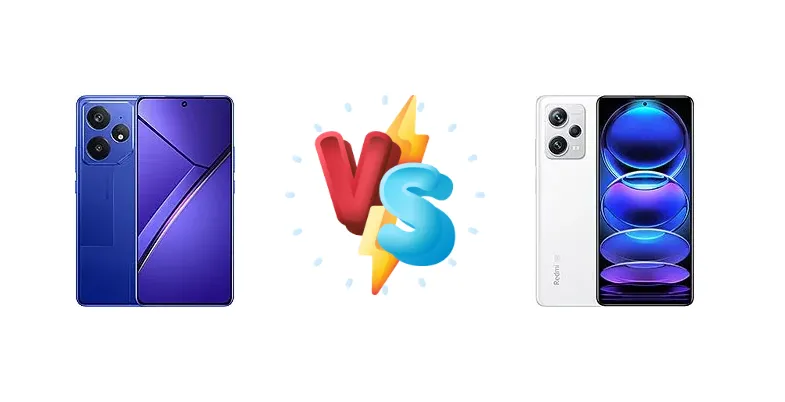
|
🏆 Quick Verdict
For users prioritizing raw performance and future-proofing, the Realme Neo7 is the clear winner. Its Dimensity 9300+ chipset offers a significant leap in CPU and GPU capabilities over the Redmi Note 12 Pro+'s Dimensity 1080. However, the Redmi Note 12 Pro+ excels in charging speed and battery life, making it ideal for users who value convenience and longevity.
| PHONES | ||
|---|---|---|
| Phone Names | Realme Neo7 | Xiaomi Redmi Note 12 Pro+ |
| Network | ||
|---|---|---|
| 2G bands | GSM 850 / 900 / 1800 / 1900 | GSM 850 / 900 / 1800 / 1900 - SIM 1 & SIM 2 |
| 3G bands | HSDPA 800 / 850 / 900 / 1700(AWS) / 2100 | HSDPA 800 / 850 / 900 / 1900 / 2100 |
| 4G bands | 1, 3, 4, 5, 8, 18, 19, 20, 26, 28, 34, 38, 39, 40, 41, 66 | 1, 3, 5, 8, 19, 34, 38, 39, 40, 41 - International, China |
| 5G bands | 1, 3, 5, 8, 20, 28, 38, 40, 41, 66, 77, 78 SA/NSA | 1, 3, 5, 8, 28, 38, 40, 41, 77, 78 SA/NSA - International |
| Speed | HSPA, LTE, 5G | HSPA, LTE-A (CA), 5G |
| Technology | GSM / HSPA / LTE / 5G | GSM / CDMA / HSPA / EVDO / LTE / 5G |
| - | 1, 3, 5, 8, 28, 38, 41, 77, 78 SA/NSA - China | |
| Launch | ||
|---|---|---|
| Announced | 2024, December 11 | 2022, October 27 |
| Status | Available. Released 2024, December 11 | Available. Released 2022, November 01 |
| Body | ||
|---|---|---|
| Build | - | Glass front (Gorilla Glass 5), glass back |
| Dimensions | 162.6 x 76.4 x 8.6 mm (6.40 x 3.01 x 0.34 in) | 162.9 x 76 x 8.9 mm (6.41 x 2.99 x 0.35 in) |
| SIM | Nano-SIM + Nano-SIM | Dual SIM (Nano-SIM, dual stand-by) |
| Weight | 213 g (7.51 oz) | 208.4 g (7.34 oz) |
| - | IP53, dust and splash resistant | |
| Display | ||
|---|---|---|
| Protection | Crystal Armor glass | Corning Gorilla Glass 5 |
| Resolution | 1264 x 2780 pixels (~450 ppi density) | 1080 x 2400 pixels, 20:9 ratio (~395 ppi density) |
| Size | 6.78 inches, 111.7 cm2 (~90.0% screen-to-body ratio) | 6.67 inches, 107.4 cm2 (~86.8% screen-to-body ratio) |
| Type | LTPO AMOLED, 1B colors, 120Hz, HDR, 1600 nits (HBM), 6000 nits (peak) | OLED, 1B colors, 120Hz, Dolby Vision, HDR10+, 500 nits (typ), 900 nits (HBM) |
| Platform | ||
|---|---|---|
| CPU | Octa-core (1x3.4 GHz Cortex-X4 & 3x2.85 GHz Cortex-X4 & 4x2.0 GHz Cortex-A720) | Octa-core (2x2.6 GHz Cortex-A78 & 6x2.0 GHz Cortex-A55) |
| Chipset | Mediatek Dimensity 9300+ (4 nm) | Mediatek MT6877V Dimensity 1080 (6 nm) |
| GPU | Immortalis-G720 MC12 | Mali-G68 MC4 |
| OS | Android 15, Realme UI 6.0 | Android 12, MIUI 13 |
| Memory | ||
|---|---|---|
| Card slot | No | No |
| Internal | 256GB 12GB RAM, 256GB 16GB RAM, 512GB 12GB RAM, 512GB 16GB RAM, 1TB 16GB RAM | 256GB 8GB RAM, 256GB 12GB RAM |
| - | UFS 2.2 | |
| Main Camera | ||
|---|---|---|
| Dual | 50 MP, f/1.9, 26mm (wide), 1/1.95", PDAF, OIS 8 MP, f/2.2, 16mm, 112˚ (ultrawide), 1/4.0", 1.12µm | - |
| Features | Color spectrum sensor, LED flash, HDR, panorama | Dual-LED dual-tone flash, HDR, panorama |
| Triple | - | 200 MP, f/1.7, 24mm (wide), 1/1.4", 0.56µm, PDAF, OIS 8 MP, f/2.2, 120˚ (ultrawide), 1/4", 1.12µm 2 MP, f/2.4, (macro) |
| Video | 4K@30/60fps, 1080p@30/60/120fps | 4K@30fps, 1080p@30/60/120fps, 720p@960fps |
| Selfie camera | ||
|---|---|---|
| Features | Panorama | HDR |
| Single | 16 MP, f/2.4, 23mm (wide) | 16 MP, f/2.5, (wide), 1/3.06", 1.0µm |
| Video | 1080p@30fps | 1080p@30/60fps |
| Sound | ||
|---|---|---|
| 3.5mm jack | - | Yes |
| 35mm jack | No | - |
| Loudspeaker | Yes, with stereo speakers | Yes, with stereo speakers |
| - | 24-bit/192kHz audio | |
| Comms | ||
|---|---|---|
| Bluetooth | 5.4, A2DP, LE | 5.2, A2DP, LE |
| Infrared port | Yes | Yes |
| NFC | Yes | Yes (market/region dependent) |
| Positioning | GPS (L1+L5), BDS (B1I+B1c+B2a), GALILEO (E1+E5a), QZSS (L1+L5), NavIC (L5), GLONASS | GPS (L1), GLONASS (G1), BDS (B1I+B1c), GALILEO (E1), QZSS (L1) |
| Radio | No | No |
| USB | USB Type-C 2.0 | USB Type-C 2.0, OTG |
| WLAN | Wi-Fi 802.11 a/b/g/n/ac/6/7, dual-band | Wi-Fi 802.11 a/b/g/n/ac/6, dual-band, Wi-Fi Direct |
| Features | ||
|---|---|---|
| Sensors | Fingerprint (under display, optical), accelerometer, gyro, proximity, compass | Fingerprint (side-mounted), accelerometer, proximity, gyro, compass |
| Battery | ||
|---|---|---|
| Charging | 80W wired | 120W wired, PD3.0, 100% in 19 min (advertised) |
| Type | Si/C Li-Ion 7000 mAh | Li-Po 5000 mAh, non-removable |
| Misc | ||
|---|---|---|
| Colors | Black, Blue, Silver | Arctic White, Iceberg Blue, Obsidian Black, Trend edition |
| Models | RMX5060 | 22101316UCP, 22101316UG |
| Price | About 280 EUR | $ 348.00 / £ 439.00 / € 399.00 / ₹ 29,949 |
| Tests | ||
|---|---|---|
| Battery life | - | Endurance rating 88h |
| Camera | - | Photo / Video |
| Display | - | Contrast ratio: Infinite (nominal) |
| Loudspeaker | - | -26.7 LUFS (Good) |
| Performance | - | AnTuTu: 498710 (v9) GeekBench: 2208 (v5.1), 2372 (v6) GFXBench: 22fps (ES 3.1 onscreen) |
Realme Neo7
- Significantly more powerful processor (Dimensity 9300+)
- Potentially better thermal management due to 4nm process
- Likely to offer smoother gaming experience
- Slower charging speed (80W vs 120W)
- Battery capacity unknown, potentially smaller than Redmi
Xiaomi Redmi Note 12 Pro+
- Ultra-fast 120W charging (100% in 19 minutes)
- Excellent battery endurance (88h rating)
- Potentially better display contrast
- Less powerful processor (Dimensity 1080)
- May struggle with demanding games or applications
Display Comparison
The Redmi Note 12 Pro+ boasts an 'Infinite' (nominal) contrast ratio, suggesting a strong AMOLED panel, but lacks specific details like peak brightness or refresh rate. The Neo7’s display specifications are currently unavailable, making a direct comparison difficult. However, given the Neo7’s focus on performance, it’s likely to feature a high refresh rate panel to complement the powerful chipset. Without knowing the Neo7’s panel technology, the Redmi Note 12 Pro+ likely has the edge in contrast and potentially color accuracy, assuming a well-calibrated AMOLED.
Camera Comparison
The Redmi Note 12 Pro+’s camera specifications are currently limited to 'Photo / Video' without details on sensor size or resolution. While the inclusion of OIS is likely, its effectiveness remains unknown. The Neo7’s camera details are also missing. Given the current market trends, it’s reasonable to expect both phones to feature multi-camera setups, but without specific sensor information, a meaningful comparison is impossible. We can assume both will offer decent image quality in good lighting conditions, but low-light performance will heavily depend on sensor size and image processing algorithms.
Performance
This is where the Realme Neo7 truly shines. The Mediatek Dimensity 9300+ (4nm) with its unique CPU core configuration – 1x3.4 GHz Cortex-X4, 3x2.85 GHz Cortex-X4, and 4x2.0 GHz Cortex-A720 – represents a substantial upgrade over the Redmi Note 12 Pro+'s Dimensity 1080 (6nm). The Cortex-X4 cores in the Neo7 are significantly more powerful than the Cortex-A78 cores in the Redmi, resulting in faster application loading, smoother multitasking, and superior gaming performance. The 4nm process node further enhances efficiency, potentially leading to better thermal management. The Redmi Note 12 Pro+'s Dimensity 1080 is still a capable chip, but it’s outmatched in raw processing power.
Battery Life
The Redmi Note 12 Pro+ boasts a significant advantage in charging speed with its 120W wired charging, advertised to reach 100% in just 19 minutes. This is considerably faster than the Realme Neo7’s 80W charging. However, the Redmi Note 12 Pro+ achieves an endurance rating of 88 hours, while the Neo7’s battery capacity is unknown. The faster charging of the Redmi Note 12 Pro+ offsets any potential capacity difference, making it the more convenient option for users who frequently need to top up their battery. The Neo7’s 80W charging is still respectable, but it can’t compete with the Redmi’s speed.
Buying Guide
Buy the Realme Neo7 if you are a demanding user who prioritizes gaming, content creation, or running resource-intensive applications. The Dimensity 9300+ will provide a smoother, more responsive experience. Buy the Xiaomi Redmi Note 12 Pro+ if you value fast charging, long battery life, and a balanced feature set. It’s the better choice for everyday users who want a reliable phone that can easily last a full day and recharge in under 20 minutes.