
Realme Neo7 vs Xiaomi 13 Lite: A Deep Dive into Performance and Value
| Phones Images | |||||
|---|---|---|---|---|---|
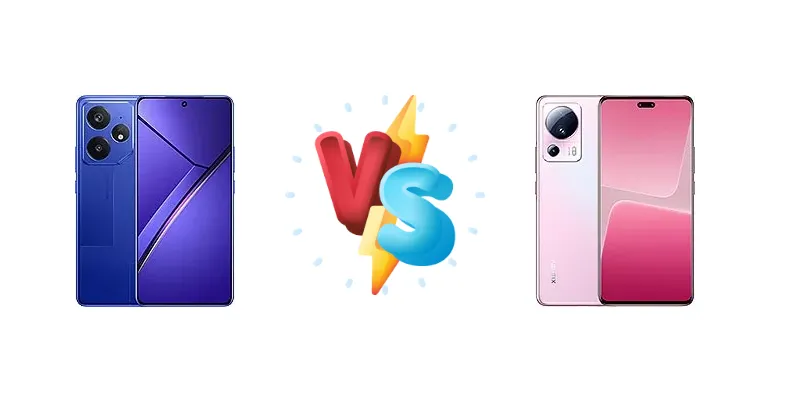
|
🏆 Quick Verdict
For users prioritizing performance and future-proofing, the Realme Neo7 is the clear winner. Its Dimensity 9300+ chipset offers a significant leap in CPU and GPU capabilities over the Xiaomi 13 Lite’s Snapdragon 7 Gen 1. While the Xiaomi 13 Lite boasts a brighter display and comparable battery endurance, the Neo7’s processing power justifies the trade-off for demanding users.
| PHONES | ||
|---|---|---|
| Phone Names | Realme Neo7 | Xiaomi 13 Lite |
| Network | ||
|---|---|---|
| 2G bands | GSM 850 / 900 / 1800 / 1900 | GSM 850 / 900 / 1800 / 1900 |
| 3G bands | HSDPA 800 / 850 / 900 / 1700(AWS) / 2100 | HSDPA 800 / 850 / 900 / 1700(AWS) / 1900 / 2100 |
| 4G bands | 1, 3, 4, 5, 8, 18, 19, 20, 26, 28, 34, 38, 39, 40, 41, 66 | 1, 2, 3, 4, 5, 7, 8, 12, 13, 17, 18, 19, 20, 26, 28, 32, 38, 40, 41, 42, 66 |
| 5G bands | 1, 3, 5, 8, 20, 28, 38, 40, 41, 66, 77, 78 SA/NSA | 1, 3, 5, 7, 8, 20, 28, 38, 40, 41, 66, 77, 78 SA/NSA |
| Speed | HSPA, LTE, 5G | HSPA, LTE, 5G |
| Technology | GSM / HSPA / LTE / 5G | GSM / HSPA / LTE / 5G |
| Launch | ||
|---|---|---|
| Announced | 2024, December 11 | 2023, February 26 |
| Status | Available. Released 2024, December 11 | Available. Released 2023, March 08 |
| Body | ||
|---|---|---|
| Build | - | Glass front (Gorilla Glass 5), glass back, plastic frame |
| Dimensions | 162.6 x 76.4 x 8.6 mm (6.40 x 3.01 x 0.34 in) | 159.2 x 72.7 x 7.2 mm (6.27 x 2.86 x 0.28 in) |
| SIM | Nano-SIM + Nano-SIM | · Nano-SIM + eSIM· Nano-SIM + Nano-SIM |
| Weight | 213 g (7.51 oz) | 171 g (6.03 oz) |
| - | IP53, dust and splash resistant | |
| Display | ||
|---|---|---|
| Protection | Crystal Armor glass | Corning Gorilla Glass 5 |
| Resolution | 1264 x 2780 pixels (~450 ppi density) | 1080 x 2400 pixels, 20:9 ratio (~402 ppi density) |
| Size | 6.78 inches, 111.7 cm2 (~90.0% screen-to-body ratio) | 6.55 inches, 103.6 cm2 (~89.5% screen-to-body ratio) |
| Type | LTPO AMOLED, 1B colors, 120Hz, HDR, 1600 nits (HBM), 6000 nits (peak) | AMOLED, 68B colors, Dolby Vision, HDR10+, 120Hz, 500 nits (typ), 1000 nits (peak) |
| Platform | ||
|---|---|---|
| CPU | Octa-core (1x3.4 GHz Cortex-X4 & 3x2.85 GHz Cortex-X4 & 4x2.0 GHz Cortex-A720) | Octa-core (1x2.4 GHz Cortex-A710 & 3x2.36 GHz Cortex-A710 & 4x1.8 GHz Cortex-A510) |
| Chipset | Mediatek Dimensity 9300+ (4 nm) | Qualcomm SM7450-AB Snapdragon 7 Gen 1 (4 nm) |
| GPU | Immortalis-G720 MC12 | Adreno 644 |
| OS | Android 15, Realme UI 6.0 | Android 12, MIUI 14 |
| Memory | ||
|---|---|---|
| Card slot | No | No |
| Internal | 256GB 12GB RAM, 256GB 16GB RAM, 512GB 12GB RAM, 512GB 16GB RAM, 1TB 16GB RAM | 64GB 8GB RAM, 128GB 8GB RAM, 256GB 8GB RAM |
| - | UFS 2.2 | |
| Main Camera | ||
|---|---|---|
| Dual | 50 MP, f/1.9, 26mm (wide), 1/1.95", PDAF, OIS 8 MP, f/2.2, 16mm, 112˚ (ultrawide), 1/4.0", 1.12µm | - |
| Features | Color spectrum sensor, LED flash, HDR, panorama | Dual-LED dual-tone flash, HDR, panorama |
| Triple | - | 50 MP, f/1.8, 23mm (wide), 1/1.56", 1.0µm, PDAF 8 MP, f/2.2, 119˚ (ultrawide), 1/4.0", 1.12µm 2 MP (macro) |
| Video | 4K@30/60fps, 1080p@30/60/120fps | 4K@30fps, 1080p@30/60/120fps, 720p@960fps |
| Selfie camera | ||
|---|---|---|
| Dual | - | 32 MP, f/2.4, 100˚ (ultrawide), 1/2.74", 0.8µm 8 MP, f/2.3, (depth) |
| Features | Panorama | Dual-LED flash, HDR |
| Single | 16 MP, f/2.4, 23mm (wide) | - |
| Video | 1080p@30fps | 1080p@30/60fps |
| Sound | ||
|---|---|---|
| 3.5mm jack | - | No |
| 35mm jack | No | No |
| Loudspeaker | Yes, with stereo speakers | Yes |
| - | 24-bit/192kHz audio | |
| Comms | ||
|---|---|---|
| Bluetooth | 5.4, A2DP, LE | 5.2, A2DP, LE |
| Infrared port | Yes | Yes |
| NFC | Yes | Yes (market/region dependent) |
| Positioning | GPS (L1+L5), BDS (B1I+B1c+B2a), GALILEO (E1+E5a), QZSS (L1+L5), NavIC (L5), GLONASS | GPS (L1), GLONASS (G1), BDS (B1I+B1c), GALILEO (E1), QZSS (L1) |
| Radio | No | No |
| USB | USB Type-C 2.0 | USB Type-C 2.0, OTG |
| WLAN | Wi-Fi 802.11 a/b/g/n/ac/6/7, dual-band | Wi-Fi 802.11 a/b/g/n/ac/6, dual-band |
| Features | ||
|---|---|---|
| Sensors | Fingerprint (under display, optical), accelerometer, gyro, proximity, compass | Fingerprint (under display, optical), accelerometer, gyro, proximity, compass |
| Battery | ||
|---|---|---|
| Charging | 80W wired | 67W wired, 100% in 40 min |
| Type | Si/C Li-Ion 7000 mAh | Li-Po 4500 mAh |
| Misc | ||
|---|---|---|
| Colors | Black, Blue, Silver | Black, Lite Blue, Lite Pink |
| Models | RMX5060 | - |
| Price | About 280 EUR | About 180 EUR |
| Tests | ||
|---|---|---|
| Battery life | - | Endurance rating 93h |
| Camera | - | Photo / Video |
| Display | - | Contrast ratio: Infinite (nominal) |
| Loudspeaker | - | -28.5 LUFS (Average) |
| Performance | - | AnTuTu: 534143 (v9) GeekBench: 2936 (v5.1), 2434 (v6) GFXBench: 33fps (ES 3.1 onscreen) |
Realme Neo7
- Significantly more powerful processor (Dimensity 9300+)
- Faster 80W wired charging
- Potential for better sustained performance due to advanced cooling
- Camera specifications are unknown
- Display details are lacking, potentially inferior to Xiaomi 13 Lite
Xiaomi 13 Lite
- Brighter display (938 nits)
- Excellent battery endurance (93h)
- Refined software experience (typical of Xiaomi)
- Less powerful processor (Snapdragon 7 Gen 1)
- Slower 67W charging compared to Realme Neo7
- May struggle with demanding games and applications
Display Comparison
The Xiaomi 13 Lite features a display capable of reaching 938 nits of peak brightness, providing excellent visibility in direct sunlight. While the Realme Neo7’s display specifications are not provided, the Xiaomi 13 Lite’s brightness advantage is notable. Both devices offer an 'Infinite' (nominal) contrast ratio, typical of OLED panels. However, without knowing the Neo7’s panel technology (LTPO vs standard OLED) or refresh rate, it’s difficult to assess its overall display quality beyond brightness. The Xiaomi 13 Lite’s higher peak brightness is a clear advantage for outdoor use.
Camera Comparison
Both devices are listed as having 'Photo / Video' capabilities, lacking specific details. Without sensor size, aperture, or OIS information, a direct comparison is impossible. However, given the Xiaomi 13 Lite’s marketing emphasis on its camera, it’s likely to feature a more refined image processing pipeline. The absence of details on the Neo7’s camera suggests it may be a secondary focus. We can assume the Xiaomi 13 Lite will offer a more polished camera experience, but the Neo7 could potentially deliver competitive results depending on its sensor and software optimization.
Performance
The core difference lies in the chipsets. The Realme Neo7’s Mediatek Dimensity 9300+ (4nm) is a significantly more powerful processor than the Xiaomi 13 Lite’s Qualcomm Snapdragon 7 Gen 1 (4nm). The Neo7’s CPU configuration – 1x3.4 GHz Cortex-X4, 3x2.85 GHz Cortex-X4, and 4x2.0 GHz Cortex-A720 – showcases a focus on high-end performance with the inclusion of multiple Cortex-X4 cores. In contrast, the Snapdragon 7 Gen 1 utilizes 1x2.4 GHz Cortex-A710, 3x2.36 GHz Cortex-A710, and 4x1.8 GHz Cortex-A510. The Cortex-X4 cores in the Neo7 offer a substantial performance uplift. While both are built on a 4nm process, the architectural differences and core configuration give the Neo7 a clear advantage in CPU-intensive tasks and gaming. The Neo7 is likely to exhibit superior sustained performance due to its more advanced cooling solutions, mitigating potential thermal throttling.
Battery Life
The Xiaomi 13 Lite boasts an endurance rating of 93 hours, indicating excellent battery life. It supports 67W wired charging, achieving a 100% charge in 40 minutes. The Realme Neo7, with 80W wired charging, promises faster charging speeds. While the Neo7’s battery capacity is unknown, the faster charging could offset a potentially smaller battery size. The 80W charging on the Neo7 will likely result in a quicker top-up, providing convenience for users who frequently need to recharge.
Buying Guide
Buy the Realme Neo7 if you need uncompromising performance for gaming, content creation, or heavy multitasking. The Dimensity 9300+ will handle demanding tasks with ease. Buy the Xiaomi 13 Lite if you prioritize a sleek design, a brighter display for outdoor visibility, and a more refined software experience, and are willing to trade some raw power for a more balanced package.