
Realme Neo7 Turbo vs ZTE nubia RedMagic 7 Pro: A Deep Dive Comparison
| Phones Images | |||||
|---|---|---|---|---|---|
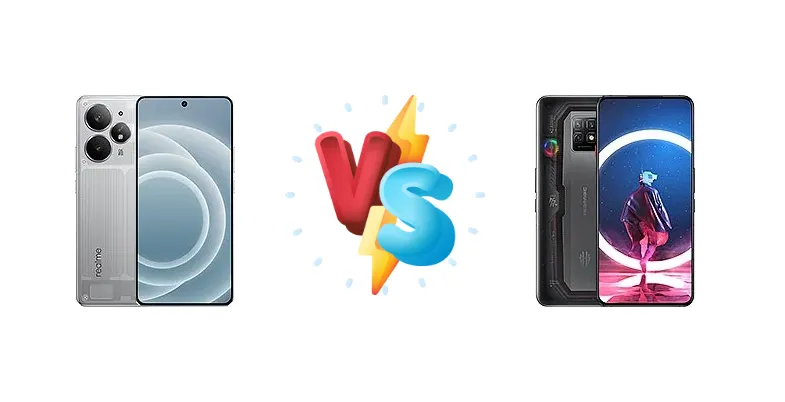
|
🏆 Quick Verdict
For the average user prioritizing everyday performance and fast charging, the Realme Neo7 Turbo emerges as the winner. Its newer Dimensity 9400e chipset offers competitive performance, and the 100W charging is significantly faster than the global version of the RedMagic 7 Pro. However, dedicated gamers may still prefer the RedMagic 7 Pro's gaming-centric features.
| PHONES | ||
|---|---|---|
| Phone Names | Realme Neo7 Turbo | ZTE nubia RedMagic 7 Pro |
| Network | ||
|---|---|---|
| 2G bands | GSM 850 / 900 / 1800 / 1900 | GSM 850 / 900 / 1800 / 1900 |
| 3G bands | HSDPA 800 / 850 / 900 / 1700(AWS) / 2100 | HSDPA 850 / 900 / 1700(AWS) / 1900 / 2100 |
| 4G bands | 1, 3, 4, 5, 8, 18, 19, 20, 26, 28, 34, 38, 39, 40, 41, 42, 48, 66 | 1, 2, 3, 4, 5, 7, 8, 12, 17, 18, 19, 20, 26, 28, 34, 38, 40, 41, 66 - International |
| 5G bands | 1, 3, 5, 8, 20, 28, 38, 40, 41, 48, 66, 77, 78 SA/NSA | 1, 3, 5, 7, 8, 20, 28, 38, 41, 77, 78 SA/NSA - International, China |
| Speed | HSPA, LTE, 5G | HSPA, LTE, 5G |
| Technology | GSM / CDMA / HSPA / LTE / 5G | GSM / CDMA / HSPA / EVDO / LTE / 5G |
| Launch | ||
|---|---|---|
| Announced | 2025, May 29 | 2022, February 17 |
| Status | Available. Released 2025, May 29 | Available. Released 2022, February 28 |
| Body | ||
|---|---|---|
| Build | - | Glass front (Gorilla Glass 5), glass back, aluminum frame |
| Dimensions | 162.4 x 76.1 x 8.6 mm (6.39 x 3.00 x 0.34 in) | 166.3 x 77.1 x 10 mm (6.55 x 3.04 x 0.39 in) |
| SIM | Nano-SIM + Nano-SIM | Nano-SIM + Nano-SIM |
| Weight | 205 g (7.23 oz) | 235 g (8.29 oz) |
| Display | ||
|---|---|---|
| Protection | - | Corning Gorilla Glass 5 |
| Resolution | 1280 x 2800 pixels, 19.5:9 ratio (~453 ppi density) | 1080 x 2400 pixels, 20:9 ratio (~387 ppi density) |
| Size | 6.8 inches, 112.8 cm2 (~91.3% screen-to-body ratio) | 6.8 inches, 111.6 cm2 (~87.1% screen-to-body ratio) |
| Type | AMOLED, 1B colors, 120Hz, HDR, 1800 nits (HBM), 6500 nits (peak) | AMOLED, 1B colors (China only), 120Hz, 600 nits |
| Platform | ||
|---|---|---|
| CPU | Octa-core (1x3.4 GHz Cortex-X4 & 3x2.85 GHz Cortex-X4 & 4x2.0 GHz Cortex-A720) | Octa-core (1x3.00 GHz Cortex-X2 & 3x2.50 GHz Cortex-A710 & 4x1.80 GHz Cortex-A510) |
| Chipset | Mediatek Dimensity 9400e (4 nm) | Qualcomm SM8450 Snapdragon 8 Gen 1 (4 nm) |
| GPU | Immortalis-G720 MC12 | Adreno 730 |
| OS | Android 15, Realme UI 6.0 | Android 12, Redmagic 5.0 |
| Memory | ||
|---|---|---|
| Card slot | No | No |
| Internal | 256GB 12GB RAM, 256GB 16GB RAM, 512GB 12GB RAM, 512GB 16GB RAM | 128GB 8GB RAM, 128GB 12GB RAM, 256GB 12GB RAM, 256GB 16GB RAM, 512GB 16GB RAM, 512GB 18GB RAM, 1TB 16GB RAM |
| Main Camera | ||
|---|---|---|
| Dual | 50 MP, f/1.8, 26mm (wide), 1/1.95", 0.8µm, PDAF, OIS 8 MP, f/2.2, 16mm, 112˚ (ultrawide), 1/4.0", 1.12µm | - |
| Features | Color spectrum sensor, LED flash, HDR, panorama | LED flash, HDR, panorama |
| Triple | - | 64 MP, f/1.8, 26mm (wide), 1/1.97", 0.7µm, PDAF 8 MP, f/2.2, 120˚, 13mm (ultrawide), 1/4.0", 1.12µm 2 MP (macro) |
| Video | 4K@30/60fps, 1080p@30/60/120fps, gyro-EIS, OIS | 8K@30fps, 4K@30/60fps, 1080p@30/60/120/240fps |
| Selfie camera | ||
|---|---|---|
| Features | Panorama | HDR |
| Single | 16 MP, f/2.4, 23mm (wide), 1/3.09" | 16 MP, f/2.0, 26mm (wide), 1/2.8", 1.22µm, under display |
| Video | 1080p@30/60fps, gyro-EIS | 1080p@30/60fps |
| Sound | ||
|---|---|---|
| 35mm jack | No | Yes |
| Loudspeaker | Yes, with stereo speakers | Yes, with stereo speakers |
| Comms | ||
|---|---|---|
| Bluetooth | 5.4, A2DP, LE | 5.2, A2DP, aptX, LE |
| Infrared port | Yes | - |
| NFC | Yes, 360˚ | Yes |
| Positioning | GPS (L1+L5), BDS (B1I+B1C+B2a+B2b), GALILEO (E1+E5a+E5b), QZSS (L1+L5), NavIC (L5), GLONASS | GPS (L1+L5), GLONASS, BDS, GALILEO |
| Radio | No | No |
| USB | USB Type-C 2.0 | USB Type-C 3.0, OTG, accessory connector |
| WLAN | Wi-Fi 802.11 a/b/g/n/ac/6/7, dual-band | Wi-Fi 802.11 a/b/g/n/ac/6e, dual-band, Wi-Fi Direct |
| Features | ||
|---|---|---|
| Sensors | Fingerprint (under display, optical), accelerometer, gyro, proximity, compass | Fingerprint (under display, optical), accelerometer, gyro, proximity, compass |
| Battery | ||
|---|---|---|
| Charging | 100W wired, PD, PPS, UFCS, 50% in 18 min, 100% in 47 min | 135W wired, PD3.0, 100% in 15 min (China) 65W wired, PD3.0 (Global) |
| Type | Si/C Li-Ion 7200 mAh | Li-Po 5000 mAh |
| Misc | ||
|---|---|---|
| Colors | Black, Silver | Obsidian, Pulsar, Supernova |
| Models | - | NX709J |
| Price | About 250 EUR | About 800 EUR |
Realme Neo7 Turbo
- Faster charging speed (100W vs 65W global RedMagic)
- Newer chipset (Dimensity 9400e) potentially offering better efficiency
- Likely more balanced feature set for everyday use
- Gaming features are less prominent than the RedMagic 7 Pro
- Cooling solution likely less robust than the RedMagic 7 Pro
ZTE nubia RedMagic 7 Pro
- Dedicated gaming features (active cooling, gaming triggers)
- High endurance rating (64h)
- Faster charging (135W in China)
- Older chipset (Snapdragon 8 Gen 1) potentially prone to throttling
- Global version has slower 65W charging
- Camera likely a secondary focus
Display Comparison
The nubia RedMagic 7 Pro’s display achieves a measured peak brightness of 447 nits, which is adequate but not exceptional in direct sunlight. While the Neo7 Turbo’s display specifications are not provided, Realme typically employs AMOLED panels with competitive brightness levels. The RedMagic 7 Pro’s gaming focus likely prioritizes refresh rate and response time over absolute peak brightness. The RedMagic 7 Pro’s design incorporates a fully flat display, maximizing screen real estate for gaming, while the Neo7 Turbo’s display characteristics remain unknown, but are likely more geared towards general consumption.
Camera Comparison
Detailed camera specifications for both devices are limited. The RedMagic 7 Pro includes a photo/video camera system, but details on sensor size and image processing are absent. The Neo7 Turbo’s camera details are also unavailable. Given the RedMagic 7 Pro’s gaming focus, its camera is likely a secondary consideration. The Neo7 Turbo, positioned as a more mainstream device, may offer a more versatile camera experience, but without specific details, it’s difficult to assess. We can assume both phones will have a primary and ultrawide lens, but the quality will depend on sensor size and software optimization.
Performance
The Realme Neo7 Turbo’s Mediatek Dimensity 9400e (4nm) features a tri-cluster architecture with one Cortex-X4 prime core at 3.4 GHz, three Cortex-X4 performance cores at 2.85 GHz, and four Cortex-A720 efficiency cores at 2.0 GHz. This contrasts with the ZTE nubia RedMagic 7 Pro’s Snapdragon 8 Gen 1 (4nm) which utilizes a 1x3.00 GHz Cortex-X2, 3x2.50 GHz Cortex-A710, and 4x1.80 GHz Cortex-A510 configuration. While the Snapdragon 8 Gen 1 was a flagship chip, the Dimensity 9400e’s newer architecture and higher clock speeds on its X4 cores suggest comparable, if not superior, performance in many workloads. The RedMagic 7 Pro’s active cooling system is a key advantage for maintaining sustained performance under heavy load, mitigating potential throttling of the Snapdragon 8 Gen 1. The Neo7 Turbo’s thermal solution is unknown, but likely less aggressive.
Battery Life
The ZTE nubia RedMagic 7 Pro boasts an endurance rating of 64 hours, indicating good battery life. However, its charging speed varies significantly by region: 135W wired (China) for a full charge in 15 minutes, versus 65W wired (Global). The Realme Neo7 Turbo offers 100W wired charging, achieving 50% charge in 18 minutes and 100% in 47 minutes. While the RedMagic 7 Pro’s 135W charging is faster, the global 65W option is slower than the Neo7 Turbo’s 100W. The Neo7 Turbo’s charging speed provides a significant convenience factor, especially for users who frequently need to top up their battery quickly.
Buying Guide
Buy the Realme Neo7 Turbo if you need a well-rounded smartphone with excellent charging speeds, a modern processor, and a focus on daily usability. It’s ideal for users who game casually and value a responsive experience across all applications. Buy the ZTE nubia RedMagic 7 Pro if you prioritize sustained gaming performance, active cooling, and a more aggressive design aesthetic. This phone is for the hardcore mobile gamer who demands the best possible experience during long gaming sessions.