
Realme Neo7 Turbo vs. iQOO 9T: A Head-to-Head Comparison of Mid-Range Powerhouses
| Phones Images | |||||
|---|---|---|---|---|---|
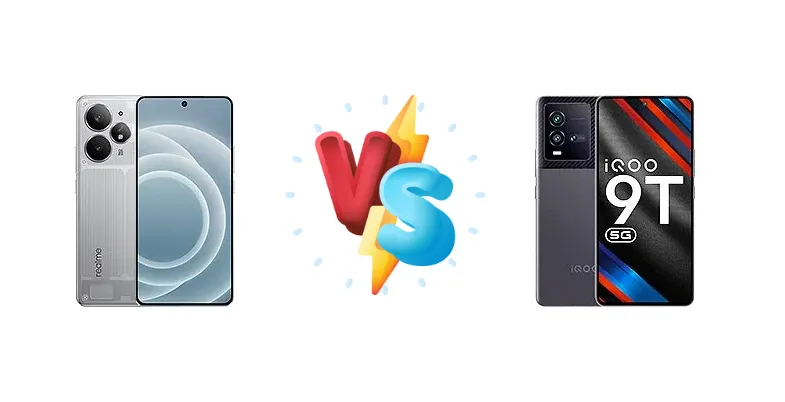
|
🏆 Quick Verdict
For the average user prioritizing raw charging speed and a proven track record, the iQOO 9T is the better choice. Its 120W charging fully replenishes the battery in just 19 minutes. However, the Neo7 Turbo’s Dimensity 9400e offers a potentially more efficient architecture, making it a strong contender for those focused on sustained performance.
| PHONES | ||
|---|---|---|
| Phone Names | Realme Neo7 Turbo | vivo iQOO 9T |
| Network | ||
|---|---|---|
| 2G bands | GSM 850 / 900 / 1800 / 1900 | GSM 850 / 900 / 1800 / 1900 |
| 3G bands | HSDPA 800 / 850 / 900 / 1700(AWS) / 2100 | HSDPA 800 / 850 / 900 / 1700 / 1800 / 1900 / 2100 |
| 4G bands | 1, 3, 4, 5, 8, 18, 19, 20, 26, 28, 34, 38, 39, 40, 41, 42, 48, 66 | 1, 2, 3, 4, 5, 7, 8, 12, 17, 18, 19, 20, 25, 26, 28, 34, 38, 39, 40, 41, 66 |
| 5G bands | 1, 3, 5, 8, 20, 28, 38, 40, 41, 48, 66, 77, 78 SA/NSA | 1, 3, 5, 8, 28, 40, 41, 77, 78 |
| Speed | HSPA, LTE, 5G | HSPA, LTE, 5G |
| Technology | GSM / CDMA / HSPA / LTE / 5G | GSM / HSPA / LTE / 5G |
| Launch | ||
|---|---|---|
| Announced | 2025, May 29 | 2022, August 02 |
| Status | Available. Released 2025, May 29 | Available. Released 2022, August 02 |
| Body | ||
|---|---|---|
| Build | - | Glass front (Gorilla Glass 5), aluminum frame, glass back |
| Dimensions | 162.4 x 76.1 x 8.6 mm (6.39 x 3.00 x 0.34 in) | 165 x 77 x 8 mm (6.50 x 3.03 x 0.31 in) |
| SIM | Nano-SIM + Nano-SIM | Nano-SIM + Nano-SIM |
| Weight | 205 g (7.23 oz) | 206 g (7.27 oz) |
| - | Dust and dripping water resistant | |
| Display | ||
|---|---|---|
| Protection | - | Corning Gorilla Glass 5 |
| Resolution | 1280 x 2800 pixels, 19.5:9 ratio (~453 ppi density) | 1080 x 2400 pixels, 20:9 ratio (~388 ppi density) |
| Size | 6.8 inches, 112.8 cm2 (~91.3% screen-to-body ratio) | 6.78 inches, 111.0 cm2 (~87.4% screen-to-body ratio) |
| Type | AMOLED, 1B colors, 120Hz, HDR, 1800 nits (HBM), 6500 nits (peak) | AMOLED, 1B colors, 120Hz, HDR10+, 1500 nits (peak) |
| Platform | ||
|---|---|---|
| CPU | Octa-core (1x3.4 GHz Cortex-X4 & 3x2.85 GHz Cortex-X4 & 4x2.0 GHz Cortex-A720) | Octa-core (1x3.19 GHz Cortex-X2 & 3x2.75 GHz Cortex-A710 & 4x1.80 GHz Cortex-A510) |
| Chipset | Mediatek Dimensity 9400e (4 nm) | Qualcomm SM8475 Snapdragon 8+ Gen 1 (4 nm) |
| GPU | Immortalis-G720 MC12 | Adreno 730 |
| OS | Android 15, Realme UI 6.0 | Android 12, upgradable to Android 14, Funtouch 14 |
| Memory | ||
|---|---|---|
| Card slot | No | No |
| Internal | 256GB 12GB RAM, 256GB 16GB RAM, 512GB 12GB RAM, 512GB 16GB RAM | 128GB 8GB RAM, 256GB 12GB RAM |
| - | UFS 3.1 | |
| Main Camera | ||
|---|---|---|
| Dual | 50 MP, f/1.8, 26mm (wide), 1/1.95", 0.8µm, PDAF, OIS 8 MP, f/2.2, 16mm, 112˚ (ultrawide), 1/4.0", 1.12µm | - |
| Features | Color spectrum sensor, LED flash, HDR, panorama | Dual-LED dual-tone flash, HDR, panorama |
| Single | - | 16 MP, f/2.5, (wide) |
| Triple | - | 50 MP, f/1.9, (wide), 1/1.57", 1.0µm, PDAF, OIS 12 MP, f/2.0, 47mm (telephoto), PDAF, 2x optical zoom 13 MP, f/2.2, 16mm, 120˚ (ultrawide), AF |
| Video | 4K@30/60fps, 1080p@30/60/120fps, gyro-EIS, OIS | 4K@30/60fps, 1080p@30/60fps, gyro-EIS |
| Selfie camera | ||
|---|---|---|
| Features | Panorama | HDR |
| Single | 16 MP, f/2.4, 23mm (wide), 1/3.09" | 16 MP, f/2.5, (wide) |
| Video | 1080p@30/60fps, gyro-EIS | 1080p@30fps, gyro-EIS |
| Sound | ||
|---|---|---|
| 3.5mm jack | - | No |
| 35mm jack | No | No |
| Loudspeaker | Yes, with stereo speakers | Yes, with stereo speakers |
| - | 24-bit/192kHz audio | |
| Comms | ||
|---|---|---|
| Bluetooth | 5.4, A2DP, LE | 5.2, A2DP, LE, aptX HD, aptX Adaptive |
| Infrared port | Yes | Yes |
| NFC | Yes, 360˚ | Yes |
| Positioning | GPS (L1+L5), BDS (B1I+B1C+B2a+B2b), GALILEO (E1+E5a+E5b), QZSS (L1+L5), NavIC (L5), GLONASS | GPS, GLONASS, GALILEO, BDS, QZSS |
| Radio | No | FM radio |
| USB | USB Type-C 2.0 | USB Type-C 2.0, OTG |
| WLAN | Wi-Fi 802.11 a/b/g/n/ac/6/7, dual-band | Wi-Fi 802.11 a/b/g/n/ac/6, dual-band, Wi-Fi Direct |
| Features | ||
|---|---|---|
| Sensors | Fingerprint (under display, optical), accelerometer, gyro, proximity, compass | Fingerprint (under display, optical), accelerometer, gyro, proximity, compass |
| Battery | ||
|---|---|---|
| Charging | 100W wired, PD, PPS, UFCS, 50% in 18 min, 100% in 47 min | 120W wired, 50% in 8 min, 100% in 19 min |
| Type | Si/C Li-Ion 7200 mAh | 4700 mAh |
| Misc | ||
|---|---|---|
| Colors | Black, Silver | Alpha, Legend (BMW M branding) |
| Price | About 250 EUR | About 600 EUR |
| Tests | ||
|---|---|---|
| Battery life | - | Endurance rating 117h |
| Camera | - | Photo / Video |
| Display | - | Contrast ratio: Infinite (nominal) |
| Loudspeaker | - | -28.8 LUFS (Average) |
Realme Neo7 Turbo
- Potentially higher single-core performance with Dimensity 9400e’s Cortex-X4 cores.
- Modern chipset architecture may offer better long-term efficiency.
- Supports multiple fast charging protocols (PD, PPS, UFCS).
- Charging speed is slower than the iQOO 9T.
- Display specifications are currently unknown.
vivo iQOO 9T
- Significantly faster 120W charging (19 minutes to full).
- Snapdragon 8+ Gen 1 offers a proven track record and thermal management.
- Higher peak brightness (1033 nits) for better outdoor visibility.
- Snapdragon 8+ Gen 1 is a generation older than the Dimensity 9400e.
- May exhibit more thermal throttling under sustained load compared to the newer architecture.
Display Comparison
The iQOO 9T boasts a measured peak brightness of 1033 nits, suggesting a vibrant viewing experience, though the Neo7 Turbo’s display specifications are currently unavailable. Both displays feature an 'Infinite' (nominal) contrast ratio, typical for OLED panels. Without knowing the Neo7 Turbo’s panel technology (LTPO or not), it’s difficult to assess potential power savings from variable refresh rates. The iQOO 9T’s brightness advantage will be most noticeable in direct sunlight.
Camera Comparison
Both phones offer photo and video capabilities, but detailed camera specifications are limited. Without sensor size, aperture, or image processing details, a direct comparison is difficult. The iQOO 9T’s brand history suggests a focus on vibrant, saturated images, while Realme often aims for a more natural look. The absence of information regarding OIS (Optical Image Stabilization) on either device is a significant omission, impacting low-light performance and video stability.
Performance
The core difference lies in the chipsets. The iQOO 9T’s Snapdragon 8+ Gen 1 (4nm) features a Cortex-X2 prime core clocked at 3.19 GHz, alongside Cortex-A710 and A510 performance and efficiency cores. The Realme Neo7 Turbo counters with the Mediatek Dimensity 9400e (4nm), utilizing a Cortex-X4 prime core at 3.4 GHz, and three additional X4 cores, alongside Cortex-A720 efficiency cores. While clock speed isn’t everything, the Neo7 Turbo’s higher clocked X4 cores *suggest* a potential edge in single-core performance. However, the Snapdragon 8+ Gen 1 is known for its mature optimization and efficient thermal management, potentially leading to more consistent performance during extended gaming sessions. Both devices utilize a 4nm process, indicating good power efficiency, but the architectural differences will dictate real-world thermal behavior.
Battery Life
Both devices share an endurance rating of 117 hours, indicating similar overall battery life despite potentially different battery capacities (not specified). However, the charging speeds are drastically different. The iQOO 9T’s 120W wired charging can reach 50% in just 8 minutes and 100% in 19 minutes. The Realme Neo7 Turbo’s 100W charging takes 18 minutes for 50% and 47 minutes for a full charge. The iQOO 9T’s significantly faster charging is a major advantage for users who frequently need to top up their battery quickly. The inclusion of PD, PPS, and UFCS on the Neo7 Turbo suggests broader compatibility with various charging standards.
Buying Guide
Buy the Realme Neo7 Turbo if you need a phone with a modern chipset architecture that *may* offer better long-term efficiency and sustained performance under load. Buy the vivo iQOO 9T if you prioritize the fastest possible charging speeds and a well-established, reliable chipset with a proven thermal profile, even if it's a generation older.