
Realme Neo7 Turbo vs Samsung Galaxy S22+: A Detailed Comparison
| Phones Images | |||||
|---|---|---|---|---|---|
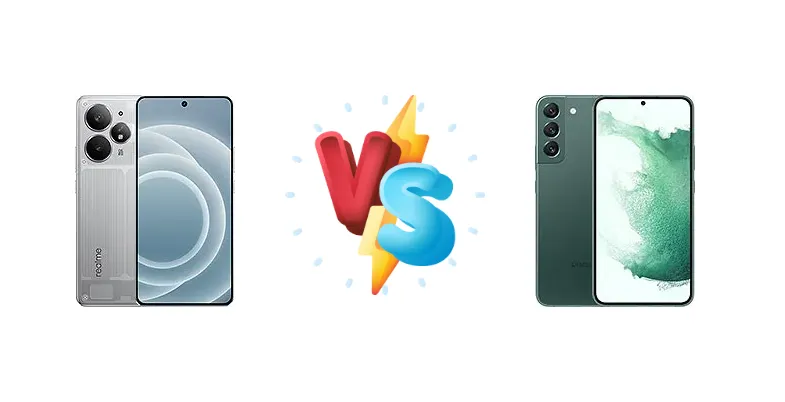
|
🏆 Quick Verdict
For most users prioritizing raw performance and rapid charging, the Realme Neo7 Turbo emerges as the winner. Its Mediatek Dimensity 9400e chipset offers a significant leap in CPU capabilities, and the 100W charging is dramatically faster than the S22+'s 45W. However, the S22+ retains an edge in display brightness and a more polished software experience.
| PHONES | ||
|---|---|---|
| Phone Names | Realme Neo7 Turbo | Samsung Galaxy S22+ 5G |
| Network | ||
|---|---|---|
| 2G bands | GSM 850 / 900 / 1800 / 1900 | GSM 850 / 900 / 1800 / 1900 |
| 3G bands | HSDPA 800 / 850 / 900 / 1700(AWS) / 2100 | HSDPA 850 / 900 / 1700(AWS) / 1900 / 2100 |
| 4G bands | 1, 3, 4, 5, 8, 18, 19, 20, 26, 28, 34, 38, 39, 40, 41, 42, 48, 66 | 1, 2, 3, 4, 5, 7, 8, 12, 13, 17, 18, 19, 20, 25, 26, 28, 32, 38, 39, 40, 41, 66 - International |
| 5G bands | 1, 3, 5, 8, 20, 28, 38, 40, 41, 48, 66, 77, 78 SA/NSA | 1, 2, 3, 5, 7, 8, 12, 20, 25, 28, 38, 40, 41, 66, 75, 77, 78 SA/NSA/Sub6 - International |
| Speed | HSPA, LTE, 5G | HSPA 42.2/5.76 Mbps, LTE (7CA) Cat20 2000/200 Mbps, 5G (5+ Gbps DL) |
| Technology | GSM / CDMA / HSPA / LTE / 5G | GSM / CDMA / HSPA / EVDO / LTE / 5G |
| - | 1, 3, 5, 7, 8, 20, 28, 38, 41, 66, 71, 260, 261 SA/NSA/Sub6/mmWave - USA | |
| Launch | ||
|---|---|---|
| Announced | 2025, May 29 | 2022, February 09 |
| Status | Available. Released 2025, May 29 | Available. Released 2022, February 25 |
| Body | ||
|---|---|---|
| Build | - | Glass front (Gorilla Glass Victus+), glass back (Gorilla Glass Victus+), aluminum frame |
| Dimensions | 162.4 x 76.1 x 8.6 mm (6.39 x 3.00 x 0.34 in) | 157.4 x 75.8 x 7.6 mm (6.20 x 2.98 x 0.30 in) |
| SIM | Nano-SIM + Nano-SIM | · Nano-SIM + eSIM· Nano-SIM + Nano-SIM + eSIM (max 2 at a time) |
| Weight | 205 g (7.23 oz) | 195 g / 196 g (mmWave) (6.88 oz) |
| - | IP68 dust/water resistant (up to 1.5m for 30 min) Armor aluminum frame with tougher drop and scratch resistance (advertised) | |
| Display | ||
|---|---|---|
| Protection | - | Corning Gorilla Glass Victus+ |
| Resolution | 1280 x 2800 pixels, 19.5:9 ratio (~453 ppi density) | 1080 x 2340 pixels, 19.5:9 ratio (~393 ppi density) |
| Size | 6.8 inches, 112.8 cm2 (~91.3% screen-to-body ratio) | 6.6 inches, 105.3 cm2 (~88.3% screen-to-body ratio) |
| Type | AMOLED, 1B colors, 120Hz, HDR, 1800 nits (HBM), 6500 nits (peak) | Dynamic AMOLED 2X, 120Hz, HDR10+, 1750 nits (peak) |
| - | Always-on display | |
| Platform | ||
|---|---|---|
| CPU | Octa-core (1x3.4 GHz Cortex-X4 & 3x2.85 GHz Cortex-X4 & 4x2.0 GHz Cortex-A720) | Octa-core (1x2.8 GHz Cortex-X2 & 3x2.50 GHz Cortex-A710 & 4x1.8 GHz Cortex-A510) - EuropeOcta-core (1x3.00 GHz Cortex-X2 & 3x2.50 GHz Cortex-A710 & 4x1.80 GHz Cortex-A510) - ROW |
| Chipset | Mediatek Dimensity 9400e (4 nm) | Exynos 2200 (4 nm) - EuropeQualcomm SM8450 Snapdragon 8 Gen 1 (4 nm) - ROW |
| GPU | Immortalis-G720 MC12 | Xclipse 920 - EuropeAdreno 730 - ROW |
| OS | Android 15, Realme UI 6.0 | Android 12, up to 4 major Android upgrades, One UI 6.1.1 |
| Memory | ||
|---|---|---|
| Card slot | No | No |
| Internal | 256GB 12GB RAM, 256GB 16GB RAM, 512GB 12GB RAM, 512GB 16GB RAM | 128GB 8GB RAM, 256GB 8GB RAM |
| - | UFS 3.1 | |
| Main Camera | ||
|---|---|---|
| Dual | 50 MP, f/1.8, 26mm (wide), 1/1.95", 0.8µm, PDAF, OIS 8 MP, f/2.2, 16mm, 112˚ (ultrawide), 1/4.0", 1.12µm | - |
| Features | Color spectrum sensor, LED flash, HDR, panorama | LED flash, auto-HDR, panorama |
| Triple | - | 50 MP, f/1.8, 23mm (wide), 1/1.56", 1.0µm, dual pixel PDAF, OIS 10 MP, f/2.4, 70mm (telephoto), 1/3.94", 1.0µm, PDAF, OIS, 3x optical zoom 12 MP, f/2.2, 13mm, 120˚ (ultrawide), 1/2.55" 1.4µm, Super Steady video |
| Video | 4K@30/60fps, 1080p@30/60/120fps, gyro-EIS, OIS | 8K@24fps, 4K@30/60fps, 1080p@30/60/120/240fps, HDR10+, stereo sound rec., gyro-EIS |
| Selfie camera | ||
|---|---|---|
| Features | Panorama | HDR |
| Single | 16 MP, f/2.4, 23mm (wide), 1/3.09" | 10 MP, f/2.2, 26mm (wide), 1/3.24", 1.22µm, dual pixel PDAF |
| Video | 1080p@30/60fps, gyro-EIS | 4K@30/60fps, 1080p@30fps |
| Sound | ||
|---|---|---|
| 3.5mm jack | - | No |
| 35mm jack | No | No |
| Loudspeaker | Yes, with stereo speakers | Yes, with stereo speakers |
| - | 32-bit/384kHz audio Tuned by AKG | |
| Comms | ||
|---|---|---|
| Bluetooth | 5.4, A2DP, LE | 5.2, A2DP, LE |
| Infrared port | Yes | - |
| NFC | Yes, 360˚ | Yes |
| Positioning | GPS (L1+L5), BDS (B1I+B1C+B2a+B2b), GALILEO (E1+E5a+E5b), QZSS (L1+L5), NavIC (L5), GLONASS | GPS, GLONASS, BDS, GALILEO |
| Radio | No | No |
| USB | USB Type-C 2.0 | USB Type-C 3.2, OTG |
| WLAN | Wi-Fi 802.11 a/b/g/n/ac/6/7, dual-band | Wi-Fi 802.11 a/b/g/n/ac/6e, dual-band, Wi-Fi Direct |
| Features | ||
|---|---|---|
| Sensors | Fingerprint (under display, optical), accelerometer, gyro, proximity, compass | Fingerprint (under display, ultrasonic), accelerometer, gyro, proximity, compass, barometer |
| - | Samsung DeX, Samsung Wireless DeX (desktop experience support) Bixby natural language commands and dictation Samsung Pay (Visa, MasterCard certified) Ultra Wideband (UWB) support | |
| Battery | ||
|---|---|---|
| Charging | 100W wired, PD, PPS, UFCS, 50% in 18 min, 100% in 47 min | 45W wired, PD3.0 15W wireless (Qi) 4.5W reverse wireless |
| Type | Si/C Li-Ion 7200 mAh | Li-Ion 4500 mAh |
| Misc | ||
|---|---|---|
| Colors | Black, Silver | Phantom Black, White, Pink Gold, Green, Graphite, Sky Blue, Violet, Cream, Bora Purple |
| Models | - | SM-S906B, SM-S906B/DS, SM-S906U, SM-S906U1, SM-S906W, SM-S906N, SM-S9060, SM-S906E, SM-S906E/DS, SM-S906L |
| Price | About 250 EUR | € 236.99 / $ 194.37 / £ 349.00 |
| SAR | - | 1.19 W/kg (head) 1.08 W/kg (body) |
| SAR EU | - | 0.57 W/kg (head) 1.40 W/kg (body) |
| Tests | ||
|---|---|---|
| Battery life | - | Endurance rating 97h |
| Camera | - | Photo / Video |
| Display | - | Contrast ratio: Infinite (nominal) |
| Loudspeaker | - | -26.0 LUFS (Very good) |
| Performance | - | AnTuTu: 722495 (v8), 886916 (v9) GeekBench: 3528 (v5.1) GFXBench: 68fps (ES 3.1 onscreen) |
Realme Neo7 Turbo
- Significantly faster 100W charging
- Potentially superior CPU performance with Dimensity 9400e
- Likely more aggressive pricing
- Missing wireless charging
- Camera system details are limited
- Software support may be shorter than Samsung
Samsung Galaxy S22+ 5G
- Brighter and more color-accurate display
- Mature software experience with longer update commitment
- Wireless and reverse wireless charging
- Slower 45W charging
- Exynos 2200/Snapdragon 8 Gen 1 can throttle under load
- Higher price point
Display Comparison
The Samsung Galaxy S22+ boasts a peak brightness of 1214 nits, a figure the Neo7 Turbo’s display specifications don’t directly address. This suggests a superior outdoor visibility experience on the S22+. While the Neo7 Turbo’s panel technology isn’t specified, the S22+’s ‘Infinite’ contrast ratio indicates a high-quality AMOLED panel. The S22+ likely benefits from Samsung’s extensive display calibration expertise, offering potentially more accurate colors. The absence of refresh rate information for the Neo7 Turbo is a notable omission, while the S22+ is expected to have a 120Hz adaptive refresh rate.
Camera Comparison
Both devices feature capable camera systems, but detailed sensor information is limited. The S22+’s camera is known for its versatile performance, excelling in both photo and video capture. The Neo7 Turbo’s camera capabilities are less well-defined, and the inclusion of a 2MP macro lens suggests a focus on quantity over quality. Without specific sensor size and aperture details for the Neo7 Turbo, it’s difficult to assess its low-light performance relative to the S22+. Samsung’s image processing algorithms are generally well-regarded, offering consistent results and a wide dynamic range.
Performance
The Realme Neo7 Turbo’s Mediatek Dimensity 9400e, built on a 4nm process, features a unique CPU configuration with a Cortex-X4 prime core clocked at 3.4GHz, alongside three more Cortex-X4 cores at 2.85GHz. This contrasts with the Galaxy S22+'s Exynos 2200 (Europe) or Snapdragon 8 Gen 1 (ROW), both also 4nm chips, but utilizing a Cortex-X2 prime core. The Neo7 Turbo’s architecture suggests a stronger focus on multi-core performance, potentially excelling in heavily threaded workloads. The Snapdragon 8 Gen 1, while powerful, is known to throttle under sustained load, a potential weakness the Dimensity 9400e might avoid due to its core configuration and newer architecture. The Neo7 Turbo’s LPDDR5x RAM is expected to provide faster memory bandwidth than the S22+'s LPDDR5, further boosting performance.
Battery Life
The Galaxy S22+ achieved an endurance rating of 97 hours, indicating solid battery life despite its age. The Neo7 Turbo’s battery capacity is not specified, but its 100W wired charging is a game-changer. Achieving 50% charge in 18 minutes and 100% in 47 minutes significantly reduces downtime compared to the S22+'s 45W charging. While the S22+ offers 15W wireless and 4.5W reverse wireless charging, the Neo7 Turbo lacks these features. The faster charging speed of the Neo7 Turbo effectively mitigates any potential disadvantage from a smaller battery capacity.
Buying Guide
Buy the Realme Neo7 Turbo if you need uncompromising CPU performance for demanding tasks like gaming or video editing, and value incredibly fast charging. You’ll benefit from a newer chipset and a more aggressive price point. Buy the Samsung Galaxy S22+ 5G if you prioritize a brighter, more color-accurate display, a more mature software experience with longer guaranteed updates, and the convenience of wireless charging and a well-established brand reputation.