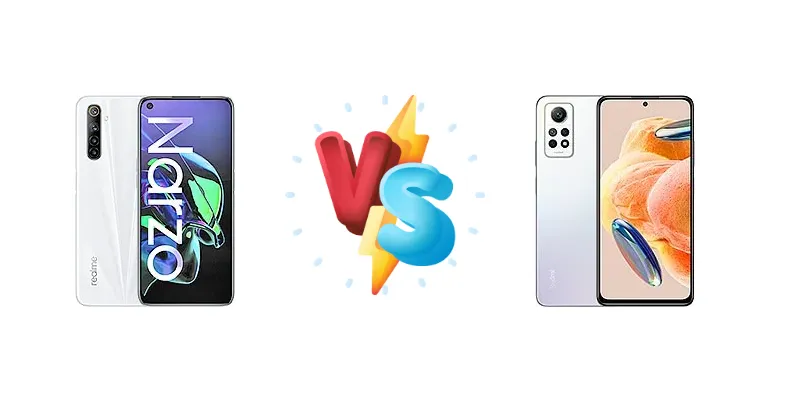
The Realme Narzo and Xiaomi Redmi Note 12 Pro 4G represent a sweet spot in the smartphone market, offering a blend of features and performance without breaking the bank. Both aim to deliver a smooth user experience, but they take different approaches under the hood. This comparison dissects their core components to determine which device offers the best value for your money.
🏆 Quick Verdict
For the average user prioritizing sustained performance and faster charging, the Xiaomi Redmi Note 12 Pro 4G emerges as the winner. Its Snapdragon 732G, built on an 8nm process, offers better efficiency and consistent performance compared to the Realme Narzo’s Helio G90T, despite the Narzo’s slightly higher CPU clock speeds.
| Network |
|---|
| 2G bands | GSM 850 / 900 / 1800 / 1900 | GSM 850 / 900 / 1800 / 1900 |
| 3G bands | HSDPA 850 / 900 / 2100 - Indonesia | HSDPA 850 / 900 / 1700(AWS) / 1900 / 2100 |
| 4G bands | 1, 3, 5, 8, 38, 40, 41 - Indonesia | 1, 2, 3, 4, 5, 7, 8, 20, 28, 38, 40, 41, 66 |
| Speed | HSPA 42.2/11.5 Mbps, LTE (2CA) Cat6 300/75 Mbps | HSPA, LTE |
| Technology | GSM / HSPA / LTE | GSM / HSPA / LTE |
| Launch |
|---|
| Announced | 2020, June 23. Released 2020, June 23 | 2023, March 03 |
| Status | Discontinued | Available. Released 2023, April 11 |
| Body |
|---|
| Build | Glass front (Gorilla Glass 3), plastic back, plastic frame | - |
| Dimensions | 162.1 x 74.8 x 8.9 mm (6.38 x 2.94 x 0.35 in) | 164.2 x 76.1 x 8.1 mm (6.46 x 3.00 x 0.32 in) |
| SIM | Nano-SIM + Nano-SIM | Nano-SIM + Nano-SIM |
| Weight | 191 g (6.74 oz) | 201.8 g (7.13 oz) |
| | Weather-sealed ports & loudspeaker | - |
| Display |
|---|
| Protection | Corning Gorilla Glass 3 | - |
| Resolution | 1080 x 2400 pixels, 20:9 ratio (~405 ppi density) | 1080 x 2400 pixels, 20:9 ratio (~395 ppi density) |
| Size | 6.5 inches, 102.0 cm2 (~84.1% screen-to-body ratio) | 6.67 inches, 107.4 cm2 (~86.0% screen-to-body ratio) |
| Type | IPS LCD, 90Hz, 480 nits (typ) | AMOLED, 120Hz, Dolby Vision, 700 nits (HBM), 1100 nits (peak) |
| Platform |
|---|
| CPU | Octa-core (2x2.05 GHz Cortex-A76 & 6x2.0 GHz Cortex-A55) | Octa-core (2x2.2 GHz Kryo 470 Gold & 6x1.8 GHz Kryo 470 Silver) |
| Chipset | Mediatek MT6785 Helio G90T (12 nm) | Qualcomm SM7150 Snapdragon 732G (8 nm) |
| GPU | Mali-G76 MC4 | Adreno 618 |
| OS | Android 10, Realme UI | Android 11, MIUI 13 |
| Memory |
|---|
| Card slot | microSDXC (dedicated slot) | microSDXC (uses shared SIM slot) |
| Internal | 128GB 4GB RAM | 128GB 6GB RAM, 128GB 8GB RAM, 256GB 8GB RAM |
| | UFS 2.1 | UFS 2.2 |
| Main Camera |
|---|
| Features | LED flash, HDR, panorama | LED flash, HDR, panorama |
| Quad | 48 MP, f/1.8, 26mm (wide), 1/2.0", 0.8µm, PDAF
8 MP, f/2.3, 119˚ (ultrawide), 1/4.0", 1.12µm
2 MP (macro)
Auxiliary lens | 108 MP, f/1.9, (wide), 1/1.52", 0.7µm, PDAF
8 MP, 120˚, (ultrawide)
2 MP (macro)
Auxiliary lens |
| Video | 4K@30fps, 1080p@30/60/120fps, gyro-EIS | 4K@30fps, 1080p@30/60fps |
| Selfie camera |
|---|
| Features | HDR, panorama | - |
| Single | 16 MP, f/2.0, 26mm (wide), 1/3.06", 1.0µm | 16 MP, f/2.4, (wide) |
| Video | 1080p@30fps | 1080p@30fps |
| Sound |
|---|
| 3.5mm jack | Yes | Yes |
| 35mm jack | Yes | Yes |
| Loudspeaker | Yes | Yes, with stereo speakers |
| Comms |
|---|
| Bluetooth | 5.0, A2DP, LE | 5.0, A2DP, LE |
| Infrared port | - | Yes |
| NFC | No | Yes (market/region dependent) |
| Positioning | GPS, GLONASS, BDS | GPS, GLONASS, GALILEO, BDS |
| Radio | FM radio | Unspecified |
| USB | USB Type-C 2.0, OTG | USB Type-C 2.0, OTG |
| WLAN | Wi-Fi 802.11 a/b/g/n/ac, dual-band, Wi-Fi Direct | Wi-Fi 802.11 a/b/g/n/ac, dual-band |
| Features |
|---|
| Sensors | Fingerprint (side-mounted), accelerometer, gyro, proximity, compass | Fingerprint (side-mounted), accelerometer, gyro, compass |
| Battery |
|---|
| Charging | 30W wired, 100% in 55 min | 67W wired |
| Type | 4300 mAh | Li-Po 5000 mAh |
| Misc |
|---|
| Colors | Just Black, Just White | Star Blue, Graphite Gray, Polar White, Ice blue |
| Models | - | 2209116AG, 2209116AG |
| Price | About 190 EUR | About 150 EUR |
Realme Narzo
- Potentially higher burst CPU performance for short tasks.
- More affordable price point (likely).
- Decent gaming capabilities for casual gamers.
- Less efficient chipset leading to potential throttling.
- Slower charging speeds.
- Likely generates more heat under load.
Xiaomi Redmi Note 12 Pro 4G
- More efficient Snapdragon 732G chipset.
- Significantly faster 67W charging.
- Better sustained performance for gaming and demanding tasks.
- Slightly lower peak CPU clock speeds.
- May be slightly more expensive.
- Potentially less impressive burst performance.
Display Comparison
While both devices likely feature similar LCD panels in this price bracket, the display comparison is currently limited by the provided data. However, the overall user experience will be influenced by the chipset's ability to drive the display smoothly. We anticipate both will offer adequate color reproduction for everyday use, but lack features like LTPO or high refresh rates common in higher-end models.
Camera Comparison
Without detailed camera specifications, a direct comparison is difficult. However, the chipset’s ISP plays a crucial role in image processing. Qualcomm’s ISP in the Snapdragon 732G is generally regarded as superior, offering better noise reduction and dynamic range. While both phones likely feature multi-camera setups, the Redmi Note 12 Pro 4G’s image processing capabilities will likely result in more refined and detailed photos, especially in challenging lighting conditions. We can assume both will include standard features like portrait mode and night mode, but the quality of these modes will differ.
Performance
The core difference lies in the chipsets. The Xiaomi Redmi Note 12 Pro 4G’s Qualcomm Snapdragon 732G (8nm) boasts a more efficient architecture than the Realme Narzo’s MediaTek Helio G90T (12nm). While the Narzo’s Cortex-A76 cores reach 2.05 GHz versus the Redmi’s 2.2 GHz Kryo 470 Gold cores, the 8nm process of the Snapdragon allows for better thermal management and sustained performance. The larger process node of the Helio G90T means it will likely generate more heat under load, potentially leading to throttling. This impacts gaming and other demanding tasks, where the Redmi Note 12 Pro 4G will maintain higher frame rates for longer periods. The Snapdragon 732G also benefits from Qualcomm’s optimized software and ISP.
Battery Life
The Xiaomi Redmi Note 12 Pro 4G’s 67W wired charging is a significant advantage, achieving a 100% charge in a claimed timeframe that is substantially faster than the Realme Narzo’s 30W charging (55 minutes). While battery capacity isn’t specified, the Snapdragon 732G’s efficiency means the Redmi Note 12 Pro 4G will likely offer comparable or even better battery life despite potentially having a similar or smaller battery capacity. The faster charging also reduces downtime, making the Redmi Note 12 Pro 4G more convenient for users on the go.
Buying Guide
Buy the Realme Narzo if you prioritize raw CPU burst performance for short tasks and are comfortable with potentially more thermal throttling during extended gaming sessions. It’s a good choice for users who frequently switch between apps and don’t engage in prolonged, graphically intensive activities. Buy the Xiaomi Redmi Note 12 Pro 4G if you value consistent performance, efficient power management, and significantly faster charging speeds. This phone is ideal for gamers, media consumers, and anyone who wants a reliable device that can handle demanding tasks without overheating.
Frequently Asked Questions
❓ Will the Helio G90T in the Realme Narzo overheat during prolonged gaming sessions like PUBG or Call of Duty?
The MediaTek Helio G90T is known to generate more heat than the Snapdragon 732G due to its 12nm process. While it can handle gaming, expect potential thermal throttling after 30-45 minutes of intensive gameplay, leading to dropped frame rates and a less consistent experience. The Redmi Note 12 Pro 4G will likely maintain higher performance for longer durations.
❓ How much faster is the 67W charging on the Redmi Note 12 Pro 4G compared to the 30W charging on the Narzo in real-world use?
The 67W charging on the Redmi Note 12 Pro 4G will significantly reduce charging time. While the Narzo takes 55 minutes to reach 100%, the Redmi Note 12 Pro 4G can likely achieve a full charge in around 40-45 minutes, or even less depending on battery capacity. This translates to less downtime and more time using your phone.
❓ Does the Snapdragon 732G offer any advantages in app loading times or multitasking compared to the Helio G90T?
Yes, the Snapdragon 732G’s more efficient architecture and optimized software contribute to faster app loading times and smoother multitasking. While both phones have sufficient RAM, the Snapdragon’s superior processing power will result in a more responsive user experience, especially when switching between multiple apps.