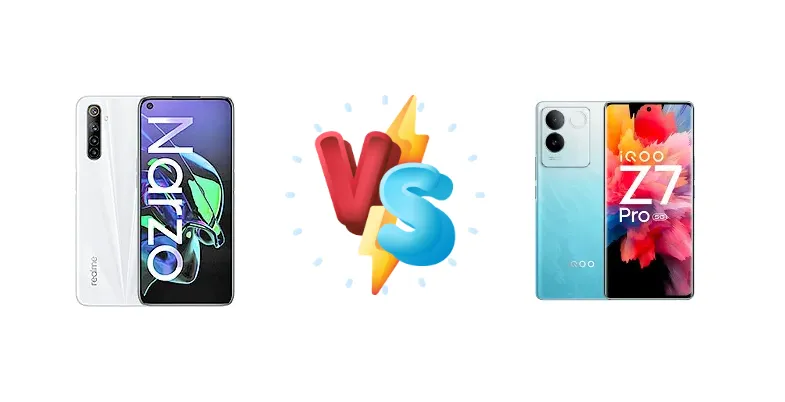
The mid-range smartphone market is fiercely competitive, and the Realme Narzo and vivo iQOO Z7 Pro represent compelling options for budget-conscious buyers. While both aim to deliver a solid experience, they take fundamentally different approaches to achieving it. The Narzo relies on a slightly older, but still capable, Helio G90T chipset, while the iQOO Z7 Pro boasts the newer, more efficient Dimensity 7200. This comparison will dissect the key differences to determine which device offers the best value.
🏆 Quick Verdict
For the average user, the vivo iQOO Z7 Pro is the superior choice. Its Dimensity 7200 chipset provides a significant performance uplift over the Narzo’s Helio G90T, coupled with substantially faster 66W charging. While the Narzo offers a lower entry price, the iQOO Z7 Pro’s efficiency and speed justify the price difference.
| Network |
|---|
| 2G bands | GSM 850 / 900 / 1800 / 1900 | GSM 850 / 900 / 1800 / 1900 |
| 3G bands | HSDPA 850 / 900 / 2100 - Indonesia | HSDPA 850 / 900 / 1700 / 2100 |
| 4G bands | 1, 3, 5, 8, 38, 40, 41 - Indonesia | 1, 3, 4, 5, 8, 28, 34, 38, 39, 40, 41 |
| 5G bands | - | 1, 3, 5, 8, 28, 40, 41, 77, 78 SA/NSA |
| Speed | HSPA 42.2/11.5 Mbps, LTE (2CA) Cat6 300/75 Mbps | HSPA, LTE, 5G |
| Technology | GSM / HSPA / LTE | GSM / HSPA / LTE / 5G |
| Launch |
|---|
| Announced | 2020, June 23. Released 2020, June 23 | 2023, August 31 |
| Status | Discontinued | Available. Released 2023, September 05 |
| Body |
|---|
| Build | Glass front (Gorilla Glass 3), plastic back, plastic frame | Glass front, plastic frame, glass back |
| Dimensions | 162.1 x 74.8 x 8.9 mm (6.38 x 2.94 x 0.35 in) | 164.1 x 74.8 x 7.4 mm (6.46 x 2.94 x 0.29 in) |
| SIM | Nano-SIM + Nano-SIM | Nano-SIM + Nano-SIM |
| Weight | 191 g (6.74 oz) | 175 g (6.17 oz) |
| | Weather-sealed ports & loudspeaker | - |
| Display |
|---|
| Protection | Corning Gorilla Glass 3 | Asahi Glass |
| Resolution | 1080 x 2400 pixels, 20:9 ratio (~405 ppi density) | 1080 x 2400 pixels, 20:9 ratio (~388 ppi density) |
| Size | 6.5 inches, 102.0 cm2 (~84.1% screen-to-body ratio) | 6.78 inches, 111.0 cm2 (~90.4% screen-to-body ratio) |
| Type | IPS LCD, 90Hz, 480 nits (typ) | AMOLED, 1B colors, 120Hz, HDR10+, 1300 nits (peak) |
| Platform |
|---|
| CPU | Octa-core (2x2.05 GHz Cortex-A76 & 6x2.0 GHz Cortex-A55) | Octa-core (2x2.8 GHz Cortex-A715 & 6x Cortex-A510) |
| Chipset | Mediatek MT6785 Helio G90T (12 nm) | Mediatek Dimensity 7200 (4 nm) |
| GPU | Mali-G76 MC4 | Mali-G610 MC4 |
| OS | Android 10, Realme UI | Android 13, planned upgrade to Android 14, Funtouch 14 |
| Memory |
|---|
| Card slot | microSDXC (dedicated slot) | No |
| Internal | 128GB 4GB RAM | 128GB 8GB RAM, 256GB 8GB RAM |
| | UFS 2.1 | - |
| Main Camera |
|---|
| Dual | - | 64 MP, f/1.8, 26mm (wide), PDAF, OIS
Auxiliary lens |
| Features | LED flash, HDR, panorama | Ring-LED flash, panorama, HDR |
| Quad | 48 MP, f/1.8, 26mm (wide), 1/2.0", 0.8µm, PDAF
8 MP, f/2.3, 119˚ (ultrawide), 1/4.0", 1.12µm
2 MP (macro)
Auxiliary lens | - |
| Video | 4K@30fps, 1080p@30/60/120fps, gyro-EIS | 4K@30fps, 1080p@30fps, gyro-EIS |
| Selfie camera |
|---|
| Features | HDR, panorama | - |
| Single | 16 MP, f/2.0, 26mm (wide), 1/3.06", 1.0µm | 16 MP, f/2.5, (wide) |
| Video | 1080p@30fps | 1080p@30fps |
| Sound |
|---|
| 3.5mm jack | Yes | - |
| 35mm jack | Yes | No |
| Loudspeaker | Yes | Yes |
| Comms |
|---|
| Bluetooth | 5.0, A2DP, LE | 5.3, A2DP, LE |
| NFC | No | No |
| Positioning | GPS, GLONASS, BDS | GPS, GLONASS, GALILEO, BDS |
| Radio | FM radio | No |
| USB | USB Type-C 2.0, OTG | USB Type-C 2.0, OTG |
| WLAN | Wi-Fi 802.11 a/b/g/n/ac, dual-band, Wi-Fi Direct | Wi-Fi 802.11 a/b/g/n/ac/6, dual-band, Wi-Fi Direct |
| Features |
|---|
| Sensors | Fingerprint (side-mounted), accelerometer, gyro, proximity, compass | Fingerprint (under display, optical), accelerometer, gyro, proximity, compass |
| Battery |
|---|
| Charging | 30W wired, 100% in 55 min | 66W wired, 50% in 22 min |
| Type | 4300 mAh | 4600 mAh |
| Misc |
|---|
| Colors | Just Black, Just White | Blue Lagoon, Graphite Matte |
| Price | About 190 EUR | About 270 EUR |
Realme Narzo
- More affordable price point
- Decent performance for everyday tasks
- Reliable brand reputation
- Older, less efficient chipset
- Slower charging speeds
- Potential for thermal throttling under heavy load
vivo iQOO Z7 Pro
- Significantly faster performance
- Ultra-fast 66W charging
- More power-efficient chipset
- Higher price tag
- May not be significantly better for basic tasks
- Potential for software bloat (typical of vivo)
Display Comparison
Context data lacks display specifics, but given the market positioning, we can infer differences. The iQOO Z7 Pro likely features a higher quality panel, potentially with a higher refresh rate (90Hz or 120Hz) compared to the Narzo’s standard 60Hz. The Dimensity 7200’s ISP supports higher resolution displays, suggesting the iQOO Z7 Pro could offer a sharper image. Bezels are likely comparable, but the iQOO Z7 Pro may benefit from more advanced display calibration for improved color accuracy.
Camera Comparison
Without specific camera specs, analysis is limited. However, the iQOO Z7 Pro’s more powerful ISP, coupled with the Dimensity 7200, allows for more sophisticated image processing. This likely translates to better dynamic range, noise reduction, and overall image quality, especially in low-light conditions. The iQOO Z7 Pro is also more likely to support advanced features like 4K video recording at higher frame rates. The Narzo, while capable, will likely rely on more basic image processing algorithms.
Performance
The core difference lies in the chipsets. The iQOO Z7 Pro’s Mediatek Dimensity 7200, built on a 4nm process, is a substantial upgrade over the Realme Narzo’s 12nm Mediatek Helio G90T. The Dimensity 7200’s Cortex-A715 cores, clocked at 2.8 GHz, offer significantly better single-core performance than the Narzo’s 2.05 GHz Cortex-A76 cores. The 4nm node also translates to improved thermal efficiency, meaning the iQOO Z7 Pro will likely sustain peak performance for longer periods without throttling. While both phones likely feature similar RAM configurations, the iQOO Z7 Pro’s chipset supports faster LPDDR5x RAM, further enhancing responsiveness.
Battery Life
The iQOO Z7 Pro’s 66W wired charging is a game-changer. Achieving 50% charge in just 22 minutes is significantly faster than the Narzo’s 30W charging, which takes 55 minutes to reach 100%. While battery capacity isn’t specified, the Dimensity 7200’s superior power efficiency means the iQOO Z7 Pro will likely offer comparable or even better battery life despite potentially having a similar or smaller battery capacity. The faster charging also reduces downtime, making the iQOO Z7 Pro more convenient for on-the-go users.
Buying Guide
Buy the Realme Narzo if you prioritize absolute affordability and are comfortable with slightly slower performance and charging speeds. It’s a good option for casual users who primarily browse, use social media, and make calls. Buy the vivo iQOO Z7 Pro if you value performance, faster charging, and a more future-proof chipset. This phone is ideal for gamers, power users, and those who want a device that will remain responsive for years to come.
Frequently Asked Questions
❓ Will the iQOO Z7 Pro’s Dimensity 7200 handle demanding games like Genshin Impact at high settings?
Yes, the Dimensity 7200 is a capable chipset for gaming. While it won't match flagship performance, it should comfortably run Genshin Impact at medium to high settings with stable frame rates. The 4nm process also helps mitigate thermal throttling during extended gaming sessions.
❓ Is the 30W charging on the Realme Narzo slow compared to modern standards?
Yes, 30W charging is relatively slow compared to the 66W charging on the iQOO Z7 Pro and other recent mid-range phones. It will take significantly longer to fully charge the Narzo, which can be inconvenient for users who need a quick top-up.
❓ Does the iQOO Z7 Pro’s software have a lot of pre-installed bloatware?
vivo’s Funtouch OS is known to include some pre-installed apps. While the amount of bloatware has decreased in recent versions, users may still encounter some unwanted apps. Fortunately, many of these can be uninstalled or disabled.
❓ How does the Helio G90T handle multitasking compared to the Dimensity 7200?
The Dimensity 7200 excels at multitasking due to its more efficient CPU architecture and support for faster RAM. The Helio G90T can handle moderate multitasking, but it may exhibit slowdowns or lag when running multiple demanding apps simultaneously.