
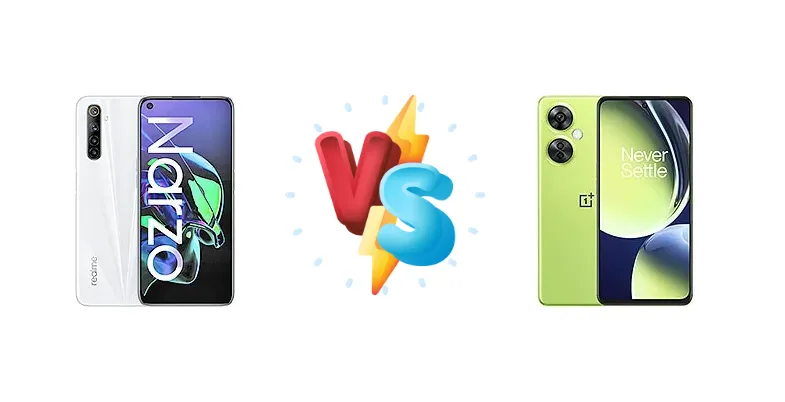
Realme Narzo vs. OnePlus Nord CE 3 Lite: A Deep Dive into Budget 5G Contenders
| Phones Images | |||||
|---|---|---|---|---|---|
|
🏆 Quick Verdict
For the average user prioritizing fast charging and efficient 5G connectivity, the OnePlus Nord CE 3 Lite emerges as the winner. Its Snapdragon 695, built on a 6nm process, offers a more balanced experience, and the 67W SuperVOOC charging is significantly faster than the Narzo's 30W. However, gamers might find the Narzo's Helio G90T slightly more appealing.
| PHONES | ||
|---|---|---|
| Phone Names | Realme Narzo | OnePlus Nord CE 3 Lite |
| Network | ||
|---|---|---|
| 2G bands | GSM 850 / 900 / 1800 / 1900 | GSM 850 / 900 / 1800 / 1900 |
| 3G bands | HSDPA 850 / 900 / 2100 - Indonesia | HSDPA 800 / 850 / 900 / 1700(AWS) / 1900 / 2100 - International |
| 4G bands | 1, 3, 5, 8, 38, 40, 41 - Indonesia | 1, 2, 3, 4, 5, 7, 8, 12, 13, 17, 18, 19, 20, 26, 28, 32, 38, 39, 40, 41, 66 - International |
| 5G bands | - | 1, 3, 5, 7, 8, 20, 28, 38, 40, 41, 66, 77, 78 SA/NSA - International |
| Speed | HSPA 42.2/11.5 Mbps, LTE (2CA) Cat6 300/75 Mbps | HSPA, LTE, 5G |
| Technology | GSM / HSPA / LTE | GSM / HSPA / LTE / 5G |
| - | 1, 3, 5, 8, 28, 40, 41, 77, 78 SA/NSA - India | |
| Launch | ||
|---|---|---|
| Announced | 2020, June 23. Released 2020, June 23 | 2023, April 04 |
| Status | Discontinued | Available. Released 2023, April 11 |
| Body | ||
|---|---|---|
| Build | Glass front (Gorilla Glass 3), plastic back, plastic frame | Glass front, plastic frame, plastic back |
| Dimensions | 162.1 x 74.8 x 8.9 mm (6.38 x 2.94 x 0.35 in) | 165.5 x 76 x 8.3 mm (6.52 x 2.99 x 0.33 in) |
| SIM | Nano-SIM + Nano-SIM | Nano-SIM + Nano-SIM |
| Weight | 191 g (6.74 oz) | 195 g (6.88 oz) |
| Weather-sealed ports & loudspeaker | - | |
| Display | ||
|---|---|---|
| Protection | Corning Gorilla Glass 3 | Corning Gorilla Glass |
| Resolution | 1080 x 2400 pixels, 20:9 ratio (~405 ppi density) | 1080 x 2400 pixels, 20:9 ratio (~391 ppi density) |
| Size | 6.5 inches, 102.0 cm2 (~84.1% screen-to-body ratio) | 6.72 inches, 109.6 cm2 (~87.1% screen-to-body ratio) |
| Type | IPS LCD, 90Hz, 480 nits (typ) | IPS LCD, 120Hz, 550 nits (typ), 680 nits (peak) |
| Platform | ||
|---|---|---|
| CPU | Octa-core (2x2.05 GHz Cortex-A76 & 6x2.0 GHz Cortex-A55) | Octa-core (2x2.2 GHz Kryo 660 Gold & 6x1.7 GHz Kryo 660 Silver) |
| Chipset | Mediatek MT6785 Helio G90T (12 nm) | Qualcomm SM6375 Snapdragon 695 5G (6 nm) |
| GPU | Mali-G76 MC4 | Adreno 619 |
| OS | Android 10, Realme UI | Android 13, OxygenOS 13.1 |
| Memory | ||
|---|---|---|
| Card slot | microSDXC (dedicated slot) | microSDXC (uses shared SIM slot) |
| Internal | 128GB 4GB RAM | 128GB 8GB RAM, 256GB 8GB RAM |
| UFS 2.1 | UFS 2.2 | |
| Main Camera | ||
|---|---|---|
| Features | LED flash, HDR, panorama | LED flash, HDR, panorama |
| Quad | 48 MP, f/1.8, 26mm (wide), 1/2.0", 0.8µm, PDAF 8 MP, f/2.3, 119˚ (ultrawide), 1/4.0", 1.12µm 2 MP (macro) Auxiliary lens | - |
| Triple | - | 108 MP, f/1.8, (wide), 1/1.67", 0.64µm, PDAF 2 MP (macro) Auxiliary lens |
| Video | 4K@30fps, 1080p@30/60/120fps, gyro-EIS | 1080p@30fps |
| Selfie camera | ||
|---|---|---|
| Features | HDR, panorama | HDR, panorama |
| Single | 16 MP, f/2.0, 26mm (wide), 1/3.06", 1.0µm | 16 MP, f/2.4, (wide), 1.0µm |
| Video | 1080p@30fps | 1080p@30fps |
| Sound | ||
|---|---|---|
| 3.5mm jack | Yes | Yes |
| 35mm jack | Yes | Yes |
| Loudspeaker | Yes | Yes, with stereo speakers |
| Comms | ||
|---|---|---|
| Bluetooth | 5.0, A2DP, LE | 5.1, A2DP, LE, aptX HD |
| NFC | No | Yes (market/region dependent) |
| Positioning | GPS, GLONASS, BDS | GPS, GALILEO, GLONASS, BDS, QZSS |
| Radio | FM radio | No |
| USB | USB Type-C 2.0, OTG | USB Type-C 2.0, OTG |
| WLAN | Wi-Fi 802.11 a/b/g/n/ac, dual-band, Wi-Fi Direct | Wi-Fi 802.11 a/b/g/n/ac, dual-band |
| Features | ||
|---|---|---|
| Sensors | Fingerprint (side-mounted), accelerometer, gyro, proximity, compass | Fingerprint (side-mounted), accelerometer, gyro, proximity, compass |
| Battery | ||
|---|---|---|
| Charging | 30W wired, 100% in 55 min | 67W wired, 80% in 30 min |
| Type | 4300 mAh | Li-Po 5000 mAh |
| Misc | ||
|---|---|---|
| Colors | Just Black, Just White | Pastel Lime, Chromatic Gray |
| Models | - | CPH2467, CPH2465 |
| Price | About 190 EUR | £ 169.98 / € 209.99 |
| SAR | - | 1.17 W/kg (head) 0.70 W/kg (body) |
| Tests | ||
|---|---|---|
| Performance | - | AnTuTu: 412006 (v9) GeekBench: 2052 (v5) GFXBench: 17fps (ES 3.1 onscreen) |
Realme Narzo
- Potentially higher peak CPU performance for short bursts.
- More affordable price point (likely).
- Dedicated gaming-focused chipset.
- Less efficient chipset leading to potential throttling.
- Slower charging speeds.
- Likely inferior image processing.
OnePlus Nord CE 3 Lite
- Faster and more efficient Snapdragon 695 chipset.
- Significantly faster 67W charging.
- Better 5G connectivity and efficiency.
- Potentially slightly lower peak CPU performance.
- May be slightly more expensive.
- No standout camera features.
Display Comparison
Neither device boasts a standout display. While specific panel details (like peak brightness or color gamut coverage) are absent, the focus here is on the underlying processors impacting the user experience *with* the display. Both likely utilize LCD panels given the price point. The more efficient Snapdragon 695 in the Nord CE 3 Lite may contribute to slightly better battery life when viewing content, but the difference will be marginal without detailed display specs.
Camera Comparison
Without detailed camera specs beyond the main sensors, a direct comparison is difficult. However, the image signal processor (ISP) within the Snapdragon 695 generally offers superior image processing capabilities compared to the ISP found in the Helio G90T. This translates to better dynamic range, noise reduction, and overall image quality, particularly in challenging lighting conditions. The absence of OIS on either device suggests a reliance on software stabilization, where the Snapdragon's ISP would again have an advantage. The 2MP macro cameras on both devices are likely present for marketing purposes and offer limited real-world utility.
Performance
The core difference lies in the chipsets. The Realme Narzo’s MediaTek Helio G90T (12nm) features a CPU with 2x2.05 GHz Cortex-A76 cores and 6x2.0 GHz Cortex-A55 cores. This configuration prioritizes peak CPU performance, potentially offering a slight edge in single-core tasks. However, the OnePlus Nord CE 3 Lite’s Qualcomm Snapdragon 695 5G (6nm) utilizes 2x2.2 GHz Kryo 660 Gold cores and 6x1.7 GHz Kryo 660 Silver cores. The 6nm process node is crucial; it translates to significantly improved power efficiency and thermal management. This means the Snapdragon 695 will likely sustain higher performance for longer periods without throttling, and deliver better battery life. While the Narzo might win in short bursts, the Nord CE 3 Lite offers a more consistent experience.
Battery Life
The OnePlus Nord CE 3 Lite’s 67W SuperVOOC charging is a game-changer. Achieving 80% charge in just 30 minutes is a significant advantage over the Realme Narzo’s 30W charging, which takes 55 minutes for a full charge. While battery capacity isn’t specified, the more efficient Snapdragon 695 in the Nord CE 3 Lite will likely offset any capacity difference, providing comparable or even better real-world battery life. The faster charging speed is a major convenience factor for users who are constantly on the go.
Buying Guide
Buy the Realme Narzo if you prioritize raw gaming performance on a tight budget and don't mind slightly slower charging speeds. Its Helio G90T chipset offers a performance edge in graphically demanding titles. Buy the OnePlus Nord CE 3 Lite if you value all-day battery life, faster 5G speeds, and significantly quicker charging. The Snapdragon 695 provides a more efficient and modern platform for everyday tasks and connectivity.