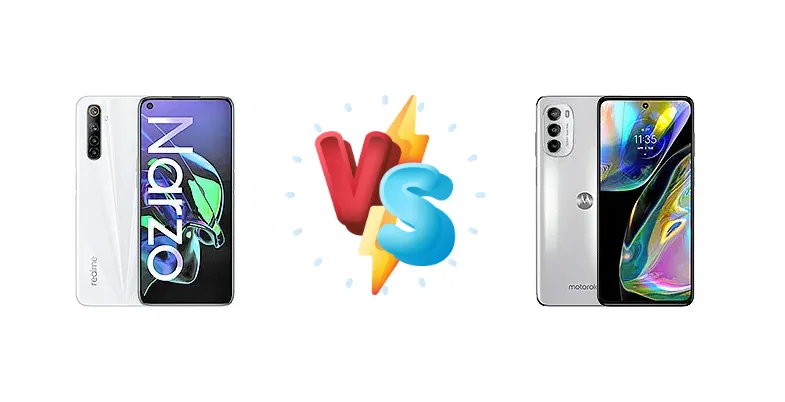
The Realme Narzo and Motorola Moto G82 occupy a similar price bracket, but cater to different priorities. The Narzo prioritizes raw processing power with its Helio G90T chipset, aiming for a smoother gaming experience. Conversely, the Moto G82 focuses on a balanced package with a more efficient Snapdragon 695, a brighter display, and a focus on all-day battery life. This comparison will dissect the key differences to help you choose the right phone for your needs.
🏆 Quick Verdict
For users prioritizing gaming and demanding tasks, the Realme Narzo offers a noticeable performance edge thanks to its Helio G90T. However, the Motorola Moto G82 is the better choice for everyday users who value battery life, a brighter display, and a more refined software experience. The Moto G82 wins for the average user.
| Network |
|---|
| 2G bands | GSM 850 / 900 / 1800 / 1900 | GSM 850 / 900 / 1800 / 1900 |
| 3G bands | HSDPA 850 / 900 / 2100 - Indonesia | HSDPA 850 / 900 / 1700(AWS) / 1900 / 2100 |
| 4G bands | 1, 3, 5, 8, 38, 40, 41 - Indonesia | 1, 2, 3, 4, 5, 7, 8, 12, 13, 17, 18, 19, 20, 26, 28, 32, 38, 39, 40, 41, 42, 43, 66 |
| 5G bands | - | 1, 2, 3, 5, 7, 8, 20, 28, 38, 40, 41, 66, 77, 78, 78 SA/NSA |
| Speed | HSPA 42.2/11.5 Mbps, LTE (2CA) Cat6 300/75 Mbps | HSPA, LTE, 5G |
| Technology | GSM / HSPA / LTE | GSM / HSPA / LTE / 5G |
| Launch |
|---|
| Announced | 2020, June 23. Released 2020, June 23 | 2022, May 12 |
| Status | Discontinued | Available. Released 2022, June 07 |
| Body |
|---|
| Build | Glass front (Gorilla Glass 3), plastic back, plastic frame | Glass front, plastic frame, plastic back |
| Dimensions | 162.1 x 74.8 x 8.9 mm (6.38 x 2.94 x 0.35 in) | 160.9 x 74.5 x 8 mm (6.33 x 2.93 x 0.31 in) |
| SIM | Nano-SIM + Nano-SIM | Nano-SIM + Nano-SIM |
| Weight | 191 g (6.74 oz) | 173 g (6.10 oz) |
| | Weather-sealed ports & loudspeaker | Water-repellent design |
| Display |
|---|
| Protection | Corning Gorilla Glass 3 | - |
| Resolution | 1080 x 2400 pixels, 20:9 ratio (~405 ppi density) | 1080 x 2400 pixels, 20:9 ratio (~402 ppi density) |
| Size | 6.5 inches, 102.0 cm2 (~84.1% screen-to-body ratio) | 6.6 inches, 103.6 cm2 (~86.4% screen-to-body ratio) |
| Type | IPS LCD, 90Hz, 480 nits (typ) | AMOLED, 120Hz |
| Platform |
|---|
| CPU | Octa-core (2x2.05 GHz Cortex-A76 & 6x2.0 GHz Cortex-A55) | Octa-core (2x2.2 GHz Kryo 660 Gold & 6x1.7 GHz Kryo 660 Silver) |
| Chipset | Mediatek MT6785 Helio G90T (12 nm) | Qualcomm SM6375 Snapdragon 695 5G (6 nm) |
| GPU | Mali-G76 MC4 | Adreno 619 |
| OS | Android 10, Realme UI | Android 12, upgradable to Android 13 |
| Memory |
|---|
| Card slot | microSDXC (dedicated slot) | microSDXC (uses shared SIM slot) |
| Internal | 128GB 4GB RAM | 128GB 6GB RAM, 128GB 8GB RAM |
| | UFS 2.1 | UFS |
| Main Camera |
|---|
| Features | LED flash, HDR, panorama | LED flash, HDR, panorama |
| Quad | 48 MP, f/1.8, 26mm (wide), 1/2.0", 0.8µm, PDAF
8 MP, f/2.3, 119˚ (ultrawide), 1/4.0", 1.12µm
2 MP (macro)
Auxiliary lens | - |
| Triple | - | 50 MP, f/1.8 (wide), 1/2.76", 0.64µm, PDAF, OIS
8 MP, f/2.2, 118˚ (ultrawide), 1/4.0", 1.12µm
2 MP (macro) |
| Video | 4K@30fps, 1080p@30/60/120fps, gyro-EIS | 1080p@30/60fps |
| Selfie camera |
|---|
| Features | HDR, panorama | - |
| Single | 16 MP, f/2.0, 26mm (wide), 1/3.06", 1.0µm | 16 MP, f/2.2, (wide), 1.0µm |
| Video | 1080p@30fps | 1080p@30fps |
| Sound |
|---|
| 3.5mm jack | Yes | Yes |
| 35mm jack | Yes | Yes |
| Loudspeaker | Yes | Yes, with stereo speakers |
| Comms |
|---|
| Bluetooth | 5.0, A2DP, LE | 5.1, A2DP, LE |
| NFC | No | Yes (market/region dependent) |
| Positioning | GPS, GLONASS, BDS | GPS, GLONASS, GALILEO |
| Radio | FM radio | FM radio (market/region dependent) |
| USB | USB Type-C 2.0, OTG | USB Type-C 2.0 |
| WLAN | Wi-Fi 802.11 a/b/g/n/ac, dual-band, Wi-Fi Direct | Wi-Fi 802.11 a/b/g/n/ac, dual-band, Wi-Fi Direct |
| Features |
|---|
| Sensors | Fingerprint (side-mounted), accelerometer, gyro, proximity, compass | Fingerprint (side-mounted), accelerometer, gyro, proximity, compass |
| Battery |
|---|
| Charging | 30W wired, 100% in 55 min | 30W wired |
| Type | 4300 mAh | Li-Po 5000 mAh |
| Misc |
|---|
| Colors | Just Black, Just White | Meteorite Gray, White Lily |
| Models | - | XT2225-1 |
| Price | About 190 EUR | About 290 EUR |
| Tests |
|---|
| Battery life | - |
Endurance rating 130h
|
| Camera | - |
Photo / Video |
| Display | - |
Contrast ratio: Infinite (nominal) |
| Loudspeaker | - |
-26.4 LUFS (Good)
|
| Performance | - |
AnTuTu: 380812 (v9)
GeekBench: 1977 (v5.1)
GFXBench: 16fps (ES 3.1 onscreen) |
Realme Narzo
- Stronger CPU performance for gaming
- Faster charging speed (potentially)
- Potentially lower price point
- Less power-efficient chipset
- Likely lower display brightness
- Limited information on camera capabilities
Motorola Moto G82
- Brighter display for outdoor visibility
- More power-efficient Snapdragon 695
- Potentially better sustained performance
- Lower peak CPU performance
- May be slightly more expensive
- Camera performance may be less emphasized
Display Comparison
The Motorola Moto G82 boasts a significantly brighter display, reaching a measured 690 nits, making it far more usable outdoors under direct sunlight. While the Narzo’s display specs aren’t provided, it’s unlikely to match this peak brightness. The Moto G82’s ‘Infinite’ contrast ratio (nominal) suggests a typical IPS panel, offering good color reproduction. The lack of information on the Narzo’s panel type makes a direct comparison difficult, but the G82’s brightness is a clear advantage for outdoor visibility.
Camera Comparison
Both devices offer photo and video capabilities, but detailed camera specs are limited. Without sensor size or aperture information, a direct comparison is challenging. However, the market segment suggests the Moto G82 likely prioritizes image processing for balanced, everyday photos, while the Narzo might lean towards more vibrant, saturated images. The absence of details on OIS (Optical Image Stabilization) on either device suggests reliance on software stabilization. The usefulness of any included 2MP macro lenses on either phone is questionable, offering limited practical benefit over the main sensor.
Performance
The Realme Narzo’s Mediatek Helio G90T (12nm) and the Motorola Moto G82’s Qualcomm Snapdragon 695 (6nm) represent different approaches to performance. The G90T, with its Cortex-A76 cores clocked at 2.05 GHz, delivers higher peak CPU performance, beneficial for gaming. However, the Snapdragon 695, built on a more efficient 6nm process, offers better power efficiency and sustained performance. The 6nm node translates to less heat generation under load, potentially reducing throttling during extended gaming sessions. While the G90T has a theoretical edge in raw power, the 695’s efficiency and thermal management are significant advantages.
Battery Life
Both the Realme Narzo and Motorola Moto G82 feature 30W wired charging, achieving a full charge in approximately 55 minutes. Both phones have an endurance rating of 130 hours, suggesting similar battery capacity and power consumption in typical usage scenarios. However, the Snapdragon 695’s superior power efficiency in the Moto G82 could translate to slightly longer real-world battery life, especially with moderate usage. The Narzo’s more power-hungry chipset might require more frequent charging with heavy use.
Buying Guide
Buy the Realme Narzo if you frequently play graphically intensive mobile games, need a phone for demanding applications, and are willing to compromise slightly on battery life for increased performance. Buy the Motorola Moto G82 if you prioritize all-day battery life, a vibrant and easily visible display, and a smooth, reliable experience for everyday tasks like browsing, social media, and casual photography.
Frequently Asked Questions
❓ Will the Helio G90T in the Realme Narzo overheat during prolonged gaming sessions?
The Helio G90T is known to generate more heat than the Snapdragon 695. While the Narzo likely has thermal management features, extended gaming at high settings could lead to noticeable throttling, reducing performance over time. The 6nm process of the Snapdragon 695 in the Moto G82 offers better thermal efficiency, minimizing this issue.
❓ Is the 6nm Snapdragon 695 in the Moto G82 powerful enough for demanding games like PUBG or Call of Duty Mobile?
Yes, the Snapdragon 695 is capable of running PUBG and Call of Duty Mobile at medium to high settings with stable frame rates. While it won't match the peak performance of the Helio G90T, its efficiency ensures smoother gameplay over longer periods without significant throttling. The Moto G82 prioritizes consistent performance over raw power.
❓ How does the display quality of the Moto G82 compare to other phones in this price range?
The Moto G82’s 690 nits peak brightness is excellent for its price range, surpassing many competitors. This makes it a standout choice for users who frequently use their phones outdoors. While color accuracy isn’t specified, the IPS panel generally provides good color reproduction for everyday use.