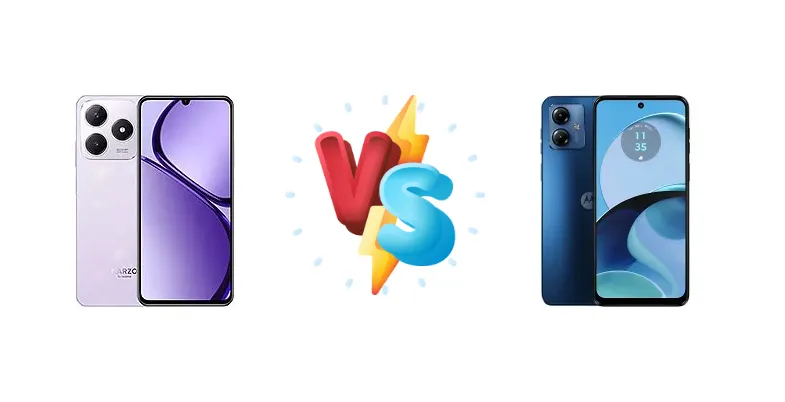
The sub-$150 smartphone market is fiercely competitive, and the Realme Narzo N63 and Motorola Moto G14 are two contenders vying for your attention. Both leverage Unisoc Tiger chipsets, but diverge significantly in charging speed and subtle CPU clock speed differences. This comparison dissects these nuances to determine which device delivers the best experience for the price.
🏆 Quick Verdict
For most users, the Realme Narzo N63 emerges as the stronger choice. Its 45W charging dramatically reduces downtime compared to the Moto G14’s 15W (or 20W in India) charging, a crucial advantage for those constantly on the go. While the Moto G14 offers a slightly higher CPU clock speed, the charging benefit outweighs this marginal performance gain.
| Network |
|---|
| 2G bands | GSM 850 / 900 / 1800 / 1900 | GSM 850 / 900 / 1800 / 1900 |
| 3G bands | HSDPA 850 / 900 / 2100 | HSDPA 850 / 900 / 1900 / 2100 |
| 4G bands | 1, 3, 5, 7, 8, 20, 28, 38, 40, 41 | 1, 2, 3, 5, 7, 8, 20, 28, 38, 40, 41 |
| Speed | HSPA, LTE | HSPA, LTE |
| Technology | GSM / HSPA / LTE | GSM / HSPA / LTE |
| Launch |
|---|
| Announced | 2024, June 06 | 2023, August 01 |
| Status | Available. Released 2024, June 10 | Available. Released 2023, August 08 |
| Body |
|---|
| Build | Glass front, plastic back or silicone polymer back (eco leather), plastic frame | Glass front (Panda glass), plastic frame, plastic back |
| Dimensions | 167.3 x 76.7 x 7.7 mm (6.59 x 3.02 x 0.30 in) | 161.5 x 73.8 x 8 mm (6.36 x 2.91 x 0.31 in) |
| SIM | Nano-SIM + Nano-SIM | Nano-SIM + Nano-SIM |
| Weight | 189 g or 191 g (6.67 oz) | 177 g (6.24 oz) |
| Display |
|---|
| Protection | - | Panda glass |
| Resolution | 720 x 1600 pixels, 20:9 ratio (~260 ppi density) | 1080 x 2400 pixels, 20:9 ratio (~405 ppi density) |
| Size | 6.75 inches, 110.0 cm2 (~85.7% screen-to-body ratio) | 6.5 inches, 102.0 cm2 (~85.6% screen-to-body ratio) |
| Type | IPS LCD, 90Hz, 560 nits (peak) | IPS LCD |
| Platform |
|---|
| CPU | Octa-core (2x1.8 GHz Cortex-A75 & 6x1.8 GHz Cortex-A55) | Octa-core (2x2.0 GHz Cortex-A75 & 6x1.8 GHz Cortex-A55) |
| Chipset | Unisoc Tiger T612 (12 nm) | Unisoc Tiger T616 (12 nm) |
| GPU | Mali-G57 | Mali-G57 MP1 |
| OS | Android 14, Realme UI 5.0 | Android 13, planned upgrade to Android 14 |
| Memory |
|---|
| Card slot | microSDXC (dedicated slot) | microSDXC (dedicated slot) |
| Internal | 64GB 4GB RAM, 128GB 4GB RAM | 128GB 4GB RAM, 256GB 8GB RAM |
| Main Camera |
|---|
| Dual | - | 50 MP, f/1.8, (wide), 0.64µm, PDAF
2 MP (macro) |
| Features | LED flash, panorama | LED flash, HDR, panorama |
| Single | 50 MP, f/1.8, (wide), 1/2.5", PDAF
Auxiliary lens | - |
| Video | 1080p@30fps | 1080p@30fps |
| Selfie camera |
|---|
| Single | 8 MP, f/2.0, (wide), 1/4.0" | 8 MP, f/2.0, (wide), 1/4.0", 1.12µm |
| Video | 720p@30fps | 1080p@30fps |
| Sound |
|---|
| 35mm jack | Yes | Yes |
| Loudspeaker | Yes, with dual speakers | Yes, with stereo speakers |
| Comms |
|---|
| Bluetooth | 5.0, A2DP, LE | 5.0, A2DP, LE |
| NFC | No | Yes (market/region dependent) |
| Positioning | GPS, GALILEO, GLONASS, BDS | GPS, GLONASS, GALILEO |
| Radio | Unspecified | FM radio |
| USB | USB Type-C 2.0 | USB Type-C 2.0 |
| WLAN | Wi-Fi 802.11 a/b/g/n/ac, dual-band | Wi-Fi 802.11 a/b/g/n/ac, dual-band |
| Features |
|---|
| Sensors | Fingerprint (side-mounted), accelerometer, gyro, proximity, compass | Fingerprint (side-mounted), accelerometer, gyro, proximity, compass (market/region dependent) |
| Battery |
|---|
| Charging | 45W wired | 15W wired
20W wired (India) |
| Type | 5000 mAh | Li-Po 5000 mAh |
| Misc |
|---|
| Colors | Leather Blue, Twilight Purple | Steel Gray, Sky Blue, Butter Cream, Pale Lilac |
| Models | - | PAYF0010IN |
| Price | About 90 EUR | $ 190.00 / £ 89.99 / € 149.90 |
Realme Narzo N63
- Significantly faster 45W charging
- Potentially more efficient Unisoc T612
- Realme UI offers extensive customization options
- Slightly lower CPU clock speed compared to Moto G14
- Camera performance likely similar to Moto G14
Motorola Moto G14
- Slightly higher CPU clock speed on A75 cores
- Clean Motorola software experience
- Potentially lower price point (depending on region)
- Slow 15W (or 20W) charging
- Less customization options in Motorola UI
Display Comparison
Neither device boasts a standout display. Both likely utilize LCD panels, common in this price bracket. While specific details like peak brightness and color gamut coverage are unavailable, the focus here isn't on visual fidelity. Bezels are expected to be noticeable on both, and neither supports high refresh rates. The display experience will be functional, prioritizing visibility over immersive quality.
Camera Comparison
Camera performance is likely to be similar, relying heavily on software processing. Both phones will likely feature a primary camera around the 50MP mark, but details regarding sensor size and aperture are missing. The inclusion of a 2MP macro camera on both is largely a marketing tactic, offering limited practical benefit. Image quality will be acceptable in good lighting conditions, but expect struggles in low-light scenarios. The image processing style will likely differ between Realme and Motorola, offering distinct aesthetic preferences.
Performance
The core difference lies in the chipsets: the Narzo N63 features the Unisoc Tiger T612, while the Moto G14 uses the T616. The T616 boasts a slightly higher CPU clock speed (2.0 GHz vs 1.8 GHz on the A75 cores), suggesting a marginal performance advantage in CPU-bound tasks. However, both chips share the same Cortex-A75 and A55 core configuration, meaning the overall architectural difference is minimal. The real-world impact will be subtle, noticeable primarily in benchmark scores rather than everyday usage. Both devices will likely pair this with 4GB or 6GB of RAM, impacting multitasking more significantly than the CPU difference.
Battery Life
Both devices likely house batteries around the 5000mAh capacity, providing all-day battery life for moderate users. However, the charging speeds are drastically different. The Narzo N63’s 45W charging is a game-changer, potentially delivering a full charge in under an hour. The Moto G14, with its 15W (or 20W in India) charging, will take significantly longer – likely exceeding two hours for a complete 0-100% charge. This difference in charging speed is the most significant practical distinction between the two devices.
Buying Guide
Buy the Realme Narzo N63 if you prioritize fast charging and minimizing downtime. This phone is ideal for users who heavily rely on their smartphone throughout the day and need quick top-ups. Buy the Motorola Moto G14 if you prefer a potentially slightly smoother experience in CPU-intensive tasks and are less concerned about charging speed, or if the Indian variant with 20W charging is available at a significantly lower price.
Frequently Asked Questions
❓ How much faster is the 45W charging on the Narzo N63 compared to the Moto G14's 15W charging?
The Realme Narzo N63's 45W charging can potentially reduce charging time by over 50%, allowing you to go from 0% to 100% in under an hour, while the Moto G14's 15W charging will likely take over two hours. This is a significant difference for users who need to quickly top up their battery.
❓ Will I notice a difference in gaming performance between the Unisoc T612 and T616?
The difference in gaming performance will be minimal. While the Moto G14's T616 has a slightly higher CPU clock speed, both chipsets utilize the same GPU and core architecture. Expect similar frame rates and graphical settings in most games. Thermal management will likely be the limiting factor before CPU performance.
❓ Does the Motorola Moto G14's software receive regular security updates?
Motorola has improved its software update commitment in recent years. The Moto G14 is likely to receive at least one major Android update and several years of security patches, but the frequency and duration may not match Realme's update schedule.
❓ Is the 2MP macro camera on either phone worth using?
Generally, 2MP macro cameras on budget phones offer limited image quality. They are often included for marketing purposes but struggle with detail and sharpness. You'll likely get better results using the main camera in standard photo mode and digitally zooming in.