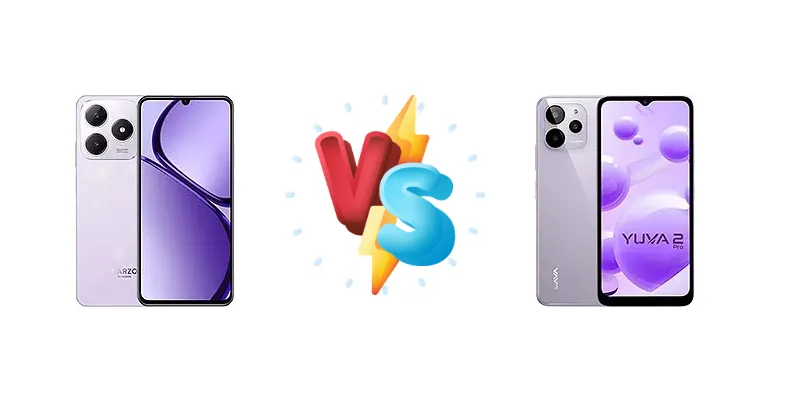
The sub-$100 smartphone market is fiercely competitive. Both the Realme Narzo N63 and Lava Yuva 2 Pro aim to deliver essential smartphone functionality at an incredibly accessible price point. However, they take different approaches to achieving this, with the Narzo N63 prioritizing fast charging and a more modern chipset, while the Yuva 2 Pro focuses on a simpler, more streamlined experience. This comparison will dissect their key differences to help you choose the right device.
🏆 Quick Verdict
For the average user prioritizing responsiveness and future-proofing, the Realme Narzo N63 emerges as the stronger contender. Its Unisoc Tiger T612 chipset and, crucially, 45W fast charging offer a significantly better user experience than the Lava Yuva 2 Pro’s Helio G37 and 10W charging, despite the Yuva 2 Pro’s slightly higher clocked cores.
| Network |
|---|
| 2G bands | GSM 850 / 900 / 1800 / 1900 | GSM 900 / 1800 |
| 3G bands | HSDPA 850 / 900 / 2100 | HSDPA 900 / 2100 |
| 4G bands | 1, 3, 5, 7, 8, 20, 28, 38, 40, 41 | 1, 3, 5, 8, 40, 41 |
| Speed | HSPA, LTE | HSPA, LTE |
| Technology | GSM / HSPA / LTE | GSM / HSPA / LTE |
| Launch |
|---|
| Announced | 2024, June 06 | 2023, February 22 |
| Status | Available. Released 2024, June 10 | Available. Released 2023, February 22 |
| Body |
|---|
| Build | Glass front, plastic back or silicone polymer back (eco leather), plastic frame | - |
| Dimensions | 167.3 x 76.7 x 7.7 mm (6.59 x 3.02 x 0.30 in) | 164.5 x 76 x 9 mm (6.48 x 2.99 x 0.35 in) |
| SIM | Nano-SIM + Nano-SIM | Nano-SIM + Nano-SIM |
| Weight | 189 g or 191 g (6.67 oz) | 204 g (7.20 oz) |
| Display |
|---|
| Resolution | 720 x 1600 pixels, 20:9 ratio (~260 ppi density) | 720 x 1600 pixels, 20:9 ratio (~269 ppi density) |
| Size | 6.75 inches, 110.0 cm2 (~85.7% screen-to-body ratio) | 6.52 inches, 102.6 cm2 (~82.1% screen-to-body ratio) |
| Type | IPS LCD, 90Hz, 560 nits (peak) | IPS LCD |
| Platform |
|---|
| CPU | Octa-core (2x1.8 GHz Cortex-A75 & 6x1.8 GHz Cortex-A55) | Octa-core (4x2.3 GHz Cortex-A53 & 4x1.8 GHz Cortex-A53) |
| Chipset | Unisoc Tiger T612 (12 nm) | Mediatek MT6765 Helio G37 (12 nm) |
| GPU | Mali-G57 | PowerVR GE8320 |
| OS | Android 14, Realme UI 5.0 | Android 12 |
| Memory |
|---|
| Card slot | microSDXC (dedicated slot) | microSDXC (dedicated slot) |
| Internal | 64GB 4GB RAM, 128GB 4GB RAM | 64GB 4GB RAM |
| | - | eMMC 5.1 |
| Main Camera |
|---|
| Features | LED flash, panorama | LED flash |
| Single | 50 MP, f/1.8, (wide), 1/2.5", PDAF
Auxiliary lens | 5 MP |
| Triple | - | 13 MP, (wide), AF
VGA
VGA |
| Video | 1080p@30fps | 1080p@30fps |
| Selfie camera |
|---|
| Single | 8 MP, f/2.0, (wide), 1/4.0" | 5 MP |
| Video | 720p@30fps | Yes |
| Sound |
|---|
| 3.5mm jack | - | Yes |
| 35mm jack | Yes | Yes |
| Loudspeaker | Yes, with dual speakers | Yes |
| Comms |
|---|
| Bluetooth | 5.0, A2DP, LE | 5.1, A2DP, LE |
| NFC | No | No |
| Positioning | GPS, GALILEO, GLONASS, BDS | GPS |
| Radio | Unspecified | FM radio |
| USB | USB Type-C 2.0 | USB Type-C 2.0, OTG |
| WLAN | Wi-Fi 802.11 a/b/g/n/ac, dual-band | Wi-Fi 802.11 b/g/n/ac |
| Features |
|---|
| Sensors | Fingerprint (side-mounted), accelerometer, gyro, proximity, compass | Fingerprint (side-mounted), accelerometer, proximity |
| Battery |
|---|
| Charging | 45W wired | 10W wired |
| Type | 5000 mAh | Li-Po 5000 mAh |
| Misc |
|---|
| Colors | Leather Blue, Twilight Purple | Glass Lavender, Glass Green, Glass White |
| Models | - | LZX408 |
| Price | About 90 EUR | About 90 EUR |
Realme Narzo N63
- Significantly faster 45W charging
- More powerful and efficient Unisoc Tiger T612 chipset
- Better overall system responsiveness
- May have a slightly higher price point
- Software experience can be cluttered with Realme UI
Lava Yuva 2 Pro
- Potentially lower price
- Simpler, more streamlined software experience
- Decent performance for basic tasks
- Extremely slow 10W charging
- Less powerful Helio G37 chipset
- Limited multitasking capabilities
Display Comparison
Neither device boasts a standout display. Given the context data focuses on processing power, we can infer both likely utilize standard 60Hz LCD panels common in this price bracket. The real difference will likely come down to color calibration and peak brightness, areas where Realme typically performs slightly better. Bezels are also likely comparable, being relatively thick on both to maintain affordability.
Camera Comparison
Without detailed camera specs, it's safe to assume both phones feature basic camera setups geared towards casual photography. The focus will be on the main sensor, and any difference in megapixel count is unlikely to be a significant differentiator in image quality. Expect both to struggle in low-light conditions. The inclusion of a 2MP macro lens on either device is largely a marketing tactic and offers limited practical benefit.
Performance
The core difference lies in the chipset architecture. The Realme Narzo N63’s Unisoc Tiger T612 utilizes a combination of Cortex-A75 and A55 cores, offering a more efficient and powerful architecture than the Lava Yuva 2 Pro’s Helio G37, which relies solely on Cortex-A53 cores. While the G37 has a higher peak clock speed (2.3 GHz vs 1.8 GHz), the A75 cores in the T612 provide a substantial performance advantage in multi-threaded tasks and overall system responsiveness. This translates to smoother app switching and a more fluid user experience on the Narzo N63. The T612's 12nm process node is also comparable to the G37's, meaning thermal management shouldn't be a major differentiator.
Battery Life
The disparity in charging speeds is the most significant difference. The Realme Narzo N63’s 45W charging is a game-changer in this price segment, allowing for a full charge in under an hour. The Lava Yuva 2 Pro’s 10W charging is comparatively slow, requiring several hours to reach 100%. While battery capacity isn't specified, the faster charging of the Narzo N63 effectively mitigates any potential disadvantage from a slightly smaller battery, providing more usable uptime throughout the day.
Buying Guide
Buy the Realme Narzo N63 if you need a phone that feels responsive for everyday tasks, benefits from significantly faster charging speeds, and offers a more modern chipset architecture. Buy the Lava Yuva 2 Pro if you prioritize simplicity, are on an extremely tight budget, and don't anticipate heavy multitasking or gaming. The Yuva 2 Pro is best suited for basic communication and light usage.
Frequently Asked Questions
❓ Will the Unisoc Tiger T612 in the Narzo N63 handle popular games like PUBG Mobile?
The Unisoc Tiger T612 can run PUBG Mobile, but expect to play at lower graphics settings and frame rates to maintain a stable experience. It's not a dedicated gaming chipset, but it's significantly more capable than the Helio G37 for gaming.
❓ How long does it *actually* take to fully charge the Lava Yuva 2 Pro with its 10W charging?
Expect a full charge from 0% to 100% on the Lava Yuva 2 Pro to take approximately 3-4 hours. This is a significant drawback compared to the Narzo N63's 45W fast charging.
❓ Is the software on either phone heavily laden with bloatware?
Realme UI, found on the Narzo N63, is known to include pre-installed apps (bloatware). The Lava Yuva 2 Pro likely has a cleaner software experience, but may receive fewer software updates.