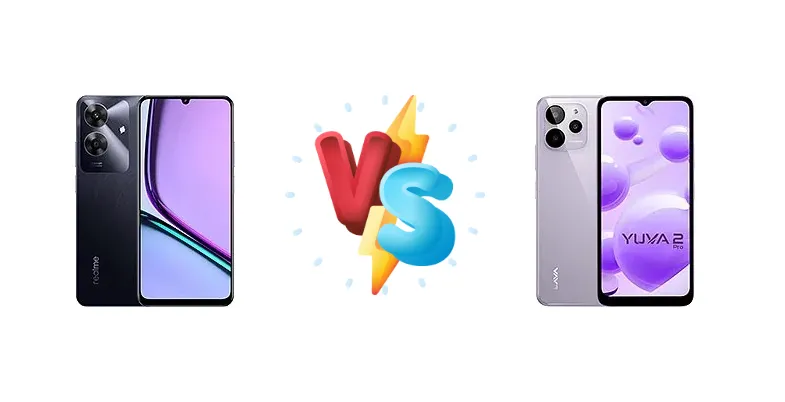
The sub-$100 smartphone market is fiercely competitive. Both the Realme Narzo N61 and Lava Yuva 2 Pro aim to deliver essential smartphone functionality at an incredibly affordable price point. This comparison dives deep into their specifications, focusing on the core differences in performance and usability to determine which device offers the best value.
🏆 Quick Verdict
For the average user prioritizing consistent performance in everyday tasks, the Realme Narzo N61 emerges as the better choice. Its Unisoc Tiger T612 chipset, with its Cortex-A75 cores, provides a noticeable advantage over the Lava Yuva 2 Pro’s Helio G37, despite both being 12nm chips. While both offer similar battery and charging, the N61’s CPU architecture translates to a smoother user experience.
| Network |
|---|
| 2G bands | GSM 850 / 900 / 1800 / 1900 | GSM 900 / 1800 |
| 3G bands | HSDPA 850 / 900 / 2100 | HSDPA 900 / 2100 |
| 4G bands | 1, 3, 5, 7, 8, 20, 28, 38, 40, 41 | 1, 3, 5, 8, 40, 41 |
| Speed | HSPA, LTE | HSPA, LTE |
| Technology | GSM / HSPA / LTE | GSM / HSPA / LTE |
| Launch |
|---|
| Announced | 2024, July 29 | 2023, February 22 |
| Status | Available. Released 2024, August 06 | Available. Released 2023, February 22 |
| Body |
|---|
| Build | Glass front, plastic frame, plastic back | - |
| Dimensions | 167.3 x 76.7 x 7.8 mm (6.59 x 3.02 x 0.31 in) | 164.5 x 76 x 9 mm (6.48 x 2.99 x 0.35 in) |
| SIM | Nano-SIM + Nano-SIM | Nano-SIM + Nano-SIM |
| Weight | 187 g (6.60 oz) | 204 g (7.20 oz) |
| Display |
|---|
| Protection | Reinforced glass | - |
| Resolution | 720 x 1600 pixels, 20:9 ratio (~260 ppi density) | 720 x 1600 pixels, 20:9 ratio (~269 ppi density) |
| Size | 6.74 inches, 109.7 cm2 (~85.5% screen-to-body ratio) | 6.52 inches, 102.6 cm2 (~82.1% screen-to-body ratio) |
| Type | IPS LCD, 90Hz, 450 nits (typ), 560 nits (HBM) | IPS LCD |
| Platform |
|---|
| CPU | Octa-core (2x1.8 GHz Cortex-A75 & 6x1.8 GHz Cortex-A55) | Octa-core (4x2.3 GHz Cortex-A53 & 4x1.8 GHz Cortex-A53) |
| Chipset | Unisoc Tiger T612 (12 nm) | Mediatek MT6765 Helio G37 (12 nm) |
| GPU | Mali-G57 | PowerVR GE8320 |
| OS | Android 14, Realme UI 5.0 | Android 12 |
| Memory |
|---|
| Card slot | microSDXC (dedicated slot) | microSDXC (dedicated slot) |
| Internal | 64GB 4GB RAM, 128GB 6GB RAM | 64GB 4GB RAM |
| | - | eMMC 5.1 |
| Main Camera |
|---|
| Features | LED flash, panorama | LED flash |
| Single | 32 MP, f/1.8, (wide), PDAF
Auxiliary lens | 5 MP |
| Triple | - | 13 MP, (wide), AF
VGA
VGA |
| Video | 1080p@30fps | 1080p@30fps |
| Selfie camera |
|---|
| Single | 5 MP, (wide) | 5 MP |
| Video | Yes | Yes |
| Sound |
|---|
| 3.5mm jack | - | Yes |
| 35mm jack | Yes | Yes |
| Loudspeaker | Yes | Yes |
| Comms |
|---|
| Bluetooth | 5.0, A2DP, LE | 5.1, A2DP, LE |
| NFC | No | No |
| Positioning | GPS, GALILEO, GLONASS, BDS | GPS |
| Radio | Unspecified | FM radio |
| USB | USB Type-C 2.0 | USB Type-C 2.0, OTG |
| WLAN | Wi-Fi 802.11 a/b/g/n/ac, dual-band | Wi-Fi 802.11 b/g/n/ac |
| Features |
|---|
| Sensors | Fingerprint (side-mounted), accelerometer, proximity, compass | Fingerprint (side-mounted), accelerometer, proximity |
| Battery |
|---|
| Charging | 10W wired | 10W wired |
| Type | 5000 mAh | Li-Po 5000 mAh |
| Misc |
|---|
| Colors | Voyage Blue, Marble Black | Glass Lavender, Glass Green, Glass White |
| Models | - | LZX408 |
| Price | About 80 EUR | About 90 EUR |
Realme Narzo N61
- More powerful CPU architecture (Cortex-A75 cores)
- Smoother multitasking experience
- Potentially better sustained performance
- 10W charging is slow
- Limited camera details available
Lava Yuva 2 Pro
- Potentially lower price point
- Acceptable for basic smartphone tasks
- 10W charging is standard for the segment
- Less powerful CPU (Cortex-A53 cores)
- May struggle with demanding apps
- Likely slower app loading times
Display Comparison
Both devices likely feature LCD panels, common in this price bracket. Specifics like resolution and brightness are not provided, but the focus here is on performance. Display quality will likely be similar, with neither offering standout features like high refresh rates or HDR support. Bezels are expected to be substantial on both, maximizing screen real estate within the budget constraints.
Camera Comparison
Camera details are sparse, but it’s safe to assume both phones feature basic camera setups. Without sensor size or aperture information, a direct comparison is difficult. However, the inclusion of a 2MP macro lens on either device is largely a marketing tactic, offering limited practical benefit. Image processing will likely be heavily reliant on software algorithms to enhance photos, and image quality will be adequate for social media sharing but not professional use. The primary sensor's quality will be the determining factor, but without specs, it's impossible to declare a winner.
Performance
The core difference lies in the chipsets. The Realme Narzo N61’s Unisoc Tiger T612 utilizes two Cortex-A75 cores clocked at 1.8 GHz alongside six Cortex-A55 cores, also at 1.8 GHz. This architecture provides a performance boost over the Lava Yuva 2 Pro’s MediaTek Helio G37, which features four Cortex-A53 cores at 2.3 GHz and four more at 1.8 GHz. While the G37 has a higher clock speed on its primary cores, the A75 cores in the T612 are significantly more efficient and powerful. This translates to faster app loading times and smoother multitasking on the Narzo N61. Both utilize a 12nm process, meaning thermal efficiency will be comparable, but the N61 will likely sustain performance for longer under load.
Battery Life
Both the Realme Narzo N61 and Lava Yuva 2 Pro are equipped with 10W wired charging. This indicates similar charging speeds – expect around 2-3 hours for a full charge from 0%. Battery capacity isn’t specified, but typical capacities for phones in this segment range from 5000mAh to 6000mAh. The actual battery life will depend on usage patterns, but both devices should comfortably last a full day with moderate use. The efficiency of the Unisoc T612 in the Narzo N61 *may* translate to slightly longer battery life, but the difference will likely be minimal.
Buying Guide
Buy the Realme Narzo N61 if you need a phone that feels responsive during daily use, handles multitasking without significant lag, and offers a slightly more refined software experience. Buy the Lava Yuva 2 Pro if you prioritize a potentially lower price point and are primarily focused on basic communication – calls, texts, and light social media – and aren't demanding in terms of app performance.
Frequently Asked Questions
❓ Will the Realme Narzo N61 handle popular games like PUBG Mobile or Call of Duty?
While the Unisoc Tiger T612 can run these games, expect to play at lower graphics settings and frame rates to maintain a stable experience. The chipset isn't designed for high-end gaming, so don't anticipate smooth performance at maximum settings. The Lava Yuva 2 Pro will likely struggle even more with these titles.
❓ Is the 10W charging a significant drawback on either phone?
Yes, 10W charging is relatively slow by today's standards. Both phones will take over two hours to fully charge. However, this is typical for smartphones in this price range. If fast charging is a priority, you'll need to consider a more expensive device.
❓ How much storage do these phones typically come with, and is it expandable?
While not specified, these phones generally come with 32GB or 64GB of internal storage. Both are likely to support microSD card expansion, allowing you to increase storage capacity for photos, videos, and apps. Check the specific model's specifications before purchasing to confirm microSD support and maximum capacity.