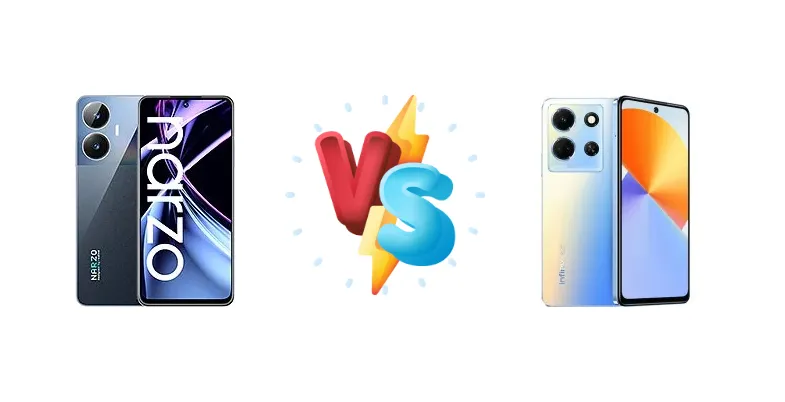
The sub-$200 smartphone market is fiercely competitive, and the Realme Narzo N55 and Infinix Note 30 5G are two strong contenders. The Narzo N55 focuses on endurance and a familiar Realme experience, while the Note 30 5G aims to deliver 5G connectivity and faster charging at an aggressive price point. This comparison dives deep into the specifications to determine which device offers the best value.
🏆 Quick Verdict
For the average user prioritizing performance and future-proofing, the Infinix Note 30 5G is the better choice. Its Mediatek Dimensity 6080 chipset, built on a 6nm process, provides a noticeable performance uplift over the Narzo N55’s Helio G88, and the 45W charging significantly reduces downtime. However, the Narzo N55’s proven endurance is still a compelling factor for those prioritizing battery life above all else.
| Network |
|---|
| 2G bands | GSM 850 / 900 / 1800 / 1900 | GSM 850 / 900 / 1800 / 1900 |
| 3G bands | HSDPA 850 / 900 / 2100 | HSDPA 850 / 900 / 1700(AWS) / 1900 / 2100 |
| 4G bands | 1, 3, 5, 8, 38, 40, 41 | 1, 2, 3, 4, 5, 7, 8, 12, 17, 20, 28, 38, 40, 41, 66 |
| 5G bands | - | 1, 3, 5, 7, 8, 12, 22, 28, 38, 40, 41, 66, 77, 78 |
| Speed | HSPA, LTE | HSPA, LTE, 5G |
| Technology | GSM / HSPA / LTE | GSM / HSPA / LTE / 5G |
| Launch |
|---|
| Announced | 2023, April 12 | 2023, May 22 |
| Status | Available. Released 2023, April 13 | Available. Released 2023, May 22 |
| Body |
|---|
| Build | Glass front, plastic frame, plastic back | Glass front, plastic frame, glass or leather back |
| Dimensions | 165.6 x 75.9 x 7.9 mm (6.52 x 2.99 x 0.31 in) | 168.5 x 76.5 x 8.5 mm (6.63 x 3.01 x 0.33 in) |
| SIM | Nano-SIM + Nano-SIM | Nano-SIM + Nano-SIM |
| Weight | 189.5 g (6.70 oz) | 205 g (7.23 oz) |
| Display |
|---|
| Resolution | 1080 x 2400 pixels, 20:9 ratio (~392 ppi density) | 1080 x 2460 pixels (~396 ppi density) |
| Size | 6.72 inches, 109.0 cm2 (~86.7% screen-to-body ratio) | 6.78 inches, 109.2 cm2 (~84.7% screen-to-body ratio) |
| Type | IPS LCD, 90Hz, 680 nits (peak) | IPS LCD, 120Hz, 580 nits (peak) |
| Platform |
|---|
| CPU | Octa-core (2x2.0 GHz Cortex-A75 & 6x1.8 GHz Cortex-A55) | Octa-core (2x2.4 GHz Cortex-A76 & 6x2.0 GHz Cortex-A55) |
| Chipset | Mediatek MT6769H Helio G88 (12 nm) | Mediatek Dimensity 6080 (6 nm) |
| GPU | Mali-G52 MC2 | Mali-G57 MC2 |
| OS | Android 13, Realme UI 4.0 | Android 13 |
| Memory |
|---|
| Card slot | microSDXC (dedicated slot) | microSDXC (dedicated slot) |
| Internal | 64GB 4GB RAM, 128GB 6GB RAM, 128GB 8GB RAM | 128GB 4GB RAM, 256GB 8GB RAM |
| | eMMC 5.1 | - |
| Main Camera |
|---|
| Dual | 64 MP, f/1.8, (wide), 1/2.0", 0.7µm, PDAF
Auxiliary lens | - |
| Features | LED flash, HDR, panorama | Quad-LED flash, HDR, panorama |
| Triple | - | 108 MP, f/1.75, 26mm (wide), 1/1.67", 0.64µm, PDAF
Auxiliary lenses |
| Video | 1080p@30/60fps | 1440p@30fps, 1080p@30/60fps |
| Selfie camera |
|---|
| Features | HDR, panorama | Dual-LED flash, HDR |
| Single | 8 MP, f/2.0, (wide) | 16 MP, f/2.0, (wide) |
| Video | 1080p@30fps | 1080p@30fps |
| Sound |
|---|
| 3.5mm jack | Yes | - |
| 35mm jack | Yes | Yes |
| Loudspeaker | Yes | Yes, with dual speakers |
| Comms |
|---|
| Bluetooth | 5.2, A2DP, LE | Yes |
| NFC | No | Yes |
| Positioning | GPS, GLONASS, GALILEO, BDS | GPS |
| Radio | No | FM radio |
| USB | USB Type-C 2.0 | USB Type-C 2.0, OTG |
| WLAN | Wi-Fi 802.11 a/b/g/n/ac, dual-band | Wi-Fi 802.11 a/b/g/n/ac, dual-band, Wi-Fi Direct |
| Features |
|---|
| Sensors | Fingerprint (side-mounted), accelerometer, proximity, compass | Fingerprint (side-mounted), accelerometer, gyro, proximity, compass |
| Battery |
|---|
| Charging | 33W wired, 50% in 29 min | 45W wired, bypass charging |
| Type | 5000 mAh | 5000 mAh |
| Misc |
|---|
| Colors | Prime Black, Prime Blue | Magic Black, Interstellar Blue, Sunset Gold |
| Models | - | X6711 |
| Price | About 120 EUR | - |
| Tests |
|---|
| Battery life |
Endurance rating 123h
| - |
| Display |
Contrast ratio: 1264:1 (nominal) | - |
| Loudspeaker |
-31.8 LUFS (Below average)
| - |
| Performance |
AnTuTu: 257263 (v9)
GeekBench: 1452 (v5.1), 1413 (v6)
GFXBench: 9fps (ES 3.1 onscreen) | - |
Realme Narzo N55
- Excellent battery endurance (123h)
- Familiar Realme UI experience
- Competitive price point
- Older Helio G88 chipset
- Slower charging speed (33W)
Infinix Note 30 5G
- More powerful Dimensity 6080 chipset
- Faster 45W charging with bypass charging
- 5G connectivity for future-proofing
- Battery endurance not explicitly stated
- Infinix UI may not appeal to all users
Display Comparison
Both phones feature displays suitable for their price range, but the Infinix Note 30 5G pulls ahead with a measured peak brightness of 607 nits, offering a more visible experience outdoors. While both have similar nominal contrast ratios (1264:1 for the Narzo N55 and 1521:1 for the Note 30 5G), the higher brightness of the Infinix gives it an edge in real-world visibility. Details regarding panel technology (IPS vs AMOLED) and refresh rates are missing, but given the price point, both are likely 60Hz IPS LCDs. The Note 30 5G’s higher contrast ratio suggests slightly better black levels.
Camera Comparison
Without detailed camera specs beyond the main sensors, a direct comparison is difficult. However, the market segment suggests both phones will rely heavily on software processing. The absence of information regarding sensor size and aperture makes it hard to assess low-light performance. It’s safe to assume both phones will include standard features like HDR and portrait modes. The inclusion of a 2MP macro lens on either device is likely a marketing feature with limited practical utility.
Performance
The core difference lies in the chipsets. The Infinix Note 30 5G’s Mediatek Dimensity 6080 (6nm) is a significant upgrade over the Realme Narzo N55’s Mediatek Helio G88 (12nm). The 6nm process inherently offers better power efficiency, translating to less heat and potentially less throttling during sustained workloads. The Dimensity 6080 also features a more modern CPU architecture – Cortex-A76 cores clocked at 2.4 GHz versus the Narzo N55’s Cortex-A75 cores at 2.0 GHz – resulting in faster application loading and smoother multitasking. While both are octa-core CPUs, the architectural improvements in the Dimensity 6080 provide a tangible performance advantage.
Battery Life
The Realme Narzo N55 boasts an endurance rating of 123 hours, indicating excellent battery life. However, the Infinix Note 30 5G compensates for any potential capacity difference with its 45W wired charging, which includes bypass charging, allowing the phone to be used while charging. The Narzo N55’s 33W charging takes 29 minutes to reach 50%, while the Note 30 5G’s 45W charging is expected to be faster. The Dimensity 6080’s 6nm efficiency also contributes to potentially comparable real-world battery performance despite any capacity differences.
Buying Guide
Buy the Realme Narzo N55 if you need a phone that prioritizes long-lasting battery life and a well-established software ecosystem. It’s ideal for users who primarily use their phone for basic tasks and don’t require demanding performance. Buy the Infinix Note 30 5G if you prefer a more powerful processor for smoother multitasking and gaming, faster charging speeds, and 5G connectivity for future network compatibility. This phone is geared towards users who want a more future-proof device.
Frequently Asked Questions
❓ Does the Mediatek Dimensity 6080 in the Infinix Note 30 5G get hot during extended gaming sessions?
The Dimensity 6080’s 6nm process is more efficient than the Helio G88’s 12nm process, meaning it generates less heat under load. While some heat is inevitable during gaming, the Note 30 5G is expected to exhibit less throttling and maintain higher frame rates for longer periods compared to the Narzo N55.
❓ Is the 45W charging on the Infinix Note 30 5G significantly faster than the 33W charging on the Realme Narzo N55 in real-world use?
Yes, the 45W charging on the Note 30 5G will noticeably reduce charging times. While the Narzo N55 takes 29 minutes to reach 50%, the Note 30 5G is expected to be faster, potentially reaching a full charge in under an hour. The inclusion of bypass charging also allows for simultaneous charging and usage.
❓ How does the software experience differ between Realme UI and Infinix’s UI?
Realme UI is generally considered more polished and feature-rich, with a larger user base and more frequent updates. Infinix’s UI, while improving, can sometimes feel less refined and may include more pre-installed bloatware. User preference plays a significant role here, but Realme UI generally offers a smoother and more consistent experience.