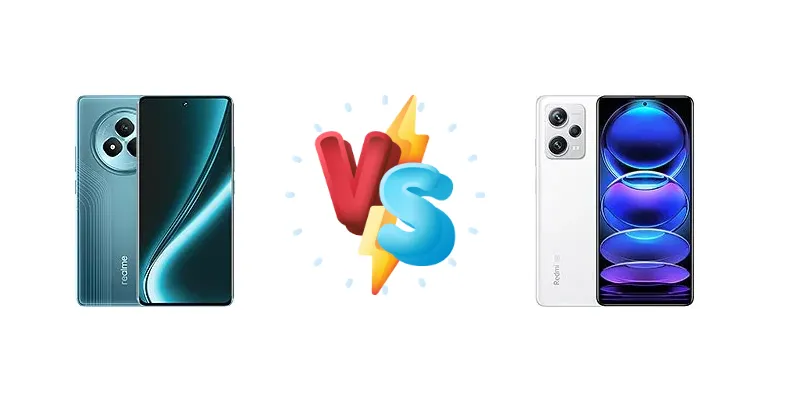
The mid-range smartphone market is fiercely competitive, and the Realme Narzo 80 Pro and Xiaomi Redmi Note 12 Pro+ represent compelling options for users seeking premium features without the flagship price tag. This comparison dives deep into their core specifications, focusing on chipset performance, charging speeds, and overall user experience to determine which device offers the most bang for your buck.
🏆 Quick Verdict
For the average user prioritizing rapid charging and a potentially smoother experience with demanding apps, the Xiaomi Redmi Note 12 Pro+ emerges as the winner. Its 120W charging significantly reduces downtime, and the Dimensity 1080, while on a 6nm process, offers a slight edge in multi-core performance. However, the Narzo 80 Pro's 4nm Dimensity 7400 provides a strong alternative with potentially better efficiency.
| Network |
|---|
| 2G bands | GSM 850 / 900 / 1800 / 1900 | GSM 850 / 900 / 1800 / 1900 - SIM 1 & SIM 2 |
| 3G bands | HSDPA 850 / 900 / 2100 | HSDPA 800 / 850 / 900 / 1900 / 2100 |
| 4G bands | 1, 3, 5, 8, 28, 40, 41 | 1, 3, 5, 8, 19, 34, 38, 39, 40, 41 - International, China |
| 5G bands | 1, 3, 5, 8, 28, 40, 41, 77, 78 SA/NSA | 1, 3, 5, 8, 28, 38, 40, 41, 77, 78 SA/NSA - International |
| Speed | HSPA, LTE, 5G | HSPA, LTE-A (CA), 5G |
| Technology | GSM / HSPA / LTE / 5G | GSM / CDMA / HSPA / EVDO / LTE / 5G |
| | - | 1, 3, 5, 8, 28, 38, 41, 77, 78 SA/NSA - China |
| Launch |
|---|
| Announced | 2025, April 09 | 2022, October 27 |
| Status | Available. Released 2025, April 09 | Available. Released 2022, November 01 |
| Body |
|---|
| Build | - | Glass front (Gorilla Glass 5), glass back |
| Dimensions | 162.8 x 74.9 x 7.6 mm (6.41 x 2.95 x 0.30 in) | 162.9 x 76 x 8.9 mm (6.41 x 2.99 x 0.35 in) |
| SIM | Nano-SIM + Nano-SIM | Dual SIM (Nano-SIM, dual stand-by) |
| Weight | 179 g (6.31 oz) | 208.4 g (7.34 oz) |
| | - | IP53, dust and splash resistant |
| Display |
|---|
| Protection | - | Corning Gorilla Glass 5 |
| Resolution | 1080 x 2392 pixels (~391 ppi density) | 1080 x 2400 pixels, 20:9 ratio (~395 ppi density) |
| Size | 6.72 inches, 109.3 cm2 (~89.6% screen-to-body ratio) | 6.67 inches, 107.4 cm2 (~86.8% screen-to-body ratio) |
| Type | OLED, 1B colors, 120Hz, HDR, 600 nits (typ), 1400 nits (HBM), 4500 nits (peak) | OLED, 1B colors, 120Hz, Dolby Vision, HDR10+, 500 nits (typ), 900 nits (HBM) |
| Platform |
|---|
| CPU | Octa-core (4x2.6 GHz Cortex-A78 & 4x2.0 GHz Cortex-A55) | Octa-core (2x2.6 GHz Cortex-A78 & 6x2.0 GHz Cortex-A55) |
| Chipset | Mediatek Dimensity 7400 (4 nm) | Mediatek MT6877V Dimensity 1080 (6 nm) |
| GPU | Mali-G615 MC2 | Mali-G68 MC4 |
| OS | Android 15, Realme UI 6.0 | Android 12, MIUI 13 |
| Memory |
|---|
| Card slot | No | No |
| Internal | 128GB 8GB RAM, 256GB 8GB RAM, 256GB 12GB RAM | 256GB 8GB RAM, 256GB 12GB RAM |
| | - | UFS 2.2 |
| Main Camera |
|---|
| Dual | 50 MP, f/1.8, 26mm (wide), 1/1.95", 0.8µm, PDAF, OIS
Auxiliary lens | - |
| Features | LED flash, HDR, panorama | Dual-LED dual-tone flash, HDR, panorama |
| Triple | - | 200 MP, f/1.7, 24mm (wide), 1/1.4", 0.56µm, PDAF, OIS
8 MP, f/2.2, 120˚ (ultrawide), 1/4", 1.12µm
2 MP, f/2.4, (macro) |
| Video | 4K@30fps, 1080p@30/60/120fps, gyro-EIS, OIS | 4K@30fps, 1080p@30/60/120fps, 720p@960fps |
| Selfie camera |
|---|
| Features | Panorama | HDR |
| Single | 16 MP, f/2.4, (wide) | 16 MP, f/2.5, (wide), 1/3.06", 1.0µm |
| Video | 1080p@30fps | 1080p@30/60fps |
| Sound |
|---|
| 3.5mm jack | - | Yes |
| 35mm jack | No | - |
| Loudspeaker | Yes, with stereo speakers | Yes, with stereo speakers |
| | - | 24-bit/192kHz audio |
| Comms |
|---|
| Bluetooth | 5.4, A2DP, LE | 5.2, A2DP, LE |
| Infrared port | - | Yes |
| NFC | No | Yes (market/region dependent) |
| Positioning | GPS, GALILEO, GLONASS, BDS | GPS (L1), GLONASS (G1), BDS (B1I+B1c), GALILEO (E1), QZSS (L1) |
| Radio | Unspecified | No |
| USB | USB Type-C 2.0, OTG | USB Type-C 2.0, OTG |
| WLAN | Wi-Fi 802.11 a/b/g/n/ac, dual-band | Wi-Fi 802.11 a/b/g/n/ac/6, dual-band, Wi-Fi Direct |
| Features |
|---|
| Sensors | Fingerprint (under display, optical), accelerometer, gyro, proximity, compass | Fingerprint (side-mounted), accelerometer, proximity, gyro, compass |
| Battery |
|---|
| Charging | 80W wired, 50% in 21 min
Reverse wired
Bypass charging | 120W wired, PD3.0, 100% in 19 min (advertised) |
| Type | Si/C Li-Ion 6000 mAh | Li-Po 5000 mAh, non-removable |
| Misc |
|---|
| Colors | Racing Green, Speed Silver | Arctic White, Iceberg Blue, Obsidian Black, Trend edition |
| Models | - | 22101316UCP, 22101316UG |
| Price | ₹ 18,998 | $ 348.00 / £ 439.00 / € 399.00 / ₹ 29,949 |
| Tests |
|---|
| Battery life | - |
Endurance rating 88h
|
| Camera | - |
Photo / Video |
| Display | - |
Contrast ratio: Infinite (nominal) |
| Loudspeaker | - |
-26.7 LUFS (Good)
|
| Performance | - |
AnTuTu: 498710 (v9)
GeekBench: 2208 (v5.1), 2372 (v6)
GFXBench: 22fps (ES 3.1 onscreen) |
Realme Narzo 80 Pro
- More power-efficient 4nm Dimensity 7400 chipset
- Potential for longer battery life
- 80W fast charging with bypass charging
- Slower charging compared to Redmi Note 12 Pro+
- Camera specifications currently unknown
Xiaomi Redmi Note 12 Pro+
- Ultra-fast 120W charging (100% in 19 mins)
- Potentially better multi-core performance
- High-resolution 200MP main camera
- Less power-efficient 6nm Dimensity 1080 chipset
- Potential for more thermal throttling
Display Comparison
The Redmi Note 12 Pro+ boasts an 'Infinite' contrast ratio, a marketing term indicating a high-quality panel, but lacks specific details like peak brightness or panel type (OLED/LCD). The Narzo 80 Pro’s display specifications are currently unavailable, making a direct comparison difficult. However, given the price point, both are likely to utilize AMOLED panels. The absence of LTPO technology in either device suggests standard refresh rate management, potentially impacting battery life during dynamic content viewing. Bezels and color accuracy will be key differentiators requiring hands-on testing.
Camera Comparison
The Xiaomi Redmi Note 12 Pro+ is known for its 200MP main camera, a significant advantage in detail capture, though pixel binning is crucial for low-light performance. The Narzo 80 Pro’s camera specifications are currently unknown. Without sensor size and aperture information, it’s difficult to assess its low-light capabilities. OIS (Optical Image Stabilization) is a critical feature for video recording and handheld photography, and its presence (or absence) on both devices will significantly impact image quality. The inclusion of a 2MP macro camera on the Redmi Note 12 Pro+ is largely a marketing gimmick and offers limited practical value.
Performance
The core difference lies in the chipsets: the Realme Narzo 80 Pro features the Mediatek Dimensity 7400 built on a 4nm process, while the Xiaomi Redmi Note 12 Pro+ uses the Dimensity 1080 on a 6nm process. While both CPUs share a similar core configuration (2x Cortex-A78 and 6x Cortex-A55), the 4nm node of the Dimensity 7400 should translate to improved power efficiency and potentially lower sustained temperatures. The Redmi Note 12 Pro+ may exhibit slightly better multi-core performance due to the higher clock speeds on its two primary cores, but the Narzo 80 Pro’s efficiency could lead to less throttling during prolonged gaming. RAM speed (likely LPDDR5X on both) is not specified, but will contribute to overall system responsiveness.
Battery Life
The Redmi Note 12 Pro+ boasts a remarkable 120W wired charging capability, promising a full charge in just 19 minutes (advertised). The Narzo 80 Pro’s 80W charging is still fast, reaching 50% in 21 minutes, but lags behind. The Redmi Note 12 Pro+ also supports PD3.0. Battery capacity is not specified for either device, but the faster charging of the Redmi Note 12 Pro+ effectively mitigates the impact of a potentially smaller battery. The Narzo 80 Pro’s 4nm chipset could contribute to better overall battery endurance, but the Redmi Note 12 Pro+'s 88-hour endurance rating suggests a well-optimized power management system.
Buying Guide
Buy the Realme Narzo 80 Pro if you prioritize long-term efficiency and are comfortable with slightly slower charging. Its 4nm Dimensity 7400 chipset promises better thermal management during extended gaming sessions and potentially longer battery life. Buy the Xiaomi Redmi Note 12 Pro+ if you value the convenience of incredibly fast 120W charging and need a phone that can quickly recover from heavy usage. It's ideal for users who frequently find themselves needing to top up their battery throughout the day.
Frequently Asked Questions
❓ Does the Dimensity 7400 in the Narzo 80 Pro struggle with graphically intensive games like Genshin Impact?
The Dimensity 7400 is a capable chipset, but Genshin Impact is notoriously demanding. While it should be playable at medium settings, sustained performance will depend on the phone's thermal management. The 4nm process should help mitigate throttling compared to the Redmi Note 12 Pro+, potentially offering a more consistent experience over longer gaming sessions.
❓ Is the 200MP camera on the Redmi Note 12 Pro+ actually useful, or is it just a marketing gimmick?
While 200MP sounds impressive, the camera primarily uses pixel binning to combine multiple pixels into one larger pixel for improved low-light performance. The resulting images are typically 12.5MP or 50MP. However, the higher resolution allows for more cropping flexibility and potentially greater detail in well-lit conditions. It's a useful feature, but not a game-changer.
❓ Does the Redmi Note 12 Pro+ support 90fps or 120fps gameplay in PUBG Mobile?
The Redmi Note 12 Pro+ *should* support 90fps gameplay in PUBG Mobile, but achieving a stable framerate depends on the phone's thermal performance and game settings. 120fps support is unlikely given the chipset and display specifications. Check online forums and user reports for real-world performance data.
❓ What type of charging protocol does the Narzo 80 Pro use, and is it compatible with my existing chargers?
The Narzo 80 Pro supports 80W wired charging and includes reverse wired charging. It likely uses Realme's proprietary SuperDart Charge protocol. While it may work with standard USB-PD chargers, you'll likely need a compatible Realme charger to achieve the full 80W charging speed.