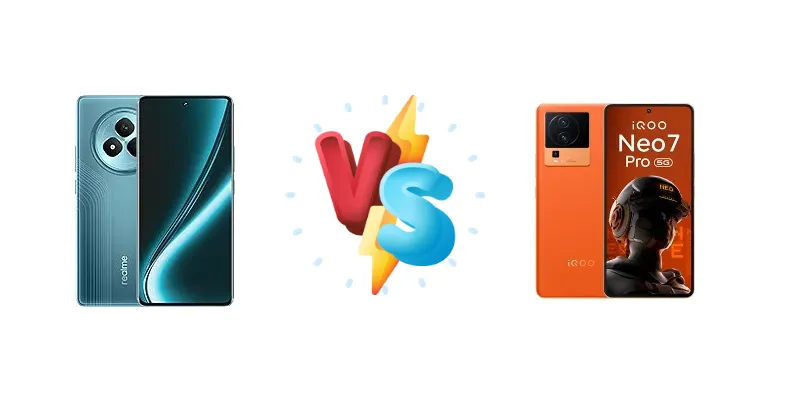
The Realme Narzo 80 Pro and vivo iQOO Neo 7 Pro represent compelling options in the increasingly competitive mid-range smartphone market. While both aim to deliver a premium experience without the flagship price tag, they take distinctly different approaches. The Narzo 80 Pro focuses on efficiency with the Dimensity 7400, while the iQOO Neo 7 Pro prioritizes raw power with the Snapdragon 8+ Gen 1. This comparison will dissect their strengths and weaknesses to determine which device best suits your needs.
🏆 Quick Verdict
For the average user prioritizing gaming and rapid charging, the vivo iQOO Neo 7 Pro is the clear winner. Its Snapdragon 8+ Gen 1 chipset delivers significantly higher performance, and the 120W charging is substantially faster than the Narzo 80 Pro’s 80W. However, the Narzo 80 Pro offers a strong value proposition for those seeking a balanced experience.
| Network |
|---|
| 2G bands | GSM 850 / 900 / 1800 / 1900 | GSM 850 / 900 / 1800 / 1900 |
| 3G bands | HSDPA 850 / 900 / 2100 | HSDPA 800 / 850 / 900 / 1700(AWS) / 1900 / 2100 |
| 4G bands | 1, 3, 5, 8, 28, 40, 41 | 1, 2, 3, 4, 5, 8, 28, 34, 38, 39, 40, 41 |
| 5G bands | 1, 3, 5, 8, 28, 40, 41, 77, 78 SA/NSA | 1, 3, 5, 8, 28, 40, 77, 78 SA/NSA |
| Speed | HSPA, LTE, 5G | HSPA, LTE, 5G |
| Technology | GSM / HSPA / LTE / 5G | GSM / HSPA / LTE / 5G |
| Launch |
|---|
| Announced | 2025, April 09 | 2023, July 04 |
| Status | Available. Released 2025, April 09 | Available. Released 2023, July 15 |
| Body |
|---|
| Build | - | Glass front, plastic frame, glass or leather back |
| Dimensions | 162.8 x 74.9 x 7.6 mm (6.41 x 2.95 x 0.30 in) | 164.8 x 76.9 x 8.5 mm or 8.9 mm |
| SIM | Nano-SIM + Nano-SIM | Nano-SIM + Nano-SIM |
| Weight | 179 g (6.31 oz) | 197 g or 202 g (6.95 oz) |
| Display |
|---|
| Resolution | 1080 x 2392 pixels (~391 ppi density) | 1080 x 2400 pixels, 20:9 ratio (~388 ppi density) |
| Size | 6.72 inches, 109.3 cm2 (~89.6% screen-to-body ratio) | 6.78 inches, 111.0 cm2 (~87.6% screen-to-body ratio) |
| Type | OLED, 1B colors, 120Hz, HDR, 600 nits (typ), 1400 nits (HBM), 4500 nits (peak) | AMOLED, 1B colors, 120Hz, HDR10+, 1300 nits (peak) |
| Platform |
|---|
| CPU | Octa-core (4x2.6 GHz Cortex-A78 & 4x2.0 GHz Cortex-A55) | Octa-core (1x3.19 GHz Cortex-X2 & 3x2.75 GHz Cortex-A710 & 4x2.0 GHz Cortex-A510) |
| Chipset | Mediatek Dimensity 7400 (4 nm) | Qualcomm SM8475 Snapdragon 8+ Gen 1 (4 nm) |
| GPU | Mali-G615 MC2 | Adreno 730 |
| OS | Android 15, Realme UI 6.0 | Android 13, Funtouch 13 |
| Memory |
|---|
| Card slot | No | No |
| Internal | 128GB 8GB RAM, 256GB 8GB RAM, 256GB 12GB RAM | 128GB 8GB RAM, 256GB 12GB RAM |
| Main Camera |
|---|
| Dual | 50 MP, f/1.8, 26mm (wide), 1/1.95", 0.8µm, PDAF, OIS
Auxiliary lens | - |
| Features | LED flash, HDR, panorama | LED flash, HDR, panorama |
| Triple | - | 50 MP, f/1.9, 24mm (wide), 1/1.57", 1.0µm, PDAF, OIS
8 MP, f/2.2, 16mm (ultrawide), 1/4.0", 1.12µm
2 MP (macro) |
| Video | 4K@30fps, 1080p@30/60/120fps, gyro-EIS, OIS | 4K@30fps, 1080p@30fps |
| Selfie camera |
|---|
| Features | Panorama | HDR |
| Single | 16 MP, f/2.4, (wide) | 16 MP, f/2.5, (wide), 1/3.1", 1.0µm |
| Video | 1080p@30fps | 1080p@30fps |
| Sound |
|---|
| 35mm jack | No | No |
| Loudspeaker | Yes, with stereo speakers | Yes, with stereo speakers |
| Comms |
|---|
| Bluetooth | 5.4, A2DP, LE | 5.3, A2DP, LE, aptX HD, aptX Adaptive |
| Infrared port | - | Yes |
| NFC | No | No |
| Positioning | GPS, GALILEO, GLONASS, BDS | GPS, GLONASS, GALILEO, BDS, QZSS, NavIC |
| Radio | Unspecified | No |
| USB | USB Type-C 2.0, OTG | USB Type-C 2.0, OTG |
| WLAN | Wi-Fi 802.11 a/b/g/n/ac, dual-band | Wi-Fi 802.11 a/b/g/n/ac/6, dual-band, Wi-Fi Direct |
| Features |
|---|
| Sensors | Fingerprint (under display, optical), accelerometer, gyro, proximity, compass | Fingerprint (under display, optical), accelerometer, gyro, proximity, compass |
| Battery |
|---|
| Charging | 80W wired, 50% in 21 min
Reverse wired
Bypass charging | 120W wired, 50% in 8 min |
| Type | Si/C Li-Ion 6000 mAh | 5000 mAh |
| Misc |
|---|
| Colors | Racing Green, Speed Silver | Fearless Flame, Dark Storm |
| Models | - | I2217 |
| Price | ₹ 18,998 | About 380 EUR |
Realme Narzo 80 Pro
- More efficient chipset (Dimensity 7400)
- Reverse wired charging for accessory power
- Potentially better value for money
- Significantly slower charging speed (80W)
- Less powerful processor for gaming and demanding tasks
vivo iQOO Neo 7 Pro
- Much faster charging (120W)
- Superior processing power (Snapdragon 8+ Gen 1)
- Likely better gaming performance
- Potentially shorter battery life due to power-hungry chipset
- May run hotter under sustained load
Display Comparison
Neither device's display specifications were provided, so we must infer. Given the price bracket, both likely feature AMOLED panels with at least 120Hz refresh rates. However, the iQOO Neo 7 Pro, historically, leans towards higher peak brightness and potentially LTPO technology for adaptive refresh rates, offering better power efficiency. The Narzo 80 Pro may prioritize color accuracy and viewing angles, but likely won't match the iQOO's peak brightness. Bezels are expected to be minimal on both, but the iQOO's build quality may be slightly more refined.
Camera Comparison
Without specific camera specs, analysis is limited. However, the iQOO Neo 7 Pro, given its positioning, likely features a larger main sensor with optical image stabilization (OIS) for improved low-light performance and video stabilization. The Narzo 80 Pro may focus on software-based image processing to compensate for a potentially smaller sensor. Expect both to offer a standard ultrawide lens, and potentially a macro lens (though its utility is questionable on both). The iQOO’s image processing is likely tuned for vibrant, social media-ready photos, while the Narzo 80 Pro may aim for more natural color reproduction.
Performance
The core difference lies in the chipsets. The iQOO Neo 7 Pro’s Snapdragon 8+ Gen 1 (4nm) is a significant step up from the Narzo 80 Pro’s Mediatek Dimensity 7400 (4nm). The Snapdragon 8+ Gen 1 features a Cortex-X2 prime core clocked at 3.19 GHz, offering superior single-core performance crucial for responsive UI and demanding applications. The Dimensity 7400’s Cortex-A78 cores, while capable, peak at 2.6 GHz. While both are 4nm chips, the Snapdragon’s architecture is more optimized for sustained performance. The iQOO Neo 7 Pro will excel in graphically intensive games and multitasking, while the Narzo 80 Pro will handle everyday tasks smoothly but may show signs of throttling under prolonged heavy load. Both likely utilize LPDDR5x RAM, but the iQOO's superior SoC will benefit more from the faster memory.
Battery Life
The iQOO Neo 7 Pro’s 120W charging is a game-changer, achieving 50% charge in just 8 minutes. The Narzo 80 Pro’s 80W charging, while still fast, takes 21 minutes to reach 50%. This difference is substantial for users who frequently need to top up their battery quickly. Battery capacity wasn't specified, but the iQOO Neo 7 Pro’s power-hungry Snapdragon 8+ Gen 1 will likely necessitate a larger battery to maintain comparable battery life to the more efficient Narzo 80 Pro. The Narzo 80 Pro also offers reverse wired charging, a feature absent from the iQOO, adding to its versatility.
Buying Guide
Buy the Realme Narzo 80 Pro if you need a well-rounded device with good efficiency and don't demand the absolute highest performance. It's ideal for everyday tasks, social media, and casual gaming. Buy the vivo iQOO Neo 7 Pro if you prioritize gaming performance, need the fastest possible charging speeds, and are willing to trade some battery life for that extra power.
Frequently Asked Questions
❓ Will the Snapdragon 8+ Gen 1 in the iQOO Neo 7 Pro overheat during extended gaming sessions?
The Snapdragon 8+ Gen 1 is known to generate heat under sustained load. However, iQOO typically implements robust cooling solutions, including vapor chamber cooling, to mitigate thermal throttling. While some temperature increase is expected, the iQOO Neo 7 Pro should maintain acceptable performance levels during prolonged gaming.
❓ Does the Realme Narzo 80 Pro's Dimensity 7400 support advanced gaming features like ray tracing?
The Mediatek Dimensity 7400 does not natively support hardware-accelerated ray tracing. While it can handle most mobile games, it won't offer the same visual fidelity as devices with dedicated ray tracing capabilities. However, for the majority of mobile games currently available, this won't be a significant limitation.
❓ How does the 80W charging on the Narzo 80 Pro compare to traditional 33W or 65W charging?
80W charging is a substantial upgrade over 33W or 65W. While not as fast as the iQOO Neo 7 Pro’s 120W, it still provides a significantly quicker top-up. Expect a full charge in around an hour, compared to 1.5-2 hours for slower charging standards. This makes it ideal for users who want a quick boost before heading out.