
Realme Narzo 80 Pro vs Google Pixel 7a: A Deep Dive Comparison
| Phones Images | |||||
|---|---|---|---|---|---|
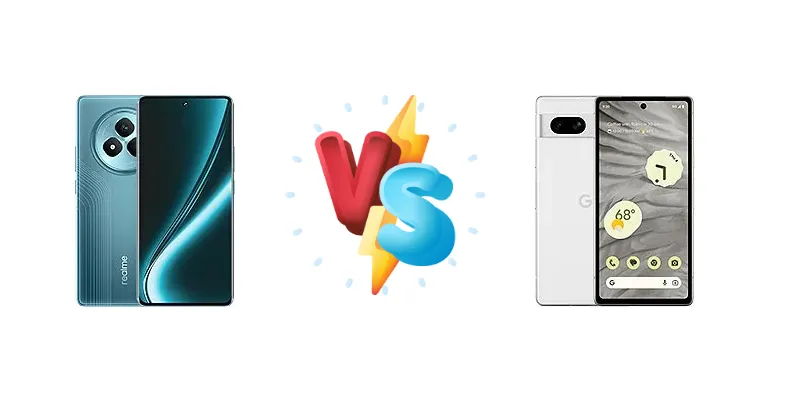
|
🏆 Quick Verdict
For the average user prioritizing camera quality and software experience, the Google Pixel 7a is the better choice. However, the Realme Narzo 80 Pro delivers significantly faster charging and potentially better sustained performance for gaming thanks to its more efficient 4nm process and superior charging tech.
| PHONES | ||
|---|---|---|
| Phone Names | Realme Narzo 80 Pro | Google Pixel 7a |
| Network | ||
|---|---|---|
| 2G bands | GSM 850 / 900 / 1800 / 1900 | GSM 850 / 900 / 1800 / 1900 |
| 3G bands | HSDPA 850 / 900 / 2100 | HSDPA 800 / 850 / 900 / 1700(AWS) / 1900 / 2100 |
| 4G bands | 1, 3, 5, 8, 28, 40, 41 | 1, 2, 3, 4, 5, 7, 8, 12, 13, 14, 17, 20, 25, 26, 28, 29, 30, 38, 40, 41, 48, 66, 71 - GWKK3, G0DZQ |
| 5G bands | 1, 3, 5, 8, 28, 40, 41, 77, 78 SA/NSA | 1, 2, 3, 5, 7, 8, 12, 14, 20, 25, 28, 30, 38, 41, 48, 66, 71, 77, 78 SA/NSA/Sub6 - GWKK3 |
| Speed | HSPA, LTE, 5G | HSPA, LTE, 5G |
| Technology | GSM / HSPA / LTE / 5G | GSM / HSPA / LTE / 5G |
| - | 1, 2, 3, 5, 7, 8, 12, 20, 25, 28, 38, 40, 41, 66, 75, 76, 77, 78, 79 SA/NSA/Sub6 - GHL1X, G82U8 | |
| Launch | ||
|---|---|---|
| Announced | 2025, April 09 | 2023, May 10 |
| Status | Available. Released 2025, April 09 | Available. Released 2023, May 10 |
| Body | ||
|---|---|---|
| Build | - | Glass front (Gorilla Glass 3), aluminum frame, plastic back |
| Dimensions | 162.8 x 74.9 x 7.6 mm (6.41 x 2.95 x 0.30 in) | 152 x 72.9 x 9 mm (5.98 x 2.87 x 0.35 in) |
| SIM | Nano-SIM + Nano-SIM | Nano-SIM + eSIM |
| Weight | 179 g (6.31 oz) | 193.5 g (6.84 oz) |
| - | IP67 dust/water resistant (up to 1m for 30 min) | |
| Display | ||
|---|---|---|
| Protection | - | Corning Gorilla Glass 3 |
| Resolution | 1080 x 2392 pixels (~391 ppi density) | 1080 x 2400 pixels, 20:9 ratio (~429 ppi density) |
| Size | 6.72 inches, 109.3 cm2 (~89.6% screen-to-body ratio) | 6.1 inches, 90.7 cm2 (~81.8% screen-to-body ratio) |
| Type | OLED, 1B colors, 120Hz, HDR, 600 nits (typ), 1400 nits (HBM), 4500 nits (peak) | OLED, HDR, 90Hz |
| - | Always-on display | |
| Platform | ||
|---|---|---|
| CPU | Octa-core (4x2.6 GHz Cortex-A78 & 4x2.0 GHz Cortex-A55) | Octa-core (2x2.85 GHz Cortex-X1 & 2x2.35 GHz Cortex-A78 & 4x1.80 GHz Cortex-A55) |
| Chipset | Mediatek Dimensity 7400 (4 nm) | Google Tensor G2 (5 nm) |
| GPU | Mali-G615 MC2 | Mali-G710 MP7 |
| OS | Android 15, Realme UI 6.0 | Android 13, upgradable to Android 15, up to 5 major Android upgrades |
| Memory | ||
|---|---|---|
| Card slot | No | No |
| Internal | 128GB 8GB RAM, 256GB 8GB RAM, 256GB 12GB RAM | 128GB 8GB RAM |
| - | UFS 3.1 | |
| Main Camera | ||
|---|---|---|
| Dual | 50 MP, f/1.8, 26mm (wide), 1/1.95", 0.8µm, PDAF, OIS Auxiliary lens | 64 MP, f/1.9, 26mm (wide), 1/1.73", 0.8µm, dual pixel PDAF, OIS 13 MP, f/2.2, 120˚ (ultrawide), 1.12µm |
| Features | LED flash, HDR, panorama | Dual-LED flash, Pixel Shift, Auto-HDR, panorama |
| Video | 4K@30fps, 1080p@30/60/120fps, gyro-EIS, OIS | 4K@30/60fps, 1080p@30/60/120/240fps, OIS |
| Selfie camera | ||
|---|---|---|
| Features | Panorama | HDR, panorama |
| Single | 16 MP, f/2.4, (wide) | 13 MP, f/2.2, 20mm (ultrawide), 1.12µm |
| Video | 1080p@30fps | 4K@30fps, 1080p@30fps |
| Sound | ||
|---|---|---|
| 3.5mm jack | - | No |
| 35mm jack | No | No |
| Loudspeaker | Yes, with stereo speakers | Yes, with stereo speakers |
| Comms | ||
|---|---|---|
| Bluetooth | 5.4, A2DP, LE | 5.3, A2DP, LE |
| NFC | No | Yes |
| Positioning | GPS, GALILEO, GLONASS, BDS | GPS, GLONASS, GALILEO, BDS, QZSS, NavIC |
| Radio | Unspecified | No |
| USB | USB Type-C 2.0, OTG | USB Type-C 3.2 |
| WLAN | Wi-Fi 802.11 a/b/g/n/ac, dual-band | Wi-Fi 802.11 a/b/g/n/ac/6e, tri-band |
| Features | ||
|---|---|---|
| Sensors | Fingerprint (under display, optical), accelerometer, gyro, proximity, compass | Fingerprint (under display, optical), accelerometer, gyro, proximity, compass, barometer |
| Battery | ||
|---|---|---|
| Charging | 80W wired, 50% in 21 min Reverse wired Bypass charging | 18W wired, PD3.0 7.5W wireless |
| Type | Si/C Li-Ion 6000 mAh | Li-Po 4385 mAh |
| Misc | ||
|---|---|---|
| Colors | Racing Green, Speed Silver | Charcoal, Snow, Sea, Coral |
| Models | - | GWKK3, GHL1X, G0DZQ, G82U8 |
| Price | ₹ 18,998 | € 179.90 / $ 150.00 / £ 170.00 / ₹ 25,980 |
Realme Narzo 80 Pro
- Significantly faster 80W charging
- Potentially better thermal management due to 4nm process
- Reverse wired charging capability
- Camera performance likely inferior to Pixel 7a
- Software experience may not be as refined as Pixel’s
Google Pixel 7a
- Exceptional camera quality and image processing
- Clean and streamlined Android software experience
- Strong brand reputation and software support
- Slow 18W charging
- Less efficient chipset potentially leading to throttling
Display Comparison
The Pixel 7a boasts a measured peak brightness of 1070 nits, ensuring excellent visibility outdoors. While the Narzo 80 Pro’s display specs are currently unavailable, Realme typically focuses on high refresh rates in this segment. The Pixel 7a’s OLED panel is likely to offer superior color accuracy and contrast. The absence of LTPO technology on either device suggests both will rely on adaptive refresh rate switching rather than variable refresh rates for power saving.
Camera Comparison
The Pixel 7a is renowned for its computational photography prowess, leveraging Google’s image processing algorithms. While specific sensor details are missing for the Narzo 80 Pro, the Pixel 7a’s camera system is a known quantity, delivering consistently excellent photos and videos. The Pixel 7a’s strength lies in its ability to extract detail and dynamic range in challenging lighting conditions. The Narzo 80 Pro will likely rely more on hardware specifications, and without knowing those, it's difficult to assess its capabilities against the Pixel's software-driven advantage.
Performance
The core difference lies in the chipsets. The Google Tensor G2 (5nm) features a prime Cortex-X1 core clocked at 2.85 GHz, designed for peak performance, alongside Cortex-A78 and A55 cores. The Realme Narzo 80 Pro utilizes the Mediatek Dimensity 7400 (4nm) with a Cortex-A78 based octa-core configuration, clocked slightly higher at 2.6 GHz. The 4nm process of the Dimensity 7400 should translate to better thermal efficiency, potentially reducing throttling during extended gaming sessions. The Pixel 7a’s Tensor G2 excels in AI-related tasks, benefiting Google’s camera and voice assistant features. The Narzo 80 Pro’s CPU configuration suggests a focus on sustained multi-core performance.
Battery Life
The Pixel 7a has an endurance rating of 76 hours, indicating solid battery life. However, the Narzo 80 Pro’s 80W wired charging is a game-changer, promising a 50% charge in just 21 minutes. The Pixel 7a’s 18W charging is comparatively slow. While the Pixel 7a’s battery endurance suggests a larger capacity, the Narzo 80 Pro’s faster charging mitigates the impact of a potentially smaller battery, allowing for quick top-ups throughout the day. The Narzo 80 Pro also offers reverse wired charging, a feature absent on the Pixel 7a.
Buying Guide
Buy the Realme Narzo 80 Pro if you need a phone for demanding tasks like gaming, prioritize rapid charging, and value raw processing power. Buy the Google Pixel 7a if you prefer a streamlined software experience, exceptional camera capabilities, and a more established brand reputation, even if it means sacrificing charging speed and some raw performance.