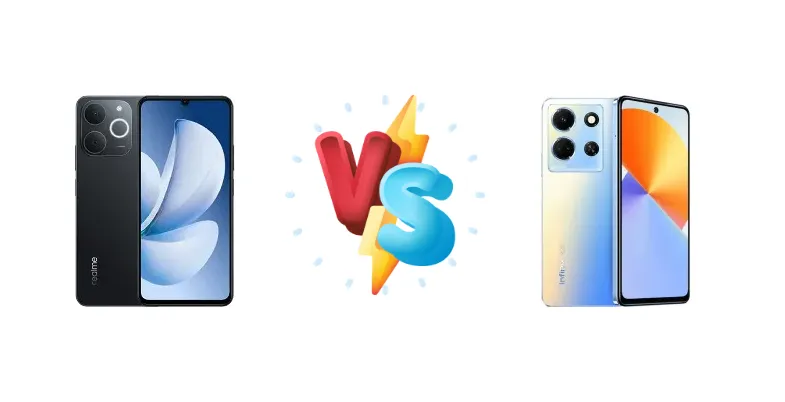
The sub-$200 5G smartphone market is heating up, with the Realme Narzo 80 Lite and Infinix Note 30 5G vying for dominance. While both aim to deliver 5G connectivity at an accessible price, they take distinctly different approaches to achieving this, particularly in chipset choice and charging technology. This comparison will dissect these differences to determine which phone offers the best overall experience.
🏆 Quick Verdict
For the average user prioritizing performance and faster charging, the Infinix Note 30 5G emerges as the stronger contender. Its Mediatek Dimensity 6080, built on a more efficient 6nm process, provides a noticeable performance uplift over the Narzo 80 Lite’s Unisoc T7250, and the 45W charging significantly reduces downtime. However, the Narzo 80 Lite remains a viable option for those on a tighter budget.
| Network |
|---|
| 2G bands | GSM 850 / 900 / 1800 / 1900 | GSM 850 / 900 / 1800 / 1900 |
| 3G bands | HSDPA 850 / 900 / 2100 | HSDPA 850 / 900 / 1700(AWS) / 1900 / 2100 |
| 4G bands | 1, 3, 5, 28, 38, 40, 41 | 1, 2, 3, 4, 5, 7, 8, 12, 17, 20, 28, 38, 40, 41, 66 |
| 5G bands | - | 1, 3, 5, 7, 8, 12, 22, 28, 38, 40, 41, 66, 77, 78 |
| Speed | HSPA, LTE | HSPA, LTE, 5G |
| Technology | GSM / HSPA / LTE | GSM / HSPA / LTE / 5G |
| Launch |
|---|
| Announced | 2025, July 23 | 2023, May 22 |
| Status | Available. Released 2025, July 28 | Available. Released 2023, May 22 |
| Body |
|---|
| Build | Glass front (Panda Glass), plastic frame, plastic back | Glass front, plastic frame, glass or leather back |
| Dimensions | 167.2 x 76.6 x 7.9 mm (6.58 x 3.02 x 0.31 in) | 168.5 x 76.5 x 8.5 mm (6.63 x 3.01 x 0.33 in) |
| SIM | Nano-SIM + Nano-SIM | Nano-SIM + Nano-SIM |
| Weight | 201 g (7.09 oz) | 205 g (7.23 oz) |
| Display |
|---|
| Protection | Panda Glass | - |
| Resolution | 720 x 1600 pixels, 20:9 ratio (~260 ppi density) | 1080 x 2460 pixels (~396 ppi density) |
| Size | 6.74 inches, 109.7 cm2 (~85.6% screen-to-body ratio) | 6.78 inches, 109.2 cm2 (~84.7% screen-to-body ratio) |
| Type | LCD, 90Hz, 563 nits | IPS LCD, 120Hz, 580 nits (peak) |
| Platform |
|---|
| CPU | Octa-core (2x1.8 GHz Cortex-A75 & 6x1.6 GHz Cortex-A55) | Octa-core (2x2.4 GHz Cortex-A76 & 6x2.0 GHz Cortex-A55) |
| Chipset | Unisoc T7250 (12 nm) | Mediatek Dimensity 6080 (6 nm) |
| GPU | Mali-G57 MP1 | Mali-G57 MC2 |
| OS | Android 15, Realme UI 5.0 | Android 13 |
| Memory |
|---|
| Card slot | microSDXC (dedicated slot) | microSDXC (dedicated slot) |
| Internal | 64GB 4GB RAM, 128GB 6GB RAM | 128GB 4GB RAM, 256GB 8GB RAM |
| Main Camera |
|---|
| Features | LED flash, panorama | Quad-LED flash, HDR, panorama |
| Single | 13 MP, f/2.2, 27mm (wide), PDAF | - |
| Triple | - | 108 MP, f/1.75, 26mm (wide), 1/1.67", 0.64µm, PDAF
Auxiliary lenses |
| Video | 1080p@30fps | 1440p@30fps, 1080p@30/60fps |
| Selfie camera |
|---|
| Features | - | Dual-LED flash, HDR |
| Single | 5 MP, 27mm (wide) | 16 MP, f/2.0, (wide) |
| Video | 720p@30fps | 1080p@30fps |
| Sound |
|---|
| 35mm jack | Yes | Yes |
| Loudspeaker | Yes | Yes, with dual speakers |
| Comms |
|---|
| Bluetooth | 5.2, A2DP, LE | Yes |
| NFC | No | Yes |
| Positioning | GPS, GALILEO, GLONASS, BDS | GPS |
| Radio | No | FM radio |
| USB | USB Type-C 2.0 | USB Type-C 2.0, OTG |
| WLAN | Wi-Fi 802.11 a/b/g/n/ac, dual-band | Wi-Fi 802.11 a/b/g/n/ac, dual-band, Wi-Fi Direct |
| Features |
|---|
| Sensors | Fingerprint (side-mounted), accelerometer, proximity, compass | Fingerprint (side-mounted), accelerometer, gyro, proximity, compass |
| Battery |
|---|
| Charging | 15W wired
6W reverse wired | 45W wired, bypass charging |
| Type | 6300 mAh | 5000 mAh |
| Misc |
|---|
| Colors | Beach Gold, Obsidian Black | Magic Black, Interstellar Blue, Sunset Gold |
| Models | - | X6711 |
| Price | ₹ 7,798 | - |
Realme Narzo 80 Lite
- Potentially lower price point
- Functional 5G connectivity
- Reverse wired charging (6W)
- Less powerful Unisoc T7250 chipset
- Slow 15W charging
- Limited display information
Infinix Note 30 5G
- More powerful Mediatek Dimensity 6080 chipset
- Faster 45W charging with bypass charging
- Brighter and higher contrast display
- Slightly higher price
- Camera specs largely unknown
- IPS LCD panel (not AMOLED)
Display Comparison
The Infinix Note 30 5G boasts a measured peak brightness of 607 nits, a significant advantage over the unstated brightness of the Narzo 80 Lite. While both likely utilize IPS LCD panels (given the price point), the Note 30 5G’s higher brightness translates to better outdoor visibility. The 1521:1 contrast ratio on the Infinix also contributes to a more vibrant image. Bezels are comparable on both devices, but the lack of detailed display specs for the Narzo 80 Lite makes a definitive comparison difficult. Color accuracy is also unknown for the Narzo 80 Lite, while the Note 30 5G’s display is adequate for everyday use.
Camera Comparison
Without detailed camera specs beyond the main sensors, a direct comparison is challenging. Both phones likely feature a multi-camera setup with a primary sensor and supporting lenses. However, the absence of information regarding sensor size, aperture, and image processing algorithms makes it difficult to assess image quality. It’s safe to assume both phones will struggle in low-light conditions, and the inclusion of 2MP macro lenses on both is largely a marketing tactic with limited real-world utility. The focus should be on the primary sensor’s capabilities, which remain unknown for both devices.
Performance
The core difference lies in the chipsets. The Infinix Note 30 5G’s Mediatek Dimensity 6080 (6nm) features more powerful Cortex-A76 cores clocked at 2.4 GHz, compared to the Narzo 80 Lite’s Unisoc T7250 (12nm) with Cortex-A75 cores at 1.8 GHz. The 6nm fabrication process of the Dimensity 6080 is crucial; it offers superior power efficiency, leading to better sustained performance and reduced thermal throttling. While both are octa-core CPUs, the architectural advantage and process node give the Dimensity 6080 a clear edge in both CPU and GPU performance. The Narzo 80 Lite will handle basic tasks, but the Note 30 5G will feel noticeably snappier in multitasking and gaming.
Battery Life
The battery capacity is not specified for either device, but the charging capabilities are vastly different. The Infinix Note 30 5G’s 45W wired charging with bypass charging is a game-changer, allowing for significantly faster top-ups. Bypass charging enables charging the battery directly, bypassing heat generation, which is beneficial for battery health. The Realme Narzo 80 Lite’s 15W charging is comparatively slow, requiring considerably more time to reach a full charge. Even if the Narzo 80 Lite has a slightly larger battery capacity, the Note 30 5G’s faster charging will likely result in less downtime.
Buying Guide
Buy the Realme Narzo 80 Lite if you need a functional 5G phone with basic performance for everyday tasks and prioritize a lower upfront cost. Buy the Infinix Note 30 5G if you prefer a smoother user experience, faster app loading times, and significantly quicker charging, even if it means spending a bit more. The Note 30 5G is the better choice for media consumption and light gaming.
Frequently Asked Questions
❓ Does the Unisoc T7250 in the Realme Narzo 80 Lite struggle with demanding games like PUBG Mobile?
The Unisoc T7250 is a budget chipset and will likely require significant graphics settings reductions to achieve playable frame rates in PUBG Mobile. Expect noticeable frame drops and potential stuttering, especially during intense firefights. The Infinix Note 30 5G’s Dimensity 6080 will offer a smoother gaming experience with higher settings.
❓ How long does it realistically take to fully charge the Infinix Note 30 5G from 0% with the 45W charger?
With the included 45W charger, the Infinix Note 30 5G can realistically charge from 0% to 100% in approximately 50-60 minutes. The bypass charging feature helps minimize heat buildup during the process, contributing to faster and safer charging.
❓ Is the reverse wired charging on the Realme Narzo 80 Lite useful for charging accessories like earbuds?
The 6W reverse wired charging on the Narzo 80 Lite is primarily intended for emergency charging of small accessories like earbuds or a smartwatch. It's not powerful enough to significantly charge a smartphone and will be a very slow process.
❓ What type of display technology does the Infinix Note 30 5G use, and is it suitable for media consumption?
The Infinix Note 30 5G utilizes an IPS LCD panel. While not as vibrant as AMOLED, the 607 nits peak brightness and 1521:1 contrast ratio make it reasonably suitable for media consumption, especially in well-lit environments. However, viewing angles and black levels won't be as impressive as on an AMOLED display.