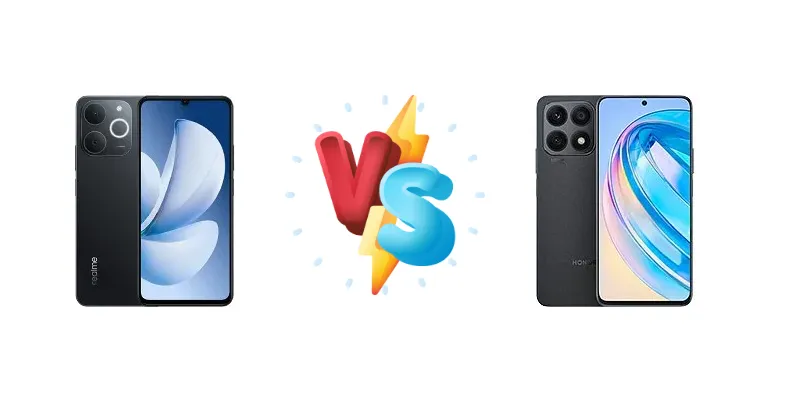
The Realme Narzo 80 Lite and Honor X8a represent compelling options in the crowded sub-$200 smartphone market. Both aim to deliver essential features without breaking the bank, but they take different approaches to achieving this. The Narzo 80 Lite leverages a Unisoc chipset, while the X8a opts for MediaTek’s Helio G88. This comparison dives deep into the specifics to determine which device offers the best value.
🏆 Quick Verdict
For the average user prioritizing faster charging and slightly better CPU performance, the Honor X8a is the stronger choice. Its 22.5W charging significantly reduces downtime compared to the Narzo 80 Lite’s 15W. However, the Narzo 80 Lite remains a viable option for those seeking a slightly different chipset architecture.
| Network |
|---|
| 2G bands | GSM 850 / 900 / 1800 / 1900 | GSM 850 / 900 / 1800 / 1900 |
| 3G bands | HSDPA 850 / 900 / 2100 | HSDPA 850 / 900 / 2100 |
| 4G bands | 1, 3, 5, 28, 38, 40, 41 | LTE |
| Speed | HSPA, LTE | HSPA, LTE |
| Technology | GSM / HSPA / LTE | GSM / HSPA / LTE |
| | - | Virtual proximity sensing |
| Launch |
|---|
| Announced | 2025, July 23 | 2023, February 08 |
| Status | Available. Released 2025, July 28 | Available. Released 2023, February 11 |
| Body |
|---|
| Build | Glass front (Panda Glass), plastic frame, plastic back | Glass front, plastic frame, plastic back |
| Dimensions | 167.2 x 76.6 x 7.9 mm (6.58 x 3.02 x 0.31 in) | 162.9 x 74.5 x 7.5 mm (6.41 x 2.93 x 0.30 in) |
| SIM | Nano-SIM + Nano-SIM | Nano-SIM + Nano-SIM |
| Weight | 201 g (7.09 oz) | 179 g (6.31 oz) |
| Display |
|---|
| Protection | Panda Glass | - |
| Resolution | 720 x 1600 pixels, 20:9 ratio (~260 ppi density) | 1080 x 2388 pixels (~391 ppi density) |
| Size | 6.74 inches, 109.7 cm2 (~85.6% screen-to-body ratio) | 6.7 inches, 108.7 cm2 (~89.6% screen-to-body ratio) |
| Type | LCD, 90Hz, 563 nits | IPS LCD, 90Hz |
| Platform |
|---|
| CPU | Octa-core (2x1.8 GHz Cortex-A75 & 6x1.6 GHz Cortex-A55) | Octa-core (2x2.0 GHz Cortex-A75 & 6x1.8 GHz Cortex-A55) |
| Chipset | Unisoc T7250 (12 nm) | Mediatek MT6769H Helio G88 (12 nm) |
| GPU | Mali-G57 MP1 | Mali-G52 MC2 |
| OS | Android 15, Realme UI 5.0 | Android 12, Magic UI 6.1 |
| Memory |
|---|
| Card slot | microSDXC (dedicated slot) | No |
| Internal | 64GB 4GB RAM, 128GB 6GB RAM | 128GB 4GB RAM, 128GB 6GB RAM, 128GB 8GB RAM, 128GB 12GB RAM, 256GB 4GB RAM, 256GB 8GB RAM |
| Main Camera |
|---|
| Features | LED flash, panorama | LED flash, panorama, HDR |
| Single | 13 MP, f/2.2, 27mm (wide), PDAF | 16 MP, f/2.5 |
| Triple | - | 100 MP, f/1.9, (wide), AF
5 MP, f/2.2, (ultrawide)
2 MP (macro) |
| Video | 1080p@30fps | 1080p@30fps |
| Selfie camera |
|---|
| Single | 5 MP, 27mm (wide) | 16 MP, f/2.5 |
| Video | 720p@30fps | 1080p@30fps |
| Sound |
|---|
| 3.5mm jack | - | No |
| 35mm jack | Yes | No |
| Loudspeaker | Yes | Yes |
| Comms |
|---|
| Bluetooth | 5.2, A2DP, LE | 5.1, A2DP, LE |
| NFC | No | Yes (CRT-LX1 only) |
| Positioning | GPS, GALILEO, GLONASS, BDS | GPS, GLONASS, GALILEO, BDS |
| Radio | No | No |
| USB | USB Type-C 2.0 | USB Type-C 2.0, OTG |
| WLAN | Wi-Fi 802.11 a/b/g/n/ac, dual-band | Wi-Fi 802.11 a/b/g/n/ac, dual-band, Wi-Fi Direct |
| Features |
|---|
| Sensors | Fingerprint (side-mounted), accelerometer, proximity, compass | Fingerprint (side-mounted), accelerometer, compass |
| Battery |
|---|
| Charging | 15W wired
6W reverse wired | 22.5W wired, 50% in 30 min |
| Type | 6300 mAh | Li-Po 4500 mAh |
| Misc |
|---|
| Colors | Beach Gold, Obsidian Black | Cyan Lake, Titanium Silver, Midnight Black |
| Models | - | CRT-LX1, CRT-LX2, CRT-LX3 |
| Price | ₹ 7,798 | About 170 EUR |
Realme Narzo 80 Lite
- Unisoc chipset offers a different architecture option.
- Potentially different power efficiency profile.
- May be available at a slightly lower price point.
- Slower 15W charging.
- Slightly less powerful CPU compared to the Helio G88.
- Likely less optimized software experience.
Honor X8a
- Faster 22.5W charging with 50% charge in 30 minutes.
- Marginally more powerful CPU (Helio G88).
- Generally better software optimization from Honor.
- MediaTek chipset may not appeal to all users.
- Potentially slightly higher price.
- May include more bloatware.
Display Comparison
Neither device boasts a standout display. Both likely utilize LCD panels, common in this price bracket. Without specific display specs (resolution, brightness), the comparison hinges on panel quality, which is difficult to ascertain without testing. However, the focus here is on internal components, making display differences less critical for this comparison.
Camera Comparison
Without detailed camera specifications beyond the chipsets, a direct comparison is limited. Both phones likely feature a multi-camera setup with a primary sensor and supporting lenses. The image signal processor (ISP) within the Helio G88 and T7250 will dictate image quality, but without knowing sensor sizes or apertures, it’s difficult to predict which phone will produce better photos. It's safe to assume both will struggle in low-light conditions, and the usefulness of any included 2MP macro lenses is questionable.
Performance
The core difference lies in the chipsets. The Honor X8a’s MediaTek Helio G88 (2x2.0 GHz Cortex-A75 & 6x1.8 GHz Cortex-A55) has a slight edge in CPU clock speed over the Realme Narzo 80 Lite’s Unisoc T7250 (2x1.8 GHz Cortex-A75 & 6x1.6 GHz Cortex-A55). While both utilize the same core architecture (Cortex-A75 and A55), the higher clock speed of the G88 translates to marginally faster processing in benchmarks and everyday tasks. The Unisoc T7250, however, may offer different power efficiency characteristics, potentially impacting sustained performance. Both phones likely feature similar RAM configurations, so the chipset is the primary performance differentiator.
Battery Life
The Honor X8a’s 22.5W charging is a significant advantage over the Narzo 80 Lite’s 15W charging. While neither phone is expected to have a massive battery capacity (likely around 5000mAh), the faster charging speed of the X8a means a 50% charge in 30 minutes, as advertised, versus a considerably longer time on the Narzo 80 Lite. This difference is crucial for users who need to quickly top up their battery during the day. The actual battery life will depend on usage patterns, but the faster charging provides a tangible benefit to the X8a.
Buying Guide
Buy the Realme Narzo 80 Lite if you prioritize a different chipset vendor (Unisoc) and are comfortable with slower charging speeds. This phone suits users who aren't heavily reliant on quick top-ups. Buy the Honor X8a if you value faster charging, a marginally more powerful CPU, and a generally more responsive user experience, making it ideal for users who frequently use their phone throughout the day and need to minimize downtime.
Frequently Asked Questions
❓ Will the Helio G88 in the Honor X8a struggle with demanding games like PUBG Mobile?
The Helio G88 is a capable chipset for casual gaming, but demanding titles like PUBG Mobile will likely require reduced graphics settings to maintain a stable frame rate. Expect playable performance at medium settings, but don't anticipate a flagship-level gaming experience.
❓ How much slower is the 15W charging on the Realme Narzo 80 Lite compared to the 22.5W on the Honor X8a?
The difference is substantial. The Honor X8a can reach 50% charge in approximately 30 minutes, while the Narzo 80 Lite will take significantly longer – likely over an hour – to achieve the same level. This makes the X8a much more convenient for users who need a quick power boost.
❓ Does the Unisoc T7250 chipset in the Realme Narzo 80 Lite offer any advantages over the Helio G88 in terms of power efficiency?
While difficult to quantify without extensive testing, Unisoc chipsets sometimes prioritize power efficiency. However, the slight CPU clock speed advantage of the Helio G88 likely offsets any potential efficiency gains from the Unisoc T7250 in real-world usage.