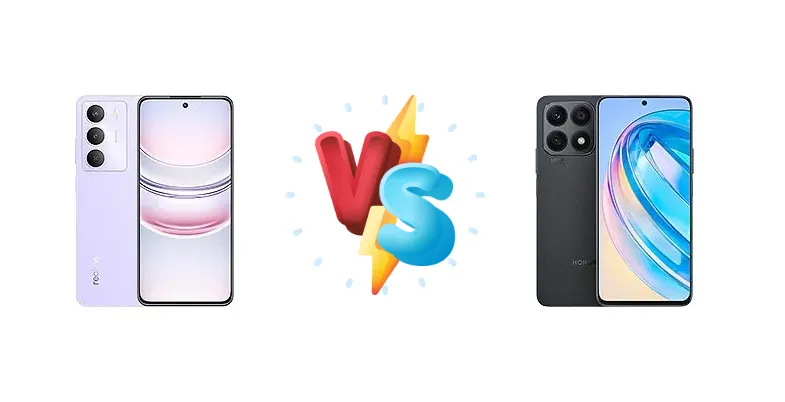
The Realme Narzo 80 Lite 5G and Honor X8a represent compelling options in the increasingly competitive sub-$200 5G smartphone market. While both aim to deliver affordable connectivity, they take distinctly different approaches to chipset selection and charging technology. This comparison will dissect those differences to determine which device offers the best overall value.
🏆 Quick Verdict
For most users, the Realme Narzo 80 Lite 5G emerges as the stronger contender. Its newer Mediatek Dimensity 6300 chipset, built on a more efficient 6nm process, provides a noticeable performance advantage and better long-term efficiency compared to the Honor X8a’s older Helio G88. While the Honor X8a boasts faster charging, the performance gap tips the scales in Realme’s favor.
| Network |
|---|
| 2G bands | GSM 850 / 900 / 1800 / 1900 | GSM 850 / 900 / 1800 / 1900 |
| 3G bands | HSDPA 850 / 900 / 2100 | HSDPA 850 / 900 / 2100 |
| 4G bands | 1, 3, 5, 8, 28, 40, 41 | LTE |
| 5G bands | 1, 3, 5, 8, 28, 40, 41, 77, 78 SA/NSA | - |
| Speed | HSPA, LTE, 5G | HSPA, LTE |
| Technology | GSM / HSPA / LTE / 5G | GSM / HSPA / LTE |
| | - | Virtual proximity sensing |
| Launch |
|---|
| Announced | 2025, June 16 | 2023, February 08 |
| Status | Available. Released 2025, June 23 | Available. Released 2023, February 11 |
| Body |
|---|
| Build | - | Glass front, plastic frame, plastic back |
| Dimensions | 165.7 x 76.2 x 7.9 mm (6.52 x 3.00 x 0.31 in) | 162.9 x 74.5 x 7.5 mm (6.41 x 2.93 x 0.30 in) |
| SIM | Nano-SIM + Nano-SIM | Nano-SIM + Nano-SIM |
| Weight | 197 g (6.95 oz) | 179 g (6.31 oz) |
| Display |
|---|
| Resolution | 720 x 1604 pixels, 20:9 ratio (~264 ppi density) | 1080 x 2388 pixels (~391 ppi density) |
| Size | 6.67 inches, 107.2 cm2 (~84.9% screen-to-body ratio) | 6.7 inches, 108.7 cm2 (~89.6% screen-to-body ratio) |
| Type | IPS LCD, 120Hz, 625 nits | IPS LCD, 90Hz |
| Platform |
|---|
| CPU | Octa-core (2x2.4 GHz Cortex-A76 & 6x2.0 GHz Cortex-A55) | Octa-core (2x2.0 GHz Cortex-A75 & 6x1.8 GHz Cortex-A55) |
| Chipset | Mediatek Dimensity 6300 (6 nm) | Mediatek MT6769H Helio G88 (12 nm) |
| GPU | Mali-G57 MC2 | Mali-G52 MC2 |
| OS | Android 15, Realme UI 6.0 | Android 12, Magic UI 6.1 |
| Memory |
|---|
| Card slot | microSDXC (uses shared SIM slot) | No |
| Internal | 64GB 4GB RAM, 128GB 4GB RAM, 128GB 6GB RAM | 128GB 4GB RAM, 128GB 6GB RAM, 128GB 8GB RAM, 128GB 12GB RAM, 256GB 4GB RAM, 256GB 8GB RAM |
| Main Camera |
|---|
| Features | LED flash, panorama | LED flash, panorama, HDR |
| Single | 32 MP, f/1.8, 27mm (wide), 1/3.1", PDAF | 16 MP, f/2.5 |
| Triple | - | 100 MP, f/1.9, (wide), AF
5 MP, f/2.2, (ultrawide)
2 MP (macro) |
| Video | 1080p@30fps | 1080p@30fps |
| Selfie camera |
|---|
| Features | Panorama | - |
| Single | 8 MP, f/2.0, (wide) | 16 MP, f/2.5 |
| Video | 1080p@30fps | 1080p@30fps |
| Sound |
|---|
| 3.5mm jack | - | No |
| 35mm jack | Yes | No |
| Loudspeaker | Yes | Yes |
| Comms |
|---|
| Bluetooth | 5.3, A2DP, LE | 5.1, A2DP, LE |
| NFC | No | Yes (CRT-LX1 only) |
| Positioning | GPS, GALILEO, GLONASS, QZSS, BDS | GPS, GLONASS, GALILEO, BDS |
| Radio | No | No |
| USB | USB Type-C 2.0, OTG | USB Type-C 2.0, OTG |
| WLAN | Wi-Fi 802.11 a/b/g/n/ac, dual-band | Wi-Fi 802.11 a/b/g/n/ac, dual-band, Wi-Fi Direct |
| Features |
|---|
| Sensors | Fingerprint (side-mounted), accelerometer, proximity, compass | Fingerprint (side-mounted), accelerometer, compass |
| Battery |
|---|
| Charging | 15W wired
5W reverse wired | 22.5W wired, 50% in 30 min |
| Type | 6000 mAh | Li-Po 4500 mAh |
| Misc |
|---|
| Colors | Crystal Purple, Onyx Black | Cyan Lake, Titanium Silver, Midnight Black |
| Models | - | CRT-LX1, CRT-LX2, CRT-LX3 |
| Price | ₹ 6,798 | About 170 EUR |
Realme Narzo 80 Lite 5G
- More powerful and efficient Dimensity 6300 chipset
- Potentially better long-term software support
- Improved thermal management due to 6nm process
- Slower 15W charging
- Display specs are unknown
Honor X8a
- Faster 22.5W charging with 30-minute 50% boost
- Likely larger display size (6.67 inches)
- Potentially lower price point
- Older and less efficient Helio G88 chipset
- Potential for throttling under sustained load
- Less future-proof chipset
Display Comparison
Neither device boasts a standout display. Both likely utilize LCD panels, common in this price bracket. However, detailed display specs (resolution, brightness, color gamut) are missing. The Honor X8a’s larger 6.67-inch display *may* offer a more immersive viewing experience, but without knowing the Realme’s screen size, it’s difficult to say. The absence of high refresh rates on both devices suggests a focus on battery life over visual fluidity.
Camera Comparison
Without detailed camera specifications beyond the chipsets, a direct comparison is limited. Both phones likely feature a primary camera and depth/macro sensors. The absence of OIS on either device suggests reliance on software stabilization. The image signal processor (ISP) within the Dimensity 6300 *may* offer slightly better image processing capabilities, but the real-world difference will depend heavily on software tuning. The 2MP macro cameras commonly found in this segment are unlikely to deliver significant detail and should be considered a secondary feature.
Performance
The core difference lies in the chipsets. The Realme Narzo 80 Lite 5G’s Mediatek Dimensity 6300 (6nm) is a significant upgrade over the Honor X8a’s Helio G88 (12nm). The 6nm process inherently offers better power efficiency, translating to less heat generation and potentially less throttling during extended use. The Dimensity 6300’s CPU configuration – 2x2.4 GHz Cortex-A76 & 6x2.0 GHz Cortex-A55 – provides a performance edge over the Helio G88’s 2x2.0 GHz Cortex-A75 & 6x1.8 GHz Cortex-A55. This means faster app loading times, smoother multitasking, and a more responsive gaming experience on the Realme. While both use an octa-core configuration, the architectural improvements in the Dimensity 6300 are substantial.
Battery Life
The Honor X8a takes the lead in charging speed with its 22.5W wired charging, capable of reaching 50% charge in 30 minutes. The Realme Narzo 80 Lite 5G is limited to 15W charging, meaning a slower recharge time. However, the Dimensity 6300’s superior power efficiency could offset this difference in daily use. The actual battery capacity of both devices is unknown, but the more efficient chipset in the Realme could deliver comparable or even better battery life despite the slower charging.
Buying Guide
Buy the Realme Narzo 80 Lite 5G if you prioritize sustained performance for gaming and multitasking, and value a more modern chipset for future software updates. Buy the Honor X8a if fast charging is your absolute top priority and you primarily use your phone for basic tasks like social media and calls, and are less concerned with demanding applications.
Frequently Asked Questions
❓ Will the Realme Narzo 80 Lite 5G handle demanding games like PUBG Mobile smoothly?
The Mediatek Dimensity 6300 is a capable chipset for gaming. While it won't deliver flagship-level performance, it should handle PUBG Mobile at medium settings with reasonable frame rates. The 6nm process will help mitigate throttling during extended gaming sessions, providing a more consistent experience than the Helio G88.
❓ How much faster is the Honor X8a's charging in real-world use compared to the Realme?
The Honor X8a's 22.5W charging will noticeably reduce charging times. While a precise 0-100% time for the Realme is unknown, expect it to take significantly longer than the Honor X8a's partial charge time of 30 minutes to 50%. However, the Realme's more efficient chipset may mean you need to charge less frequently overall.
❓ Does the Realme Narzo 80 Lite 5G support 5G carrier aggregation?
While not explicitly stated, the Dimensity 6300 generally supports 5G carrier aggregation, which can improve 5G speeds and reliability depending on your carrier and location. This is a potential advantage over the Helio G88, which may have limited carrier aggregation support.