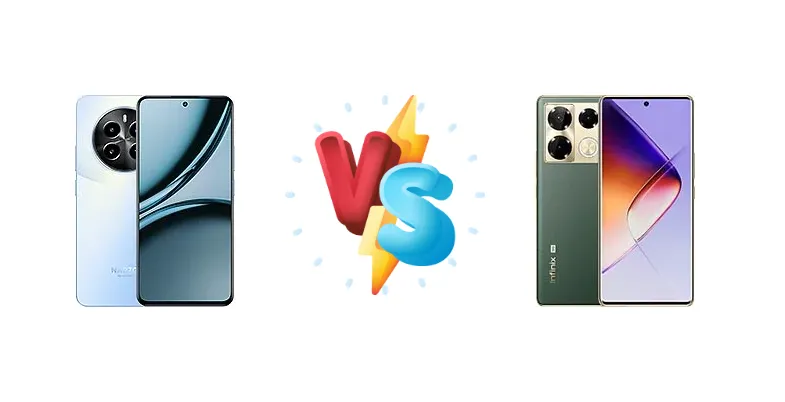
The Realme Narzo 70 and Infinix Note 40 Pro represent a fierce battle in the increasingly competitive mid-range smartphone market. Both devices leverage Mediatek's Dimensity series, aiming to deliver a balance of performance and affordability. However, key differences in chipset clock speeds and the inclusion of wireless charging on the Infinix Note 40 Pro create distinct advantages for different user profiles.
🏆 Quick Verdict
For the average user prioritizing raw processing power and a slightly faster charging experience, the Realme Narzo 70 emerges as the winner. Its Dimensity 7050, with its higher Cortex-A78 clock speed, offers a marginal performance edge. However, the Infinix Note 40 Pro’s MagCharge wireless charging and reverse charging capabilities make it a compelling alternative for those valuing convenience.
| Network |
|---|
| 2G bands | GSM 850 / 900 / 1800 / 1900 | GSM 850 / 900 / 1800 / 1900 |
| 3G bands | HSDPA 850 / 900 / 2100 | HSDPA 850 / 900 / 1700(AWS) / 1900 / 2100 |
| 4G bands | 1, 3, 5, 8, 28, 40, 41 | 1, 2, 3, 4, 5, 7, 8, 12, 17, 20, 28, 38, 40, 41, 42, 66 |
| 5G bands | 1, 3, 5, 8, 28, 40, 41, 77, 78 SA/NSA | 1, 3, 5, 7, 8, 12, 20, 28, 38, 40, 41, 66, 77, 78 SA/NSA |
| Speed | HSPA, LTE, 5G | HSPA, LTE, 5G |
| Technology | GSM / HSPA / LTE / 5G | GSM / HSPA / LTE / 5G |
| Launch |
|---|
| Announced | 2024, April 24 | 2024, March 18 |
| Status | Available. Released 2024, April 25 | Available. Released 2024, March 19 |
| Body |
|---|
| Dimensions | 163 x 75.5 x 8 mm (6.42 x 2.97 x 0.31 in) | 164.3 x 74.5 x 8.1 mm (6.47 x 2.93 x 0.32 in) |
| SIM | Nano-SIM + Nano-SIM | Nano-SIM + Nano-SIM |
| Weight | 188 g (6.63 oz) | 190 g or 196 g (6.70 oz) |
| Display |
|---|
| Protection | - | Corning Gorilla Glass |
| Resolution | 1080 x 2400 pixels, 20:9 ratio (~395 ppi density) | 1080 x 2436 pixels (~393 ppi density) |
| Size | 6.67 inches, 107.4 cm2 (~87.3% screen-to-body ratio) | 6.78 inches, 109.9 cm2 (~89.8% screen-to-body ratio) |
| Type | AMOLED, 120Hz, 600 nits (HBM), 1200 nits (peak) | AMOLED, 1B colors, 120Hz, 2160Hz PWM, 1300 nits (peak) |
| Platform |
|---|
| CPU | Octa-core (2x2.6 GHz Cortex-A78 & 6x2.0 GHz Cortex-A55) | Octa-core (2x2.2 GHz Cortex-A78 & 6x2.0 GHz Cortex-A55) |
| Chipset | Mediatek Dimensity 7050 (6 nm) | Mediatek Dimensity 7020 (6 nm) |
| GPU | Mali-G68 MC4 | IMG BXM-8-256 |
| OS | Android 14, Realme UI 5.0 | Android 14, XOS 14 |
| Memory |
|---|
| Card slot | Unspecified | Unspecified |
| Internal | 128GB 6GB RAM, 128GB 8GB RAM | 256GB 8GB RAM |
| Main Camera |
|---|
| Dual | 50 MP, f/1.8, 27mm (wide), 1/2.76", 0.64µm, PDAF
Auxiliary lens | - |
| Features | LED flash, HDR, panorama | Dual-LED flash, HDR, panorama |
| Triple | - | 108 MP, f/1.8, (wide), PDAF, OIS
2 MP, f/2.4
2 MP, f/2.4 |
| Video | 1080p@30/60/120/480fps, 720p@960fps, gyro-EIS | 1440p@30fps, 1080p@30/60fps |
| Selfie camera |
|---|
| Features | - | Dual-LED flash |
| Single | 16 MP, f/2.5, 24mm (wide), 1/3.0", 1.0µm | 32 MP, f/2.2, (wide), 1/3.1" |
| Video | 1080p@30fps | 1080p@30fps |
| Sound |
|---|
| 35mm jack | Yes | No |
| Loudspeaker | Yes, with stereo speakers | Yes, with stereo speakers |
| Comms |
|---|
| Bluetooth | 5.2, A2DP, LE | Yes |
| Infrared port | - | Yes |
| NFC | No | Yes (market/region dependent) |
| Positioning | GPS, GLONASS, GALILEO, BDS, QZSS | GPS |
| Radio | No | FM radio |
| USB | USB Type-C 2.0, OTG | USB Type-C 2.0, OTG |
| WLAN | Wi-Fi 802.11 a/b/g/n/ac, dual-band | Wi-Fi 802.11 a/b/g/n/ac, dual-band |
| Features |
|---|
| Sensors | Fingerprint (under display, optical), accelerometer, gyro, proximity, compass | Fingerprint (under display, optical), accelerometer, gyro, proximity, compass |
| Battery |
|---|
| Charging | 45W wired, 50% in 27 min | 45W wired, 50% in 26 min
20W wireless MagCharge
Reverse wired
Reverse wireless |
| Type | Li-Ion 5000 mAh | 5000 mAh |
| Misc |
|---|
| Colors | Olive Green, Sky Blue | Vintage Green, Titan Gold, Racing Edition |
| Models | RMX3869 | X6851 |
| Price | About 170 EUR | About 280 EUR |
Realme Narzo 70
- Slightly faster CPU clock speed (Dimensity 7050)
- Potentially better CPU performance in demanding tasks
- Competitive 45W wired charging
- Lacks wireless charging capabilities
- No reverse charging functionality
Infinix Note 40 Pro
- 20W Wireless MagCharge support
- Reverse wired and wireless charging
- Competitive 45W wired charging
- Slightly slower CPU clock speed (Dimensity 7020)
- Potentially lower CPU performance in demanding tasks
Display Comparison
Both devices are expected to feature 6.67-inch AMOLED displays, a common trend in this price bracket. However, detailed specifications regarding peak brightness, color accuracy (DCI-P3 coverage), and refresh rate are currently unavailable. The absence of LTPO technology suggests neither phone will offer adaptive refresh rates for optimal battery efficiency. Bezels are likely to be similar, with the overall display experience hinging on software calibration and panel quality, which requires hands-on testing.
Camera Comparison
Without detailed camera specifications, a direct comparison is difficult. Both phones likely feature a primary camera in the 50MP-108MP range, but sensor size and aperture are critical factors. Optical Image Stabilization (OIS) would be a significant advantage, but its presence is unconfirmed for either device. Image processing algorithms will also play a key role in determining image quality. The inclusion of a 2MP macro camera on either device is unlikely to provide substantial photographic value, serving primarily as a marketing feature.
Performance
The core difference lies in the chipsets: the Realme Narzo 70 utilizes the Mediatek Dimensity 7050, featuring a 2x2.6 GHz Cortex-A78 core configuration, while the Infinix Note 40 Pro employs the Dimensity 7020 with a slightly slower 2x2.2 GHz Cortex-A78 setup. While both are 6nm chips, the higher clock speed on the Narzo 70 suggests a performance advantage in CPU-intensive tasks. Both share the same 6x2.0 GHz Cortex-A55 efficiency cores. RAM configurations are likely similar, but the type (LPDDR4x vs LPDDR5x) will significantly impact multitasking performance; this detail is currently unknown. Thermal management will be crucial, as sustained performance depends on how effectively each phone dissipates heat.
Battery Life
Both the Realme Narzo 70 and Infinix Note 40 Pro feature 45W wired charging, achieving 50% charge in approximately 27 and 26 minutes respectively. This difference is minimal. However, the Infinix Note 40 Pro distinguishes itself with 20W wireless MagCharge, offering a convenient charging option. The inclusion of reverse wired and wireless charging further expands its utility, allowing it to function as a power bank for other devices. Battery capacity is currently unknown, but the efficiency of the Dimensity 7020 and software optimization will heavily influence real-world battery life.
Buying Guide
Buy the Realme Narzo 70 if you need a phone primarily for demanding tasks like gaming or video editing, where the slightly faster CPU clock speed of the Dimensity 7050 will be noticeable. Buy the Infinix Note 40 Pro if you prefer the convenience of wireless charging, especially with the MagCharge ecosystem, and appreciate the added functionality of reverse wired and wireless charging for accessories.
Frequently Asked Questions
❓ Will the Dimensity 7020 in the Infinix Note 40 Pro struggle with graphically intensive games like Genshin Impact?
The Dimensity 7020 is a capable chipset, but demanding games like Genshin Impact may require reduced graphics settings for smooth gameplay. The slightly slower CPU clock speed compared to the Narzo 70's Dimensity 7050 could result in occasional frame drops during prolonged gaming sessions. Thermal throttling will also be a factor.
❓ How practical is the 20W MagCharge wireless charging on the Infinix Note 40 Pro compared to traditional wireless charging?
The 20W MagCharge offers a faster wireless charging experience than standard Qi wireless charging, due to the magnetic alignment and optimized power transfer. However, it still won't match the speed of 45W wired charging. It's most convenient for topping up the battery throughout the day or for users who frequently use wireless charging pads.
❓ Does the Realme Narzo 70 support any form of fast charging protocol other than 45W?
While 45W is the advertised charging speed, the Narzo 70 likely supports Power Delivery (PD) and Programmable Power Supply (PPS) protocols, allowing it to charge at slower speeds with compatible chargers. However, achieving the full 45W requires a compatible charger.