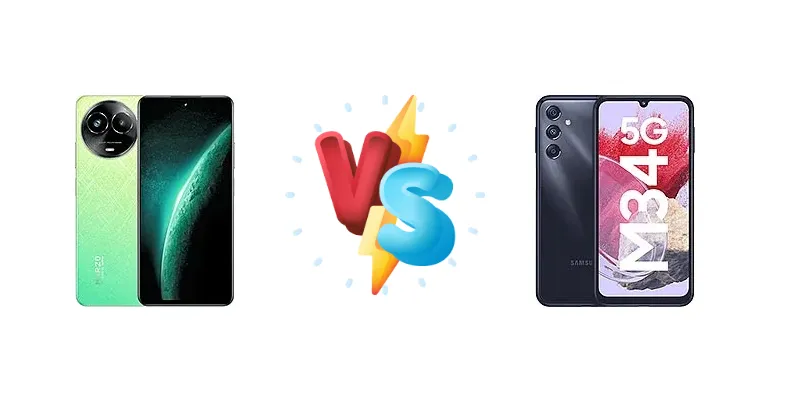
The Realme Narzo 60x and Samsung Galaxy M34 5G represent compelling options in the increasingly competitive sub-$250 5G smartphone market. While both aim to deliver a balanced experience, they take different approaches to chipset selection and charging technology, creating a clear distinction for potential buyers. This comparison dissects these differences to reveal which device offers the best value.
🏆 Quick Verdict
For the average user prioritizing fast charging and a slightly more efficient chipset, the Realme Narzo 60x is the better choice. Its Dimensity 6100+ and 33W charging offer a tangible advantage over the Galaxy M34 5G's Exynos 1280 and 25W charging, despite the Samsung's potentially more refined software experience.
| Network |
|---|
| 2G bands | GSM 850 / 900 / 1800 / 1900 | GSM 850 / 900 / 1800 / 1900 |
| 3G bands | HSDPA 850 / 900 / 2100 | HSDPA 850 / 900 / 1700(AWS) / 1900 / 2100 |
| 4G bands | 1, 3, 5, 8, 28, 40, 41 | 1, 2, 3, 4, 5, 7, 8, 12, 17, 20, 26, 28, 38, 40, 41, 66 |
| 5G bands | 1, 3, 5, 8, 28, 40, 41, 77, 78 SA/NSA | 1, 3, 5, 7, 8, 28, 38, 40, 41, 66, 78 SA/NSA/Sub6 |
| Speed | HSPA, LTE, 5G | HSPA, LTE, 5G |
| Technology | GSM / HSPA / LTE / 5G | GSM / HSPA / LTE / 5G |
| Launch |
|---|
| Announced | 2023, September 06 | 2023, July 03 |
| Status | Available. Released 2023, September 12 | Available. Released 2023, July 15 |
| Body |
|---|
| Dimensions | 165.7 x 76 x 7.9 mm (6.52 x 2.99 x 0.31 in) | 161.7 x 77.2 x 8.8 mm (6.37 x 3.04 x 0.35 in) |
| SIM | Nano-SIM + Nano-SIM | Nano-SIM + Nano-SIM |
| Weight | 190 g (6.70 oz) | 208 g (7.34 oz) |
| Display |
|---|
| Protection | - | Corning Gorilla Glass 5 |
| Resolution | 1080 x 2400 pixels, 20:9 ratio (~392 ppi density) | 1080 x 2340 pixels, 19.5:9 ratio (~396 ppi density) |
| Size | 6.72 inches, 109.0 cm2 (~86.6% screen-to-body ratio) | 6.5 inches, 103.7 cm2 (~83.1% screen-to-body ratio) |
| Type | IPS LCD, 120Hz, 550 nits (typ), 680 nits (HBM) | Super AMOLED, 120Hz, 1000 nits (peak) |
| Platform |
|---|
| CPU | Octa-core (2x2.2 GHz Cortex-A76 & 6x2.0 GHz Cortex-A55) | Octa-core (2x2.4 GHz Cortex-A78 & 6x2.0 GHz Cortex-A55) |
| Chipset | Mediatek Dimensity 6100+ (6 nm) | Exynos 1280 (5 nm) |
| GPU | Mali-G57 MC2 | Mali-G68 |
| OS | Android 13, Realme UI 4.0 | Android 13, upgradable to Android 16, One UI 8 |
| Memory |
|---|
| Card slot | microSDXC (dedicated slot) | microSDXC (uses shared SIM slot) |
| Internal | 128GB 4GB RAM, 128GB 6GB RAM | 128GB 6GB RAM, 128GB 8GB RAM, 256GB 8GB RAM |
| Main Camera |
|---|
| Dual | 50 MP, f/1.8, 27mm (wide), 0.64µm, PDAF
Auxiliary lens | - |
| Features | LED flash, HDR, panorama | LED flash, panorama, HDR |
| Triple | - | 50 MP, f/1.8, (wide), PDAF, OIS
8 MP, f/2.2, 120˚ (ultrawide)
2 MP, f/2.4 |
| Video | 1080p@30fps | 4K@30fps, 1080p@30fps |
| Selfie camera |
|---|
| Features | Panorama | - |
| Single | 8 MP, f2.1, 26mm (wide) | 13 MP, f/2.2, (wide) |
| Video | 1080p@30fps | 1080p@30fps |
| Sound |
|---|
| 35mm jack | Yes | Yes |
| Loudspeaker | Yes | Yes |
| Comms |
|---|
| Bluetooth | 5.2, A2DP, LE | 5.3, A2DP, LE |
| NFC | No | Yes |
| Positioning | GPS, GALILEO, GLONASS, BDS | GPS, GLONASS, GALILEO, BDS |
| Radio | Unspecified | FM radio |
| USB | USB Type-C 2.0 | USB Type-C 2.0, OTG |
| WLAN | Wi-Fi 802.11 a/b/g/n/ac, dual-band, Wi-Fi Direct | Wi-Fi 802.11 a/b/g/n/ac, dual-band, Wi-Fi Direct |
| Features |
|---|
| Sensors | Fingerprint (side-mounted), accelerometer, proximity, compass | Fingerprint (side-mounted), accelerometer, gyro, compass |
| Battery |
|---|
| Charging | 33W wired, 50% in 29 min | 25W wired |
| Type | 5000 mAh | Li-Po 6000 mAh |
| Misc |
|---|
| Colors | Stellar Green, Nebula Purple | Midnight Blue, Prism Silver, Waterfall Blue |
| Models | RMX3782, RMX3710 | SM-M346B, SM-M346B/DS, SM-M346B1, SM-M346B1/DS |
| Price | About 150 EUR | About 190 EUR |
| SAR | - | 0.89 W/kg (head) |
Realme Narzo 60x
- Faster 33W charging
- More efficient 6nm Dimensity 6100+ chipset
- Potentially better sustained performance
- Less established brand reputation than Samsung
- Software experience may not be as polished as One UI
Samsung Galaxy M34 5G
- Samsung’s One UI software
- Slightly faster CPU cores (A78)
- Strong brand recognition
- Slower 25W charging
- Less efficient 5nm Exynos 1280 chipset
- Potentially more thermal throttling under sustained load
Display Comparison
Neither device boasts a standout display. Both likely utilize IPS LCD panels, a common trait in this price bracket. However, detailed specs like peak brightness and color gamut coverage are missing. The focus here isn't on visual fidelity, but rather practicality. Bezels are likely comparable, and both will offer a standard 60Hz refresh rate. The absence of high refresh rates is typical for this segment, prioritizing battery life over smooth scrolling.
Camera Comparison
Camera performance is difficult to assess without detailed sensor information. Both phones likely feature a primary camera, ultrawide, and macro lens setup. However, the quality of the primary sensor is paramount. Without knowing the sensor size and aperture, it's hard to declare a winner. The 2MP macro cameras on both devices are likely present for marketing purposes and offer limited practical value. Image processing will differ – Samsung typically leans towards vibrant, saturated colors, while Realme often aims for a more natural look. The Exynos 1280's ISP *may* offer slightly more advanced processing capabilities, but this is speculative without further data.
Performance
The core difference lies in the chipsets. The Realme Narzo 60x features the Mediatek Dimensity 6100+ (6nm), while the Samsung Galaxy M34 5G uses the Exynos 1280 (5nm). While the Exynos 1280 boasts slightly faster peak CPU clock speeds (2.4 GHz vs 2.2 GHz), the Dimensity 6100+'s newer architecture and 6nm fabrication process likely translate to better power efficiency and sustained performance. The Exynos 1280's Cortex-A78 cores offer a performance boost over the Narzo's A76 cores, but the 6nm process of the Dimensity 6100+ will likely mitigate this advantage in real-world usage, especially during prolonged gaming sessions. Both phones share the same Cortex-A55 efficiency cores, meaning multi-tasking performance will be similar.
Battery Life
The battery capacity is likely similar on both devices (around 6000mAh is typical for the M34 5G). However, the charging speed is a significant differentiator. The Narzo 60x’s 33W charging is considerably faster than the M34 5G’s 25W charging. This translates to a quicker top-up time, with Realme claiming 50% charge in 29 minutes. While a larger battery capacity *can* offset slower charging, the convenience of faster charging is a significant advantage for many users. The 6nm Dimensity 6100+ in the Narzo 60x also contributes to better power efficiency, potentially extending battery life.
Buying Guide
Buy the Realme Narzo 60x if you need consistently faster charging speeds and prioritize a chipset built on a more modern 6nm process for potentially better efficiency. Buy the Samsung Galaxy M34 5G if you prefer Samsung’s One UI software experience and value a slightly more powerful CPU core configuration, even if it comes at the cost of slower charging and a less efficient 5nm process.
Frequently Asked Questions
❓ Does the Exynos 1280 in the Samsung Galaxy M34 5G tend to overheat during extended gaming sessions?
The Exynos 1280, while capable, is known to generate more heat than newer chipsets like the Dimensity 6100+. While not necessarily a deal-breaker, users engaging in prolonged gaming or demanding tasks may experience some thermal throttling, leading to reduced performance. The Narzo 60x's 6nm Dimensity 6100+ is likely to manage heat more effectively.
❓ Is the 2MP macro camera on either phone worth using for detailed close-up shots?
Generally, 2MP macro cameras on budget smartphones offer limited image quality. The small sensor size and fixed focus result in soft, often noisy images. While they can be fun to experiment with, don't expect professional-level macro photography from either device. They are primarily included for marketing purposes.
❓ Can the Realme Narzo 60x reliably maintain 60fps in popular games like PUBG Mobile?
The Dimensity 6100+ is capable of running PUBG Mobile at 60fps on medium settings. However, sustained performance will depend on thermal management. The 6nm process should help, but prolonged gaming may lead to some frame drops. Optimizing in-game graphics settings is recommended for a smoother experience.
❓ How does Samsung's One UI software compare to Realme UI in terms of bloatware and updates?
Samsung's One UI is generally considered more polished and feature-rich than Realme UI, but it historically included more pre-installed bloatware. Recent versions of One UI have reduced bloatware, but it's still present. Realme UI has improved significantly, but update frequency and long-term support are typically better with Samsung devices.