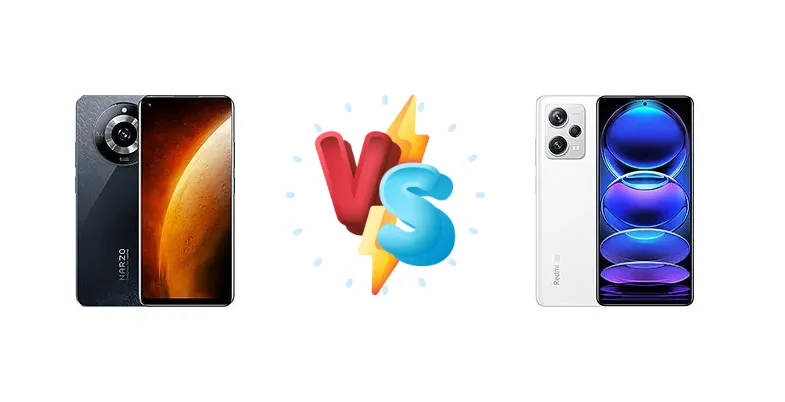
The mid-range smartphone market is fiercely competitive, and the Realme Narzo 60 and Xiaomi Redmi Note 12 Pro+ represent compelling options for budget-conscious buyers. While both aim to deliver a premium experience without the flagship price tag, they take distinctly different approaches – the Narzo 60 focuses on a streamlined experience, while the Redmi Note 12 Pro+ prioritizes charging speed and potentially, camera capabilities. This comparison will dissect their key differences to help you choose the right device.
🏆 Quick Verdict
For the average user prioritizing convenience and speed, the Xiaomi Redmi Note 12 Pro+ is the clear winner. Its 120W charging dramatically reduces downtime, and the Dimensity 1080 chipset offers a noticeable performance edge. However, the Narzo 60 remains a viable option for those on a tighter budget who don't need the fastest charging.
| Network |
|---|
| 2G bands | GSM 850 / 900 / 1800 / 1900 | GSM 850 / 900 / 1800 / 1900 - SIM 1 & SIM 2 |
| 3G bands | HSDPA 850 / 900 / 2100 | HSDPA 800 / 850 / 900 / 1900 / 2100 |
| 4G bands | 1, 3, 5, 8, 28, 40, 41 | 1, 3, 5, 8, 19, 34, 38, 39, 40, 41 - International, China |
| 5G bands | 1, 3, 5, 8, 28, 40, 41, 77, 78 SA/NSA | 1, 3, 5, 8, 28, 38, 40, 41, 77, 78 SA/NSA - International |
| Speed | HSPA, LTE, 5G | HSPA, LTE-A (CA), 5G |
| Technology | GSM / HSPA / LTE / 5G | GSM / CDMA / HSPA / EVDO / LTE / 5G |
| | - | 1, 3, 5, 8, 28, 38, 41, 77, 78 SA/NSA - China |
| Launch |
|---|
| Announced | 2023, July 06 | 2022, October 27 |
| Status | Available. Released 2023, July 15 | Available. Released 2022, November 01 |
| Body |
|---|
| Build | Glass front (Gorilla Glass 5), eco leather or plastic back, plastic frame | Glass front (Gorilla Glass 5), glass back |
| Dimensions | 159.8 x 72.9 x 7.9 mm (6.29 x 2.87 x 0.31 in) | 162.9 x 76 x 8.9 mm (6.41 x 2.99 x 0.35 in) |
| SIM | Nano-SIM + Nano-SIM | Dual SIM (Nano-SIM, dual stand-by) |
| Weight | 182 g (6.42 oz) | 208.4 g (7.34 oz) |
| | - | IP53, dust and splash resistant |
| Display |
|---|
| Protection | Corning Gorilla Glass 5 | Corning Gorilla Glass 5 |
| Resolution | 1080 x 2400 pixels, 20:9 ratio (~409 ppi density) | 1080 x 2400 pixels, 20:9 ratio (~395 ppi density) |
| Size | 6.43 inches, 99.8 cm2 (~85.7% screen-to-body ratio) | 6.67 inches, 107.4 cm2 (~86.8% screen-to-body ratio) |
| Type | Super AMOLED, 90Hz | OLED, 1B colors, 120Hz, Dolby Vision, HDR10+, 500 nits (typ), 900 nits (HBM) |
| Platform |
|---|
| CPU | Octa-core (2x2.2 GHz Cortex-A76 & 6x2.0 GHz Cortex-A55) | Octa-core (2x2.6 GHz Cortex-A78 & 6x2.0 GHz Cortex-A55) |
| Chipset | Mediatek Dimensity 6020 (7 nm) | Mediatek MT6877V Dimensity 1080 (6 nm) |
| GPU | Mali-G57 MC2 | Mali-G68 MC4 |
| OS | Android 13, Realme UI 4.0 | Android 12, MIUI 13 |
| Memory |
|---|
| Card slot | microSDXC (dedicated slot) | No |
| Internal | 128GB 8GB RAM, 256GB 8GB RAM | 256GB 8GB RAM, 256GB 12GB RAM |
| | - | UFS 2.2 |
| Main Camera |
|---|
| Dual | 64 MP, f/1.8, 25mm (wide), 1/2.0", 0.7µm, PDAF
Auxiliary lens | - |
| Features | LED flash, HDR, panorama | Dual-LED dual-tone flash, HDR, panorama |
| Triple | - | 200 MP, f/1.7, 24mm (wide), 1/1.4", 0.56µm, PDAF, OIS
8 MP, f/2.2, 120˚ (ultrawide), 1/4", 1.12µm
2 MP, f/2.4, (macro) |
| Video | 1080p@30fps | 4K@30fps, 1080p@30/60/120fps, 720p@960fps |
| Selfie camera |
|---|
| Features | Panorama, HDR | HDR |
| Single | 16 MP, f/2.5, 26mm (wide) | 16 MP, f/2.5, (wide), 1/3.06", 1.0µm |
| Video | 1080p@30fps | 1080p@30/60fps |
| Sound |
|---|
| 3.5mm jack | - | Yes |
| 35mm jack | Yes | - |
| Loudspeaker | Yes | Yes, with stereo speakers |
| | - | 24-bit/192kHz audio |
| Comms |
|---|
| Bluetooth | Yes | 5.2, A2DP, LE |
| Infrared port | - | Yes |
| NFC | Unspecified | Yes (market/region dependent) |
| Positioning | GPS, GALILEO, GLONASS, BDS, QZSS | GPS (L1), GLONASS (G1), BDS (B1I+B1c), GALILEO (E1), QZSS (L1) |
| Radio | No | No |
| USB | USB Type-C 2.0 | USB Type-C 2.0, OTG |
| WLAN | Wi-Fi 802.11 a/b/g/n/ac, dual-band | Wi-Fi 802.11 a/b/g/n/ac/6, dual-band, Wi-Fi Direct |
| Features |
|---|
| Sensors | Fingerprint (under display, optical), accelerometer, gyro, proximity, compass | Fingerprint (side-mounted), accelerometer, proximity, gyro, compass |
| Battery |
|---|
| Charging | 33W wired, 50% in 29 min | 120W wired, PD3.0, 100% in 19 min (advertised) |
| Type | 5000 mAh | Li-Po 5000 mAh, non-removable |
| Misc |
|---|
| Colors | Mars Orange, Cosmic Black | Arctic White, Iceberg Blue, Obsidian Black, Trend edition |
| Models | RMX3750 | 22101316UCP, 22101316UG |
| Price | About 200 EUR | $ 348.00 / £ 439.00 / € 399.00 / ₹ 29,949 |
| Tests |
|---|
| Battery life | - |
Endurance rating 88h
|
| Camera | - |
Photo / Video |
| Display | - |
Contrast ratio: Infinite (nominal) |
| Loudspeaker | - |
-26.7 LUFS (Good)
|
| Performance | - |
AnTuTu: 498710 (v9)
GeekBench: 2208 (v5.1), 2372 (v6)
GFXBench: 22fps (ES 3.1 onscreen) |
Realme Narzo 60
- More affordable price point
- Decent performance for everyday tasks
- Reliable Realme software experience
- Significantly slower charging speed
- Less powerful processor compared to the Redmi
- Camera specifications are unknown
Xiaomi Redmi Note 12 Pro+
- Blazing-fast 120W charging
- More powerful Dimensity 1080 chipset
- Likely superior camera system
- Higher price tag
- Potential for more heat generation under heavy load
- Software experience can be bloated with Xiaomi apps
Display Comparison
The Redmi Note 12 Pro+ boasts an unspecified display with an 'Infinite' contrast ratio, suggesting a high-quality AMOLED panel. While the Narzo 60’s display specifications are absent, Realme typically employs AMOLED panels in this price bracket. The key differentiator here is likely to be peak brightness and color accuracy, areas where the Redmi Note 12 Pro+ likely holds an advantage given its positioning. Without specific nit ratings for the Narzo 60, it's difficult to quantify the difference, but the Redmi's focus on contrast suggests a more vibrant viewing experience.
Camera Comparison
The Redmi Note 12 Pro+’s camera system is a key selling point, though specific details beyond 'Photo / Video' are missing. However, the 'Pro+' designation suggests a more sophisticated setup, potentially including a larger sensor and optical image stabilization (OIS). The Narzo 60’s camera specifications are also unavailable, making a direct comparison difficult. Given the market segment, both phones likely feature a multi-camera system, but the Redmi Note 12 Pro+ is expected to offer superior image quality, particularly in low-light conditions, due to its likely larger sensor and more advanced image processing capabilities. The absence of details on the Narzo 60’s camera makes it hard to assess its capabilities beyond basic photography.
Performance
The chipset is where the most significant difference lies. The Redmi Note 12 Pro+ utilizes the Mediatek Dimensity 1080 (6nm), featuring a more powerful CPU configuration with 2x2.6 GHz Cortex-A78 cores compared to the Narzo 60’s Dimensity 6020 (7nm) and its 2x2.2 GHz Cortex-A76 cores. The 6nm process of the Dimensity 1080 also generally translates to better power efficiency. This means the Redmi Note 12 Pro+ will handle demanding tasks like gaming and video editing more smoothly. While the Narzo 60’s Dimensity 6020 is still capable, it’s geared towards everyday use rather than intensive workloads. Both phones share the same Cortex-A55 efficiency cores, but the higher clock speeds and core architecture of the Dimensity 1080 provide a clear performance advantage.
Battery Life
The Redmi Note 12 Pro+’s 120W wired charging is a game-changer, promising a full charge in just 19 minutes (advertised). This is significantly faster than the Narzo 60’s 33W charging, which takes 29 minutes to reach 50%. While the Redmi Note 12 Pro+ has an endurance rating of 88h, the Narzo 60’s battery life is not specified. The faster charging of the Redmi Note 12 Pro+ effectively mitigates any potential battery capacity difference, offering greater convenience for users who frequently need to top up their devices. The inclusion of PD3.0 charging on the Redmi also adds to its versatility.
Buying Guide
Buy the Realme Narzo 60 if you need a reliable daily driver with decent performance and aren't overly concerned with blazing-fast charging. It's ideal for users who prioritize value and a balanced feature set. Buy the Xiaomi Redmi Note 12 Pro+ if you prioritize minimizing charging time, demand a more powerful processor for gaming or demanding apps, and are willing to spend a bit more for a more premium experience.
Frequently Asked Questions
❓ Does the Dimensity 1080 in the Redmi Note 12 Pro+ get noticeably warmer during extended gaming sessions?
While the Dimensity 1080 is a powerful chip, it can generate more heat than the Dimensity 6020 under sustained load. Xiaomi typically implements thermal management solutions, but users engaging in prolonged gaming may experience some degree of warming. The 6nm process helps, but it's not a magic bullet.
❓ Is the 33W charging on the Narzo 60 slow enough to be a major inconvenience in daily use?
For casual users, 33W charging is adequate. However, compared to the Redmi Note 12 Pro+'s 120W charging, it's significantly slower. If you frequently find yourself needing to quickly top up your phone, the Narzo 60's charging speed will likely be a noticeable drawback.
❓ Given the lack of detailed camera specs for the Narzo 60, should I assume the Redmi Note 12 Pro+ will have a superior camera?
Based on the 'Pro+' branding and Xiaomi's history, it's highly probable that the Redmi Note 12 Pro+ will offer a more capable camera system. Expect better low-light performance, more detail, and potentially more advanced features like OIS.