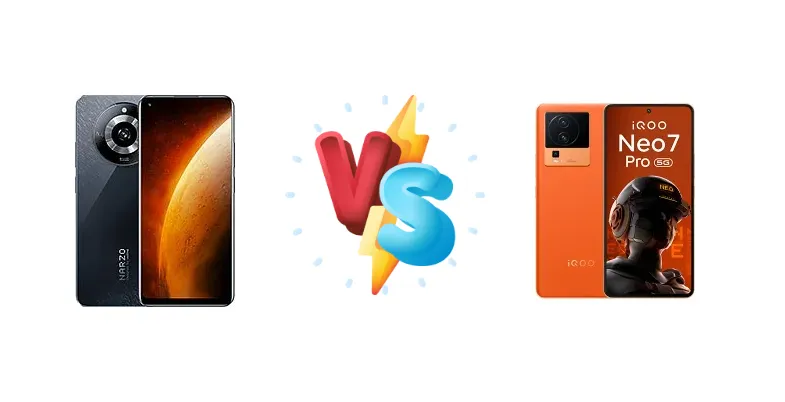
The Realme Narzo 60 and vivo iQOO Neo 7 Pro represent distinct approaches to the mid-range smartphone market. The Narzo 60 focuses on delivering a balanced experience with a modern chipset, while the iQOO Neo 7 Pro aims for near-flagship performance with a previous-generation high-end processor. This comparison dissects their key differences to determine which device best suits your needs.
🏆 Quick Verdict
For the average user prioritizing raw speed and incredibly fast charging, the iQOO Neo 7 Pro is the clear winner. Its Snapdragon 8+ Gen 1 chipset offers significantly higher performance. However, the Realme Narzo 60 provides a compelling alternative for those seeking efficiency and a more reasonable price point.
| Network |
|---|
| 2G bands | GSM 850 / 900 / 1800 / 1900 | GSM 850 / 900 / 1800 / 1900 |
| 3G bands | HSDPA 850 / 900 / 2100 | HSDPA 800 / 850 / 900 / 1700(AWS) / 1900 / 2100 |
| 4G bands | 1, 3, 5, 8, 28, 40, 41 | 1, 2, 3, 4, 5, 8, 28, 34, 38, 39, 40, 41 |
| 5G bands | 1, 3, 5, 8, 28, 40, 41, 77, 78 SA/NSA | 1, 3, 5, 8, 28, 40, 77, 78 SA/NSA |
| Speed | HSPA, LTE, 5G | HSPA, LTE, 5G |
| Technology | GSM / HSPA / LTE / 5G | GSM / HSPA / LTE / 5G |
| Launch |
|---|
| Announced | 2023, July 06 | 2023, July 04 |
| Status | Available. Released 2023, July 15 | Available. Released 2023, July 15 |
| Body |
|---|
| Build | Glass front (Gorilla Glass 5), eco leather or plastic back, plastic frame | Glass front, plastic frame, glass or leather back |
| Dimensions | 159.8 x 72.9 x 7.9 mm (6.29 x 2.87 x 0.31 in) | 164.8 x 76.9 x 8.5 mm or 8.9 mm |
| SIM | Nano-SIM + Nano-SIM | Nano-SIM + Nano-SIM |
| Weight | 182 g (6.42 oz) | 197 g or 202 g (6.95 oz) |
| Display |
|---|
| Protection | Corning Gorilla Glass 5 | - |
| Resolution | 1080 x 2400 pixels, 20:9 ratio (~409 ppi density) | 1080 x 2400 pixels, 20:9 ratio (~388 ppi density) |
| Size | 6.43 inches, 99.8 cm2 (~85.7% screen-to-body ratio) | 6.78 inches, 111.0 cm2 (~87.6% screen-to-body ratio) |
| Type | Super AMOLED, 90Hz | AMOLED, 1B colors, 120Hz, HDR10+, 1300 nits (peak) |
| Platform |
|---|
| CPU | Octa-core (2x2.2 GHz Cortex-A76 & 6x2.0 GHz Cortex-A55) | Octa-core (1x3.19 GHz Cortex-X2 & 3x2.75 GHz Cortex-A710 & 4x2.0 GHz Cortex-A510) |
| Chipset | Mediatek Dimensity 6020 (7 nm) | Qualcomm SM8475 Snapdragon 8+ Gen 1 (4 nm) |
| GPU | Mali-G57 MC2 | Adreno 730 |
| OS | Android 13, Realme UI 4.0 | Android 13, Funtouch 13 |
| Memory |
|---|
| Card slot | microSDXC (dedicated slot) | No |
| Internal | 128GB 8GB RAM, 256GB 8GB RAM | 128GB 8GB RAM, 256GB 12GB RAM |
| Main Camera |
|---|
| Dual | 64 MP, f/1.8, 25mm (wide), 1/2.0", 0.7µm, PDAF
Auxiliary lens | - |
| Features | LED flash, HDR, panorama | LED flash, HDR, panorama |
| Triple | - | 50 MP, f/1.9, 24mm (wide), 1/1.57", 1.0µm, PDAF, OIS
8 MP, f/2.2, 16mm (ultrawide), 1/4.0", 1.12µm
2 MP (macro) |
| Video | 1080p@30fps | 4K@30fps, 1080p@30fps |
| Selfie camera |
|---|
| Features | Panorama, HDR | HDR |
| Single | 16 MP, f/2.5, 26mm (wide) | 16 MP, f/2.5, (wide), 1/3.1", 1.0µm |
| Video | 1080p@30fps | 1080p@30fps |
| Sound |
|---|
| 35mm jack | Yes | No |
| Loudspeaker | Yes | Yes, with stereo speakers |
| Comms |
|---|
| Bluetooth | Yes | 5.3, A2DP, LE, aptX HD, aptX Adaptive |
| Infrared port | - | Yes |
| NFC | Unspecified | No |
| Positioning | GPS, GALILEO, GLONASS, BDS, QZSS | GPS, GLONASS, GALILEO, BDS, QZSS, NavIC |
| Radio | No | No |
| USB | USB Type-C 2.0 | USB Type-C 2.0, OTG |
| WLAN | Wi-Fi 802.11 a/b/g/n/ac, dual-band | Wi-Fi 802.11 a/b/g/n/ac/6, dual-band, Wi-Fi Direct |
| Features |
|---|
| Sensors | Fingerprint (under display, optical), accelerometer, gyro, proximity, compass | Fingerprint (under display, optical), accelerometer, gyro, proximity, compass |
| Battery |
|---|
| Charging | 33W wired, 50% in 29 min | 120W wired, 50% in 8 min |
| Type | 5000 mAh | 5000 mAh |
| Misc |
|---|
| Colors | Mars Orange, Cosmic Black | Fearless Flame, Dark Storm |
| Models | RMX3750 | I2217 |
| Price | About 200 EUR | About 380 EUR |
Realme Narzo 60
- More affordable price point
- Efficient Mediatek Dimensity 6020 chipset
- Balanced performance for everyday tasks
- Slower charging speed (33W)
- Less powerful processor compared to the iQOO Neo 7 Pro
vivo iQOO Neo 7 Pro
- Blazing-fast 120W charging
- Powerful Snapdragon 8+ Gen 1 processor
- Superior gaming performance
- Higher price tag
- Potentially more thermal throttling under sustained load
Display Comparison
While display specifications aren't provided, both phones likely feature AMOLED panels given their market segments. However, the iQOO Neo 7 Pro, historically, has prioritized higher refresh rates (often 120Hz) and peak brightness compared to Realme's Narzo series. The Narzo 60 likely focuses on color accuracy and power efficiency. Bezels are expected to be minimal on both, but the iQOO Neo 7 Pro may have a slightly more premium feel due to its higher price point.
Camera Comparison
Without specific camera specs, it's difficult to make a definitive judgment. However, the iQOO Neo 7 Pro, being a more premium device, likely features a larger main sensor and potentially optical image stabilization (OIS). The Snapdragon 8+ Gen 1’s ISP also offers more advanced image processing capabilities. The Narzo 60 will likely rely on software optimization to compensate for potentially less capable hardware. Expect the iQOO Neo 7 Pro to deliver better low-light performance and more detailed images.
Performance
The core difference lies in the chipsets. The iQOO Neo 7 Pro’s Snapdragon 8+ Gen 1 (4nm) is a substantial upgrade over the Realme Narzo 60’s Mediatek Dimensity 6020 (7nm). The Snapdragon 8+ Gen 1 boasts a Cortex-X2 prime core clocked at 3.19 GHz, alongside faster Cortex-A710 performance cores, resulting in significantly higher CPU and GPU performance. The 4nm process node also contributes to better thermal efficiency, potentially mitigating throttling during sustained workloads. The Dimensity 6020, while capable, is geared towards efficiency and everyday tasks, with its Cortex-A76 cores offering respectable performance but falling short of the Snapdragon’s capabilities. The iQOO Neo 7 Pro will excel in demanding games and applications, while the Narzo 60 will handle them adequately.
Battery Life
The iQOO Neo 7 Pro’s 120W charging is a game-changer, achieving 50% charge in just 8 minutes. This is a massive advantage over the Narzo 60’s 33W charging, which takes 29 minutes for the same level. While battery capacity isn't specified, the iQOO Neo 7 Pro’s faster charging effectively mitigates any potential capacity disadvantage. The Snapdragon 8+ Gen 1, despite its power, is relatively efficient, and the 120W charging allows for quick top-ups, minimizing downtime. The Narzo 60 will offer decent battery life, but the iQOO Neo 7 Pro provides unparalleled convenience.
Buying Guide
Buy the Realme Narzo 60 if you need a reliable daily driver with good battery life and a modern processor for everyday tasks and casual gaming. It’s ideal for users who value efficiency and don’t require the absolute highest performance. Buy the vivo iQOO Neo 7 Pro if you prioritize gaming, demanding applications, and lightning-fast 120W charging. This phone is for power users who want a near-flagship experience without the flagship price tag.
Frequently Asked Questions
❓ Will the Snapdragon 8+ Gen 1 in the iQOO Neo 7 Pro overheat during prolonged gaming sessions?
While the Snapdragon 8+ Gen 1 is a powerful chip, it can generate heat under sustained load. However, iQOO typically implements robust cooling solutions, including vapor chamber cooling, to mitigate thermal throttling. Expect some performance reduction after extended gaming, but it should remain playable.
❓ Is the 33W charging on the Realme Narzo 60 slow compared to the competition?
33W charging is adequate for most users, but it's significantly slower than the 120W charging on the iQOO Neo 7 Pro. It will take considerably longer to fully charge the Narzo 60, but it's still sufficient for overnight charging or topping up during the day.
❓ How does the Dimensity 6020 handle graphically intensive games like Genshin Impact or Call of Duty Mobile?
The Dimensity 6020 can run these games, but you'll likely need to lower the graphics settings to achieve a smooth frame rate. It's not designed for maximum settings at high frame rates, but it provides a playable experience for casual gamers.
❓ Does the iQOO Neo 7 Pro support high frame rate gaming (90fps or 120fps) in popular titles?
The iQOO Neo 7 Pro, with its powerful Snapdragon 8+ Gen 1 and likely high refresh rate display, should support high frame rate gaming in many popular titles like PUBG Mobile and Call of Duty Mobile, depending on the game's settings and optimization.