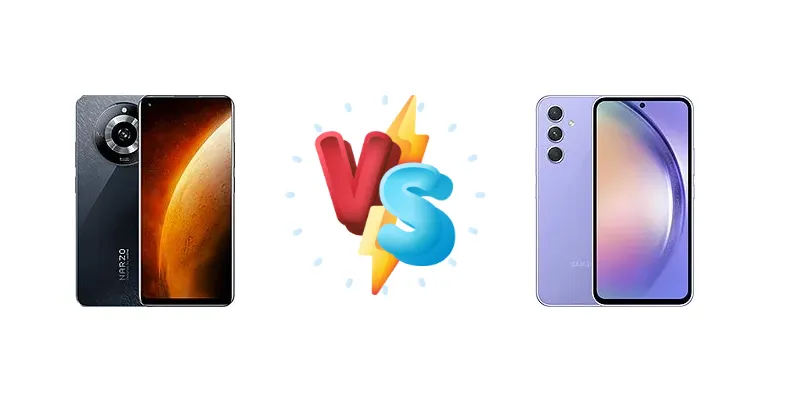
The Realme Narzo 60 and Samsung Galaxy A54 both target the competitive mid-range smartphone market, but approach it with different philosophies. The Narzo 60 prioritizes processing power with its Dimensity 6020, while the Galaxy A54 focuses on a refined user experience and strong battery endurance. This comparison dissects their key differences to determine which device offers the best value.
🏆 Quick Verdict
For the average user prioritizing all-day battery life and a polished software experience, the Samsung Galaxy A54 is the better choice. While the Realme Narzo 60 offers a slightly more powerful processor on paper, the A54’s optimized Exynos 1380 and superior display brightness deliver a more consistently enjoyable experience.
| Network |
|---|
| 2G bands | GSM 850 / 900 / 1800 / 1900 | GSM 850 / 900 / 1800 / 1900 |
| 3G bands | HSDPA 850 / 900 / 2100 | HSDPA 850 / 900 / 1700(AWS) / 1900 / 2100 |
| 4G bands | 1, 3, 5, 8, 28, 40, 41 | 1, 2, 3, 4, 5, 7, 8, 12, 17, 20, 26, 28, 32, 38, 40, 41, 66 - International |
| 5G bands | 1, 3, 5, 8, 28, 40, 41, 77, 78 SA/NSA | 1, 3, 7, 8, 20, 28, 38, 40, 41, 77, 78 SA/NSA/Sub6 - International |
| Speed | HSPA, LTE, 5G | HSPA, LTE, 5G |
| Technology | GSM / HSPA / LTE / 5G | GSM / HSPA / LTE / 5G |
| | - | 25, 41, 66, 71 SA/NSA/Sub6/mmWave - USA |
| Launch |
|---|
| Announced | 2023, July 06 | 2023, March 15 |
| Status | Available. Released 2023, July 15 | Available. Released 2023, March 24 |
| Body |
|---|
| Build | Glass front (Gorilla Glass 5), eco leather or plastic back, plastic frame | Glass front (Gorilla Glass 5), glass back (Gorilla Glass 5), plastic frame |
| Dimensions | 159.8 x 72.9 x 7.9 mm (6.29 x 2.87 x 0.31 in) | 158.2 x 76.7 x 8.2 mm (6.23 x 3.02 x 0.32 in) |
| SIM | Nano-SIM + Nano-SIM | · Nano-SIM + eSIM· Nano-SIM + Nano-SIM |
| Weight | 182 g (6.42 oz) | 202 g (7.13 oz) |
| | - | IP67 dust/water resistant (up to 1m for 30 min) |
| Display |
|---|
| Protection | Corning Gorilla Glass 5 | Corning Gorilla Glass 5 |
| Resolution | 1080 x 2400 pixels, 20:9 ratio (~409 ppi density) | 1080 x 2340 pixels, 19.5:9 ratio (~403 ppi density) |
| Size | 6.43 inches, 99.8 cm2 (~85.7% screen-to-body ratio) | 6.4 inches, 100.5 cm2 (~82.9% screen-to-body ratio) |
| Type | Super AMOLED, 90Hz | Super AMOLED, 120Hz, HDR10+, 1000 nits (HBM) |
| Platform |
|---|
| CPU | Octa-core (2x2.2 GHz Cortex-A76 & 6x2.0 GHz Cortex-A55) | Octa-core (4x2.4 GHz Cortex-A78 & 4x2.0 GHz Cortex-A55) |
| Chipset | Mediatek Dimensity 6020 (7 nm) | Exynos 1380 (5 nm) |
| GPU | Mali-G57 MC2 | Mali-G68 MP5 |
| OS | Android 13, Realme UI 4.0 | Android 13, up to 4 major Android upgrades, One UI 7 |
| Memory |
|---|
| Card slot | microSDXC (dedicated slot) | microSDXC (uses shared SIM slot) |
| Internal | 128GB 8GB RAM, 256GB 8GB RAM | 128GB 4GB RAM, 128GB 6GB RAM, 128GB 8GB RAM, 256GB 6GB RAM, 256GB 8GB RAM |
| Main Camera |
|---|
| Dual | 64 MP, f/1.8, 25mm (wide), 1/2.0", 0.7µm, PDAF
Auxiliary lens | - |
| Features | LED flash, HDR, panorama | LED flash, panorama, HDR |
| Single | - | 32 MP, f/2.2, 26mm (wide), 1/2.8", 0.8µm |
| Triple | - | 50 MP, f/1.8, 23mm (wide), 1/1.56", 1.0µm, PDAF, OIS
12 MP, f/2.2, 13mm, 123˚ (ultrawide), 1/3.X", 1.12µm
5 MP (macro) |
| Video | 1080p@30fps | 4K@30fps, 1080p@30/60fps, 720p@480fps, gyro-EIS |
| Selfie camera |
|---|
| Features | Panorama, HDR | - |
| Single | 16 MP, f/2.5, 26mm (wide) | 32 MP, f/2.2, 26mm (wide), 1/2.8", 0.8µm |
| Video | 1080p@30fps | 4K@30fps, 1080p@30/60fps |
| Sound |
|---|
| 3.5mm jack | - | No |
| 35mm jack | Yes | No |
| Loudspeaker | Yes | Yes, with stereo speakers |
| Comms |
|---|
| Bluetooth | Yes | 5.3, A2DP, LE |
| NFC | Unspecified | Yes (market/region dependent) |
| Positioning | GPS, GALILEO, GLONASS, BDS, QZSS | GPS, GLONASS, GALILEO, BDS |
| Radio | No | No |
| USB | USB Type-C 2.0 | USB Type-C 2.0, OTG |
| WLAN | Wi-Fi 802.11 a/b/g/n/ac, dual-band | Wi-Fi 802.11 a/b/g/n/ac/6, dual-band, Wi-Fi Direct |
| Features |
|---|
| Sensors | Fingerprint (under display, optical), accelerometer, gyro, proximity, compass | Fingerprint (under display, optical), accelerometer, gyro, compass, barometer (USA only) |
| | - | Virtual proximity sensing |
| Battery |
|---|
| Charging | 33W wired, 50% in 29 min | 25W wired |
| Type | 5000 mAh | 5000 mAh |
| Misc |
|---|
| Colors | Mars Orange, Cosmic Black | Lime, Graphite, Violet, White |
| Models | RMX3750 | SM-A546V, SM-A546U, SM-A546U1, SM-A546B, SM-A546B/DS, SM-A546E, SM-A546E/DS, SM-A5460, SM-A546M, SM-A546M/DS, SM-A546W |
| Price | About 200 EUR | € 210.00 / $ 119.11 / £ 169.95 / ₹ 28,999 |
| SAR | - | 0.81 W/kg (head) 0.67 W/kg (body) |
| SAR EU | - | 0.69 W/kg (head) 1.34 W/kg (body) |
| Tests |
|---|
| Battery life | - |
Endurance rating 119h
|
| Camera | - |
Photo / Video |
| Display | - |
Contrast ratio: Infinite (nominal) |
| Loudspeaker | - |
-26.6 LUFS (Good)
|
| Performance | - |
AnTuTu: 506678 (v9)
GeekBench: 2703 (v5.1), 2797 (v6)
GFXBench: 25fps (ES 3.1 onscreen) |
Realme Narzo 60
- Potentially faster CPU performance for multitasking
- Faster charging speed (33W)
- Likely more affordable price point
- Less efficient 7nm chipset
- Unspecified display brightness and quality
- Limited camera information
Samsung Galaxy A54
- Superior battery life and endurance
- Brighter and higher-quality display
- More efficient 5nm chipset
- Slower charging speed (25W)
- Potentially higher price
- Exynos chipset can sometimes exhibit thermal throttling
Display Comparison
The Samsung Galaxy A54 boasts a significantly brighter display, reaching a measured 980 nits, compared to an unstated peak brightness for the Narzo 60. This makes the A54 far more usable outdoors under direct sunlight. While both likely utilize AMOLED panels, Samsung’s ‘Infinite’ contrast ratio suggests deeper blacks and more vivid colors. The Narzo 60’s display specifications are less detailed, leaving questions about color accuracy and potential PWM dimming rates unanswered, which could impact users sensitive to flicker.
Camera Comparison
Both phones feature photo and video capabilities, but detailed sensor information is lacking for the Narzo 60. The Galaxy A54 likely benefits from Samsung’s established image processing pipeline, known for producing vibrant and shareable photos. Without knowing the main sensor size or aperture of the Narzo 60, it’s difficult to assess its low-light performance. The inclusion of Optical Image Stabilization (OIS) on the A54 is a significant advantage, resulting in sharper images and smoother videos, especially in challenging conditions. The prevalence of 2MP macro lenses on both devices suggests limited utility for serious photography.
Performance
The Samsung Galaxy A54’s Exynos 1380, built on a 5nm process, has a clear architectural advantage over the Realme Narzo 60’s Dimensity 6020 (7nm). The A54’s CPU configuration – 4x2.4 GHz Cortex-A78 cores – provides a performance edge in multi-threaded tasks compared to the Narzo 60’s 2x2.2 GHz Cortex-A76 setup. While the Narzo 60’s CPU clock speeds are higher on its prime cores, the more efficient 5nm process and superior core architecture of the Exynos 1380 likely translate to better sustained performance and thermal management. The A54’s GPU is also expected to outperform the Narzo 60’s, offering a smoother gaming experience.
Battery Life
The Samsung Galaxy A54 demonstrates impressive battery life, achieving an endurance rating of 119 hours and 11:15h of active use. While the Narzo 60’s battery capacity is unstated, its 33W charging is slower than the A54’s 25W, despite the lower wattage. The A54’s more efficient chipset and optimized software likely contribute to its superior battery performance. The Narzo 60’s 33W charging reaches 50% in 29 minutes, but the A54’s overall endurance provides a more practical benefit for daily use.
Buying Guide
Buy the Realme Narzo 60 if you need a phone primarily for demanding tasks like gaming or multitasking and are willing to compromise slightly on battery life and display quality. Buy the Samsung Galaxy A54 if you prefer a phone with exceptional battery endurance, a brighter and more vibrant display, and Samsung’s well-regarded software ecosystem, even if it means a small performance trade-off.
Frequently Asked Questions
❓ Does the Exynos 1380 in the Galaxy A54 tend to overheat during prolonged gaming sessions?
While the Exynos 1380 is a capable chipset, it has been known to exhibit some thermal throttling under sustained heavy load. However, Samsung’s software optimizations and the A54’s thermal design generally mitigate this issue, preventing significant performance drops during typical gaming sessions. The 5nm process helps with thermal efficiency compared to the Narzo 60's 7nm chip.
❓ Is the 2MP macro camera on either phone worth using for detailed close-up shots?
Generally, 2MP macro cameras on phones in this price range offer limited image quality. They often lack the detail and clarity needed for truly impressive close-up photography. While they can be fun to experiment with, don't expect professional-level results. The main camera on either phone will likely produce better results with digital zoom.
❓ Can the Realme Narzo 60 handle demanding games like PUBG Mobile at high frame rates (90fps)?
The Dimensity 6020 is capable of running PUBG Mobile, but achieving consistently high frame rates (90fps) will depend on the graphics settings and the intensity of the gameplay. You may need to lower the settings to maintain a smooth experience. The Exynos 1380 in the A54 is more likely to deliver a stable 90fps experience.
❓ How does Samsung's software support compare to Realme's for the Galaxy A54 and Narzo 60?
Samsung typically provides longer software support for its A-series phones, including more years of Android OS updates and security patches, compared to Realme. This means the Galaxy A54 is likely to remain secure and up-to-date for a longer period, increasing its longevity.