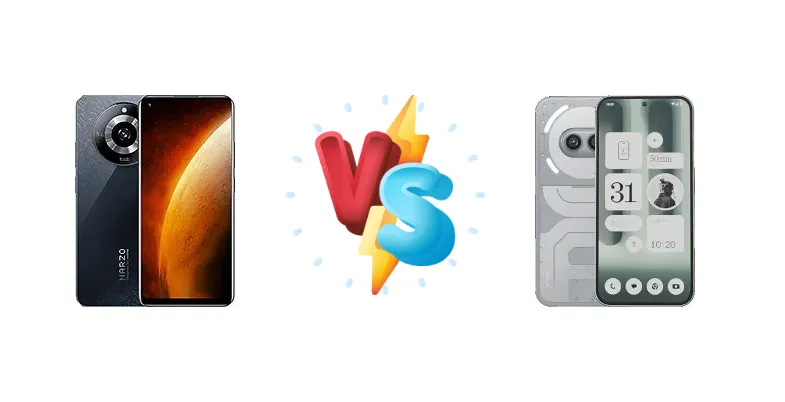
The mid-range smartphone market is fiercely competitive, and the Realme Narzo 60 and Nothing Phone (2a) Plus represent compelling options. The Narzo 60 aims for aggressive pricing, while the Nothing Phone (2a) Plus focuses on a more refined experience with a more powerful chipset. This comparison dissects their key differences to help you choose the right device.
🏆 Quick Verdict
For most users, the Nothing Phone (2a) Plus is the superior choice. Its Dimensity 7350 Pro chipset provides a noticeable performance boost over the Narzo 60’s Dimensity 6020, coupled with significantly faster 50W charging. While the Narzo 60 offers a competitive price, the Nothing Phone (2a) Plus delivers a more future-proof and enjoyable user experience.
| Network |
|---|
| 2G bands | GSM 850 / 900 / 1800 / 1900 | GSM 850 / 900 / 1800 / 1900 |
| 3G bands | HSDPA 850 / 900 / 2100 | HSDPA 800 / 850 / 900 / 1700(AWS) / 1900 / 2100 |
| 4G bands | 1, 3, 5, 8, 28, 40, 41 | 1, 3, 4, 5, 7, 8, 18, 19, 20, 26, 28, 38, 39, 40, 41, 42, 66 |
| 5G bands | 1, 3, 5, 8, 28, 40, 41, 77, 78 SA/NSA | 1, 3, 5, 7, 8, 20, 28, 38, 40, 41, 66, 77, 78 SA/NSA |
| Speed | HSPA, LTE, 5G | HSPA, LTE, 5G |
| Technology | GSM / HSPA / LTE / 5G | GSM / HSPA / LTE / 5G |
| Launch |
|---|
| Announced | 2023, July 06 | 2024, July 31 |
| Status | Available. Released 2023, July 15 | Available. Released 2024, August 03 |
| Body |
|---|
| Build | Glass front (Gorilla Glass 5), eco leather or plastic back, plastic frame | Glass front (Gorilla Glass 5), plastic frame, plastic back |
| Dimensions | 159.8 x 72.9 x 7.9 mm (6.29 x 2.87 x 0.31 in) | 161.7 x 76.3 x 8.5 mm (6.37 x 3.00 x 0.33 in) |
| SIM | Nano-SIM + Nano-SIM | Nano-SIM + Nano-SIM |
| Weight | 182 g (6.42 oz) | 190 g (6.70 oz) |
| Display |
|---|
| Protection | Corning Gorilla Glass 5 | Corning Gorilla Glass 5 |
| Resolution | 1080 x 2400 pixels, 20:9 ratio (~409 ppi density) | 1080 x 2412 pixels, 20:9 ratio (~395 ppi density) |
| Size | 6.43 inches, 99.8 cm2 (~85.7% screen-to-body ratio) | 6.7 inches, 107.5 cm2 (~87.1% screen-to-body ratio) |
| Type | Super AMOLED, 90Hz | AMOLED, 1B colors, 120Hz, 2160Hz PWM, HDR10+, 700 nits (typ), 1100 nits (HBM), 1300 nits (peak) |
| Platform |
|---|
| CPU | Octa-core (2x2.2 GHz Cortex-A76 & 6x2.0 GHz Cortex-A55) | Octa-core (2x3.0 GHz Cortex-A715 & 6x 2.0 GHz Cortex-A510) |
| Chipset | Mediatek Dimensity 6020 (7 nm) | Mediatek Dimensity 7350 Pro (4 nm) |
| GPU | Mali-G57 MC2 | Mali-G610 MC4 |
| OS | Android 13, Realme UI 4.0 | Android 14, up to 3 major Android upgrades, Nothing OS 3.0 |
| Memory |
|---|
| Card slot | microSDXC (dedicated slot) | No |
| Internal | 128GB 8GB RAM, 256GB 8GB RAM | 256GB 8GB RAM, 256GB 12GB RAM |
| Main Camera |
|---|
| Dual | 64 MP, f/1.8, 25mm (wide), 1/2.0", 0.7µm, PDAF
Auxiliary lens | 50 MP, f/1.9, 24mm (wide), 1/1.57", 1.0µm, PDAF, OIS
50 MP, f/2.2, 114˚ (ultrawide), 1/2.76", 0.64µm |
| Features | LED flash, HDR, panorama | LED flash, panorama, HDR |
| Video | 1080p@30fps | 4K@30fps, 1080p@60/120fps, gyro-EIS |
| Selfie camera |
|---|
| Features | Panorama, HDR | HDR |
| Single | 16 MP, f/2.5, 26mm (wide) | 50 MP, f/2.2, (wide), 1/2.76" |
| Video | 1080p@30fps | 4K@30fps |
| Sound |
|---|
| 35mm jack | Yes | No |
| Loudspeaker | Yes | Yes, with stereo speakers |
| Comms |
|---|
| Bluetooth | Yes | 5.3, A2DP, LE |
| NFC | Unspecified | Yes, 360˚ |
| Positioning | GPS, GALILEO, GLONASS, BDS, QZSS | GPS, GALILEO, GLONASS, BDS, QZSS |
| Radio | No | No |
| USB | USB Type-C 2.0 | USB Type-C 2.0, OTG |
| WLAN | Wi-Fi 802.11 a/b/g/n/ac, dual-band | Wi-Fi 802.11 a/b/g/n/ac/6, dual-band, Wi-Fi Direct |
| Features |
|---|
| Sensors | Fingerprint (under display, optical), accelerometer, gyro, proximity, compass | Fingerprint (under display, optical), accelerometer, gyro, proximity, compass |
| Battery |
|---|
| Charging | 33W wired, 50% in 29 min | 50W wired, 50% in 21 min, 100% in 56 min |
| Type | 5000 mAh | 5000 mAh |
| Misc |
|---|
| Colors | Mars Orange, Cosmic Black | Black, Grey |
| Models | RMX3750 | A142P |
| Price | About 200 EUR | € 269.90 / ₹ 22,599 |
Realme Narzo 60
- More affordable price point
- Functional for basic smartphone tasks
- Decent battery life for light users
- Less powerful chipset
- Slower charging speeds
- Likely lower display brightness
Nothing Phone (2a) Plus
- Superior performance with Dimensity 7350 Pro
- Faster 50W charging
- Brighter and more vibrant display
- Higher price tag
- May be overkill for basic users
- Design may not appeal to everyone
Display Comparison
The Nothing Phone (2a) Plus boasts a significantly brighter display, reaching a measured peak of 1097 nits. This is a substantial advantage over what we’d expect from the Narzo 60, making the Nothing Phone (2a) Plus far more usable outdoors under direct sunlight. While the Narzo 60’s panel specifications aren’t available, the brightness difference alone positions the Nothing Phone (2a) Plus as the winner for visual clarity. The Nothing Phone (2a) Plus’s panel likely benefits from its more advanced chipset’s display processing capabilities, resulting in more accurate colors and smoother scrolling.
Camera Comparison
Without detailed camera specifications for the Narzo 60, a direct comparison is limited. However, the Nothing Phone (2a) Plus’s image processing, powered by the Dimensity 7350 Pro’s ISP, is likely to deliver superior image quality, particularly in challenging lighting conditions. The focus should be on the main sensor performance, as the inclusion of 2MP macro lenses on either device adds little practical value. The Nothing Phone (2a) Plus’s processing capabilities will likely result in better dynamic range and noise reduction.
Performance
The core difference lies in the chipsets: the Realme Narzo 60 utilizes the Mediatek Dimensity 6020 (7nm), while the Nothing Phone (2a) Plus features the Dimensity 7350 Pro (4nm). The 4nm process node of the 7350 Pro is inherently more efficient, leading to better thermal management and sustained performance. The CPU architecture also favors the Nothing Phone (2a) Plus, with its Cortex-A715 cores clocked at 3.0 GHz compared to the Narzo 60’s Cortex-A76 cores at 2.2 GHz. This translates to faster app loading times, smoother multitasking, and a more responsive gaming experience. The Narzo 60 will handle everyday tasks adequately, but the Nothing Phone (2a) Plus offers a clear performance advantage.
Battery Life
The Nothing Phone (2a) Plus demonstrates a clear advantage in charging speed, achieving 50% charge in just 21 minutes with its 50W wired charging, and a full charge in 56 minutes. The Narzo 60’s 33W charging takes 29 minutes to reach 50%, indicating a slower overall charging experience. While battery capacity isn’t specified for the Narzo 60, the Nothing Phone (2a) Plus’s active use score of 16:34h suggests excellent battery life, likely optimized by the efficient Dimensity 7350 Pro chipset.
Buying Guide
Buy the Realme Narzo 60 if your primary concern is budget and you prioritize a functional smartphone for everyday tasks like browsing, social media, and light communication. Buy the Nothing Phone (2a) Plus if you value performance for gaming and demanding apps, appreciate faster charging speeds, and desire a brighter, more vibrant display for media consumption.
Frequently Asked Questions
❓ Does the Dimensity 7350 Pro in the Nothing Phone (2a) Plus get hot during extended gaming sessions?
The Dimensity 7350 Pro’s 4nm process node is designed for improved thermal efficiency. While some heat generation is inevitable during prolonged gaming, the Nothing Phone (2a) Plus is expected to manage temperatures effectively, minimizing throttling and maintaining consistent performance. The larger surface area of the phone also aids in heat dissipation.
❓ Is the 33W charging on the Realme Narzo 60 slow compared to other phones in this price range?
Yes, 33W charging is relatively slow compared to the 50W charging offered by the Nothing Phone (2a) Plus and increasingly common in the mid-range segment. While it’s not unusable, it will take considerably longer to fully charge the Narzo 60, impacting convenience for users who frequently need to top up their battery.
❓ How does the Dimensity 6020 in the Realme Narzo 60 perform with graphically demanding games like Genshin Impact?
The Dimensity 6020 can run Genshin Impact, but you’ll likely need to lower the graphics settings to medium or low to achieve a playable frame rate. Expect some stuttering and frame drops during intense scenes. The Nothing Phone (2a) Plus, with its Dimensity 7350 Pro, will provide a significantly smoother and more enjoyable gaming experience at higher settings.