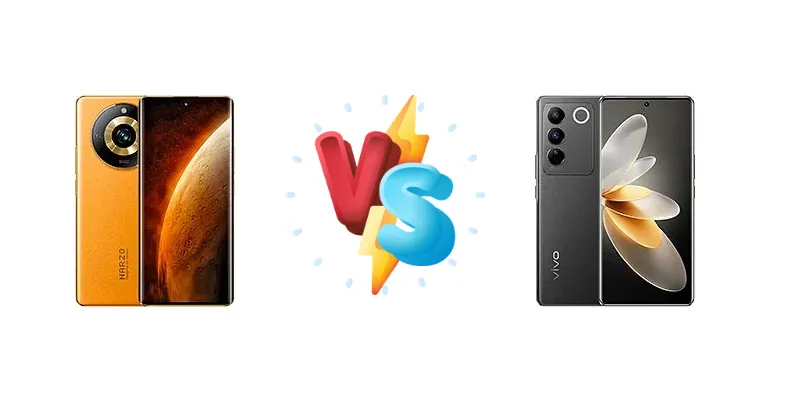
The Realme Narzo 60 Pro and vivo V27 Pro represent compelling options in the increasingly competitive mid-range smartphone market. Both devices aim to deliver a premium experience without the flagship price tag, but they take different approaches. The Narzo 60 Pro focuses on a balance of features, while the V27 Pro prioritizes processing power with a more advanced chipset.
🏆 Quick Verdict
For the average user, the vivo V27 Pro is the stronger choice. Its Mediatek Dimensity 8200 chipset, built on a more efficient 4nm process, provides a noticeable performance advantage over the Narzo 60 Pro’s Dimensity 7050, translating to smoother multitasking and gaming. While battery life is comparable, the V27 Pro’s processing edge justifies the slight price difference.
| Network |
|---|
| 2G bands | GSM 850 / 900 / 1800 / 1900 | GSM 850 / 900 / 1800 / 1900 |
| 3G bands | HSDPA 850 / 900 / 2100 | HSDPA 850 / 900 / 1700(AWS) / 2100 |
| 4G bands | 1, 3, 5, 8, 28, 40, 41 | 1, 3, 4, 5, 8, 28, 38, 40, 41 |
| 5G bands | 1, 3, 5, 8, 28, 40, 41, 77, 78 SA/NSA | 1, 3, 5, 8, 28, 77, 78 SA/NSA |
| Speed | HSPA, LTE, 5G | HSPA, LTE, 5G |
| Technology | GSM / HSPA / LTE / 5G | GSM / HSPA / LTE / 5G |
| Launch |
|---|
| Announced | 2023, July 06 | 2023, March 01 |
| Status | Available. Released 2023, July 15 | Available. Released 2023, March 01 |
| Body |
|---|
| Build | Glass front, eco leather or plastic back, plastic frame | Glass front, plastic frame, glass back |
| Dimensions | 161.6 x 73.9 x 8.2 mm or 8.7 mm | 164.1 x 74.8 x 7.4 mm (6.46 x 2.94 x 0.29 in) |
| SIM | Nano-SIM + Nano-SIM | Nano-SIM + Nano-SIM |
| Weight | 185 g or 191 g (6.53 oz) | 182 g (6.42 oz) |
| | - | Color changing back panel color |
| Display |
|---|
| Protection | Double-reinforced glass | - |
| Resolution | 1080 x 2412 pixels, 20:9 ratio (~394 ppi density) | 1080 x 2400 pixels, 20:9 ratio (~388 ppi density) |
| Size | 6.7 inches, 108.0 cm2 (~90.5% screen-to-body ratio) | 6.78 inches, 111.0 cm2 (~90.4% screen-to-body ratio) |
| Type | AMOLED, 1B colors, HDR10+, 120Hz, 950 nits (peak) | AMOLED, 1B colors, 120Hz, HDR10+ |
| Platform |
|---|
| CPU | Octa-core (2x2.6 GHz Cortex-A78 & 6x2.0 GHz Cortex-A55) | Octa-core (1x3.1 GHz Cortex-A78 & 3x3.0 GHz Cortex-A78 & 4x2.0 GHz Cortex-A55) |
| Chipset | Mediatek Dimensity 7050 (6 nm) | Mediatek Dimensity 8200 (4 nm) |
| GPU | Mali-G68 MC4 | Mali-G610 MC6 |
| OS | Android 13, Realme UI 4.0 | Android 13, Funtouch 13 |
| Memory |
|---|
| Card slot | No | No |
| Internal | 128GB 8GB RAM, 256GB 8GB RAM, 256GB 12GB RAM, 1TB 12GB RAM | 128GB 8GB RAM, 256GB 8GB RAM, 256GB 12GB RAM |
| | - | UFS 3.1 |
| Main Camera |
|---|
| Dual | 100 MP, f/1.8, 26mm (wide), PDAF, OIS
Auxiliary lens | - |
| Features | LED flash, HDR, panorama | Ring-LED flash, panorama, HDR |
| Single | - | 50 MP, f/2.5, (wide), AF |
| Triple | - | 50 MP, f/1.9, (wide), 1/1.56", 1.0µm, PDAF, OIS
8 MP, f/2.2, 16mm, 120˚ (ultrawide), 1/4.0", 1.12µm
2 MP (macro) |
| Video | 4K@30fps, 1080p@30/60/120fps, gyro-EIS | 4K@30/60fps, 1080p@30fps, gyro-EIS |
| Selfie camera |
|---|
| Features | Panorama | Dual-LED flash, HDR |
| Single | 16 MP, f/2.5, 25mm (wide) | 50 MP, f/2.5, (wide), AF |
| Video | 1080p@30fps | 4K@30/60fps, 1080p@30fps, gyro-EIS |
| Sound |
|---|
| 3.5mm jack | - | No |
| 35mm jack | No | No |
| Loudspeaker | Yes, with stereo speakers | Yes |
| | - | 24-bit/192kHz audio |
| Comms |
|---|
| Bluetooth | 5.2, A2DP, LE | 5.3, A2DP, LE |
| NFC | Unspecified | Yes |
| Positioning | GPS, GALILEO, GLONASS, BDS, QZSS | GPS, GLONASS, GALILEO, BDS, NavIC |
| Radio | No | No |
| USB | USB Type-C 2.0 | USB Type-C 2.0, OTG |
| WLAN | Wi-Fi 802.11 a/b/g/n/ac/6, dual-band | Wi-Fi 802.11 a/b/g/n/ac/6, dual-band, Wi-Fi Direct |
| Features |
|---|
| Sensors | Fingerprint (under display, optical), accelerometer, gyro, proximity, compass | Fingerprint (under display, optical), accelerometer, gyro, proximity, compass |
| Battery |
|---|
| Charging | 67W wired | 66W wired, 50% in 19 min, 72% in 30 min |
| Type | 5000 mAh | 4600 mAh |
| Misc |
|---|
| Colors | Mars Orange, Cosmic Black | Magic Blue, Noble Black |
| Models | RMX3771 | V2230 |
| Price | About 270 EUR | About 440 EUR |
| SAR | - | 1.22 W/kg (head) 0.89 W/kg (body) |
| Tests |
|---|
| Battery life | - |
Endurance rating 121h
|
| Camera | - |
Photo / Video |
| Display | - |
Contrast ratio: Infinite (nominal) |
| Loudspeaker | - |
-29.1 LUFS (Average)
|
| Performance | - |
AnTuTu: 846767 (v9)
GeekBench: 3933 (v5.1), 3421 (v6)
GFXBench: 57fps (ES 3.1 onscreen) |
Realme Narzo 60 Pro
- Potentially better value for money
- 67W fast charging
- Balanced feature set
- Less powerful chipset (Dimensity 7050)
- Limited camera details available
vivo V27 Pro
- More powerful chipset (Dimensity 8200)
- Higher peak display brightness
- Potentially better image processing
- Slightly higher price
- Charging speed marginally slower than Narzo 60 Pro
Display Comparison
The vivo V27 Pro boasts a measured peak brightness of 978 nits, suggesting a significantly more visible display in direct sunlight compared to the Narzo 60 Pro (brightness data unavailable). While both displays feature an 'infinite' contrast ratio (a marketing term), the V27 Pro’s higher brightness is a tangible benefit. Without specific panel technology details for the Narzo 60 Pro, it’s difficult to assess color accuracy or viewing angles, but the V27 Pro’s brightness gives it a clear advantage for outdoor usability.
Camera Comparison
Both phones are advertised as having capable photo and video capabilities, but without detailed sensor information, a direct comparison is limited. The absence of specific details on the Narzo 60 Pro’s camera setup makes it difficult to assess its image quality. The V27 Pro likely benefits from the Dimensity 8200’s superior image signal processor (ISP), enabling faster processing and potentially better low-light performance. It's safe to assume both phones include standard features like HDR and portrait modes, but the V27 Pro’s chipset gives it an edge in computational photography.
Performance
The core difference lies in the chipsets. The vivo V27 Pro’s Mediatek Dimensity 8200 (4nm) is a substantial upgrade over the Realme Narzo 60 Pro’s Dimensity 7050 (6nm). The 8200 features a more powerful CPU configuration – a 1x3.1 GHz Cortex-A78 core alongside 3x3.0 GHz Cortex-A78 cores – compared to the Narzo’s 2x2.6 GHz Cortex-A78 and 6x2.0 GHz Cortex-A55 setup. The 4nm fabrication process of the Dimensity 8200 also translates to improved thermal efficiency, reducing the likelihood of performance throttling during sustained workloads. This means the V27 Pro will maintain higher clock speeds for longer periods, benefiting gamers and power users.
Battery Life
Both devices share an endurance rating of 121 hours, indicating similar real-world battery life. However, the charging speeds differ slightly. The Realme Narzo 60 Pro supports 67W wired charging, while the vivo V27 Pro offers 66W. The V27 Pro’s charging is more specifically documented: 50% charge in 19 minutes and 72% in 30 minutes. While the difference is marginal, the V27 Pro’s charging curve appears slightly faster. The comparable endurance ratings suggest that despite the slightly different charging wattages, both phones will provide a full day of use for most users.
Buying Guide
Buy the Realme Narzo 60 Pro if you prioritize a balanced feature set and are looking for a strong value proposition. It’s ideal for everyday users who enjoy social media, streaming, and casual gaming. Buy the vivo V27 Pro if you demand more processing power for demanding tasks like video editing, graphically intensive games, or heavy multitasking. The V27 Pro is the better choice for power users and gamers.
Frequently Asked Questions
❓ Does the Dimensity 8200 in the vivo V27 Pro get noticeably warmer during extended gaming sessions compared to the Dimensity 7050?
The Dimensity 8200, while more powerful, is built on a 4nm process, which is more efficient than the 6nm process of the Dimensity 7050. This means the V27 Pro is *less* likely to experience significant thermal throttling and should maintain higher performance for longer gaming sessions, resulting in a cooler overall experience.
❓ How much of a performance difference will I see in everyday tasks like browsing and social media between these two phones?
For basic tasks like browsing, social media, and video streaming, the performance difference will be minimal. Both phones are capable of handling these tasks smoothly. However, when multitasking with several apps open or performing more demanding tasks like video editing, the vivo V27 Pro’s Dimensity 8200 will provide a noticeably snappier and more responsive experience.
❓ Is the 66W charging on the vivo V27 Pro significantly slower than the 67W charging on the Realme Narzo 60 Pro?
The difference in charging wattage is minimal (66W vs 67W). The V27 Pro’s charging curve is better documented, showing 50% charge in 19 minutes and 72% in 30 minutes. While a direct comparison isn’t possible without testing the Narzo 60 Pro, the difference in charging speed is unlikely to be substantial in real-world use.