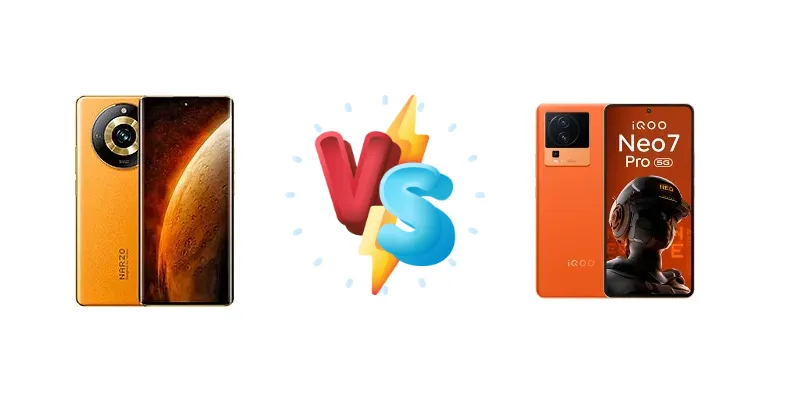
The Realme Narzo 60 Pro and vivo iQOO Neo 7 Pro represent compelling options in the increasingly competitive mid-range smartphone market. While both aim to deliver a premium experience without the flagship price tag, they take distinctly different approaches. The Narzo 60 Pro focuses on a sleek design and balanced features, while the iQOO Neo 7 Pro prioritizes raw performance and blazing-fast charging. This comparison will dissect their key differences to help you determine which device best suits your needs.
🏆 Quick Verdict
For the average user prioritizing sustained performance and rapid charging, the vivo iQOO Neo 7 Pro emerges as the winner. Its Snapdragon 8+ Gen 1 chipset offers a significant performance advantage over the Narzo 60 Pro’s Dimensity 7050, and the 120W charging is a game-changer. However, the Narzo 60 Pro remains a strong contender for those seeking a more balanced package with a focus on design.
| Network |
|---|
| 2G bands | GSM 850 / 900 / 1800 / 1900 | GSM 850 / 900 / 1800 / 1900 |
| 3G bands | HSDPA 850 / 900 / 2100 | HSDPA 800 / 850 / 900 / 1700(AWS) / 1900 / 2100 |
| 4G bands | 1, 3, 5, 8, 28, 40, 41 | 1, 2, 3, 4, 5, 8, 28, 34, 38, 39, 40, 41 |
| 5G bands | 1, 3, 5, 8, 28, 40, 41, 77, 78 SA/NSA | 1, 3, 5, 8, 28, 40, 77, 78 SA/NSA |
| Speed | HSPA, LTE, 5G | HSPA, LTE, 5G |
| Technology | GSM / HSPA / LTE / 5G | GSM / HSPA / LTE / 5G |
| Launch |
|---|
| Announced | 2023, July 06 | 2023, July 04 |
| Status | Available. Released 2023, July 15 | Available. Released 2023, July 15 |
| Body |
|---|
| Build | Glass front, eco leather or plastic back, plastic frame | Glass front, plastic frame, glass or leather back |
| Dimensions | 161.6 x 73.9 x 8.2 mm or 8.7 mm | 164.8 x 76.9 x 8.5 mm or 8.9 mm |
| SIM | Nano-SIM + Nano-SIM | Nano-SIM + Nano-SIM |
| Weight | 185 g or 191 g (6.53 oz) | 197 g or 202 g (6.95 oz) |
| Display |
|---|
| Protection | Double-reinforced glass | - |
| Resolution | 1080 x 2412 pixels, 20:9 ratio (~394 ppi density) | 1080 x 2400 pixels, 20:9 ratio (~388 ppi density) |
| Size | 6.7 inches, 108.0 cm2 (~90.5% screen-to-body ratio) | 6.78 inches, 111.0 cm2 (~87.6% screen-to-body ratio) |
| Type | AMOLED, 1B colors, HDR10+, 120Hz, 950 nits (peak) | AMOLED, 1B colors, 120Hz, HDR10+, 1300 nits (peak) |
| Platform |
|---|
| CPU | Octa-core (2x2.6 GHz Cortex-A78 & 6x2.0 GHz Cortex-A55) | Octa-core (1x3.19 GHz Cortex-X2 & 3x2.75 GHz Cortex-A710 & 4x2.0 GHz Cortex-A510) |
| Chipset | Mediatek Dimensity 7050 (6 nm) | Qualcomm SM8475 Snapdragon 8+ Gen 1 (4 nm) |
| GPU | Mali-G68 MC4 | Adreno 730 |
| OS | Android 13, Realme UI 4.0 | Android 13, Funtouch 13 |
| Memory |
|---|
| Card slot | No | No |
| Internal | 128GB 8GB RAM, 256GB 8GB RAM, 256GB 12GB RAM, 1TB 12GB RAM | 128GB 8GB RAM, 256GB 12GB RAM |
| Main Camera |
|---|
| Dual | 100 MP, f/1.8, 26mm (wide), PDAF, OIS
Auxiliary lens | - |
| Features | LED flash, HDR, panorama | LED flash, HDR, panorama |
| Triple | - | 50 MP, f/1.9, 24mm (wide), 1/1.57", 1.0µm, PDAF, OIS
8 MP, f/2.2, 16mm (ultrawide), 1/4.0", 1.12µm
2 MP (macro) |
| Video | 4K@30fps, 1080p@30/60/120fps, gyro-EIS | 4K@30fps, 1080p@30fps |
| Selfie camera |
|---|
| Features | Panorama | HDR |
| Single | 16 MP, f/2.5, 25mm (wide) | 16 MP, f/2.5, (wide), 1/3.1", 1.0µm |
| Video | 1080p@30fps | 1080p@30fps |
| Sound |
|---|
| 35mm jack | No | No |
| Loudspeaker | Yes, with stereo speakers | Yes, with stereo speakers |
| Comms |
|---|
| Bluetooth | 5.2, A2DP, LE | 5.3, A2DP, LE, aptX HD, aptX Adaptive |
| Infrared port | - | Yes |
| NFC | Unspecified | No |
| Positioning | GPS, GALILEO, GLONASS, BDS, QZSS | GPS, GLONASS, GALILEO, BDS, QZSS, NavIC |
| Radio | No | No |
| USB | USB Type-C 2.0 | USB Type-C 2.0, OTG |
| WLAN | Wi-Fi 802.11 a/b/g/n/ac/6, dual-band | Wi-Fi 802.11 a/b/g/n/ac/6, dual-band, Wi-Fi Direct |
| Features |
|---|
| Sensors | Fingerprint (under display, optical), accelerometer, gyro, proximity, compass | Fingerprint (under display, optical), accelerometer, gyro, proximity, compass |
| Battery |
|---|
| Charging | 67W wired | 120W wired, 50% in 8 min |
| Type | 5000 mAh | 5000 mAh |
| Misc |
|---|
| Colors | Mars Orange, Cosmic Black | Fearless Flame, Dark Storm |
| Models | RMX3771 | I2217 |
| Price | About 270 EUR | About 380 EUR |
Realme Narzo 60 Pro
- Sleek and modern design
- Balanced feature set
- Potentially more affordable
- Less powerful processor
- Slower charging speeds
- May throttle under sustained load
vivo iQOO Neo 7 Pro
- Exceptional performance with Snapdragon 8+ Gen 1
- Blazing-fast 120W charging
- Superior thermal management
- Potentially less refined design
- May be more expensive
- Gaming-focused aesthetic might not appeal to everyone
Display Comparison
While both phones likely feature AMOLED displays (based on market segment), the provided data doesn't specify display characteristics. However, the iQOO Neo 7 Pro, being positioned as a performance-focused device, may benefit from a higher refresh rate and peak brightness. The Narzo 60 Pro, with its emphasis on design, might prioritize color accuracy. Without specific data, it's difficult to definitively declare a winner, but the iQOO Neo 7 Pro’s likely higher refresh rate would be advantageous for gaming.
Camera Comparison
The provided data lacks camera specifications. However, given the iQOO Neo 7 Pro’s focus on overall performance, it’s reasonable to expect a more sophisticated camera system, potentially with a larger sensor and optical image stabilization (OIS). Realme often emphasizes camera features in its marketing, so the Narzo 60 Pro may offer competitive image processing algorithms. Without sensor size or aperture information, it’s impossible to definitively assess camera quality, but the iQOO Neo 7 Pro likely has an edge in low-light performance and dynamic range.
Performance
The core difference lies in the chipsets. The iQOO Neo 7 Pro’s Qualcomm Snapdragon 8+ Gen 1 (4nm) is a significant step up from the Realme Narzo 60 Pro’s MediaTek Dimensity 7050 (6nm). The Snapdragon 8+ Gen 1 boasts a prime Cortex-X2 core clocked at 3.19 GHz, compared to the Narzo’s Cortex-A78 cores at 2.6 GHz. This translates to substantially faster CPU performance in demanding tasks and a more powerful GPU for gaming. The 4nm process node of the Snapdragon also contributes to better thermal efficiency, reducing throttling during extended gaming sessions. The Narzo 60 Pro’s Dimensity 7050 is still capable, but it’s geared towards efficient performance rather than outright speed.
Battery Life
The iQOO Neo 7 Pro’s 120W wired charging is a standout feature, capable of charging 50% in just 8 minutes. This is a massive advantage over the Narzo 60 Pro’s 67W charging. While the Narzo 60 Pro’s battery capacity isn’t specified, the iQOO Neo 7 Pro’s faster charging mitigates the impact of a potentially smaller battery. For users who frequently find themselves needing a quick top-up, the iQOO Neo 7 Pro is the clear winner. The faster charging also reduces the time spent tethered to a wall, enhancing overall usability.
Buying Guide
Buy the Realme Narzo 60 Pro if you need a stylish phone with a decent processor for everyday tasks and moderate gaming, and value a more refined aesthetic. Buy the vivo iQOO Neo 7 Pro if you prioritize uncompromising performance for demanding games and applications, and absolutely need the fastest possible charging speeds – making it ideal for power users and mobile gamers.
Frequently Asked Questions
❓ Will the Snapdragon 8+ Gen 1 in the iQOO Neo 7 Pro overheat during prolonged gaming sessions?
The Snapdragon 8+ Gen 1 is known for its improved thermal efficiency compared to its predecessor, the Snapdragon 8 Gen 1. The iQOO Neo 7 Pro likely incorporates advanced cooling solutions to further mitigate heat buildup, allowing for sustained performance during extended gaming sessions. While some heat is inevitable, it should be well-managed.
❓ Is the 67W charging on the Realme Narzo 60 Pro still considered fast charging in 2024?
While 67W is still considered fast charging, it's significantly slower than the 120W charging offered by the iQOO Neo 7 Pro. It will still provide a reasonable charge time, but users accustomed to ultra-fast charging may find it less convenient.
❓ Does the Dimensity 7050 in the Narzo 60 Pro handle demanding games like Genshin Impact or Call of Duty: Mobile?
The Dimensity 7050 can run demanding games, but you may need to lower graphics settings to achieve a consistently smooth frame rate. It's not as powerful as the Snapdragon 8+ Gen 1, so expect some compromises in visual fidelity.
❓ What type of RAM does the iQOO Neo 7 Pro use, and does that impact performance?
While not specified in the provided data, iQOO Neo series phones typically utilize LPDDR5X RAM. This faster RAM standard contributes to improved multitasking and application loading speeds, enhancing the overall user experience and gaming performance.