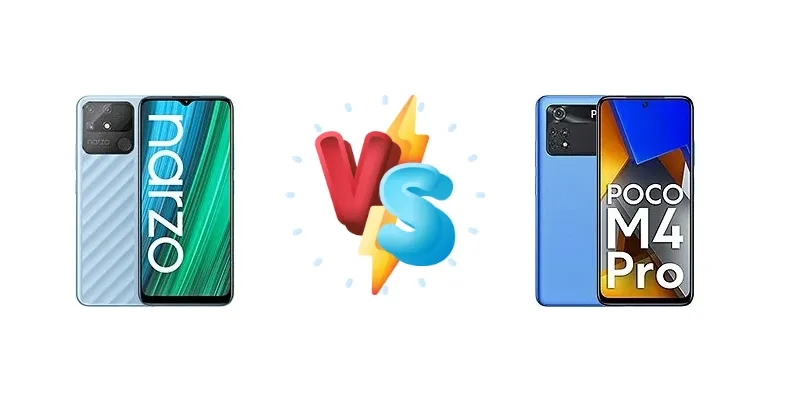
The sub-$200 smartphone market is fiercely competitive, and the Realme Narzo 50A and Xiaomi Poco M4 Pro are two strong contenders. Both aim to deliver a solid experience without breaking the bank, but they take different approaches. The Narzo 50A focuses on a streamlined experience, while the Poco M4 Pro pushes for faster charging and a brighter display. This comparison dives deep into the specs to determine which phone offers the best value.
🏆 Quick Verdict
For most users, the Xiaomi Poco M4 Pro is the better choice. Its Helio G96 chipset provides a noticeable performance edge over the Narzo 50A’s Helio G85, and the 33W fast charging significantly reduces downtime. While both phones offer similar battery endurance, the Poco M4 Pro’s brighter display and faster charging make it the more compelling overall package.
| Network |
|---|
| 2G bands | GSM 850 / 900 / 1800 / 1900 | GSM 850 / 900 / 1800 / 1900 |
| 3G bands | HSDPA 850 / 900 / 2100 | HSDPA 850 / 900 / 1700(AWS) / 1900 / 2100 - International |
| 4G bands | 1, 3, 5, 8, 38, 40, 41 | 1, 2, 3, 4, 5, 7, 8, 20, 28, 38, 40, 41 - International |
| Speed | HSPA, LTE | HSPA, LTE |
| Technology | GSM / HSPA / LTE | GSM / HSPA / LTE |
| | - | 1, 3, 5, 8, 40, 41 - India |
| Launch |
|---|
| Announced | 2021, September 24 | 2022, February 28 |
| Status | Available. Released 2021, October 07 | Available. Released 2022, March 16 |
| Body |
|---|
| Build | - | Glass front (Gorilla Glass 3), plastic frame, plastic back |
| Dimensions | 164.5 x 75.9 x 9.6 mm (6.48 x 2.99 x 0.38 in) | 159.9 x 73.9 x 8.1 mm (6.30 x 2.91 x 0.32 in) |
| SIM | Nano-SIM + Nano-SIM | Nano-SIM + Nano-SIM |
| Weight | 207 g (7.30 oz) | 179.5 g (6.31 oz) |
| | - | IP53, dust and splash resistant |
| Display |
|---|
| Protection | - | Corning Gorilla Glass 3 |
| Resolution | 720 x 1600 pixels, 20:9 ratio (~270 ppi density) | 1080 x 2400 pixels, 20:9 ratio (~409 ppi density) |
| Size | 6.5 inches, 102.0 cm2 (~81.7% screen-to-body ratio) | 6.43 inches, 99.8 cm2 (~84.5% screen-to-body ratio) |
| Type | IPS LCD, 570 nits (HBM) | AMOLED, 90Hz, 700 nits, 1000 nits (peak) |
| Platform |
|---|
| CPU | Octa-core (2x2.0 GHz Cortex-A75 & 6x1.8 GHz Cortex-A55) | Octa-core (2x2.05 GHz Cortex-A76 & 6x2.0 GHz Cortex-A55) |
| Chipset | Mediatek MT6769Z Helio G85 (12 nm) | Mediatek MT6781 Helio G96 (12 nm) |
| GPU | Mali-G52 MC2 | Mali-G57 MC2 |
| OS | Android 11, Realme UI 2.0 | Android 11, MIUI 13 for POCO |
| Memory |
|---|
| Card slot | microSDXC (dedicated slot) | microSDXC (dedicated slot) |
| Internal | 64GB 4GB RAM, 128GB 4GB RAM | 64GB 6GB RAM, 128GB 6GB RAM, 128GB 8GB RAM, 256GB 8GB RAM |
| | - | UFS 2.2 |
| Main Camera |
|---|
| Features | LED flash, HDR, panorama | LED flash, HDR, panorama |
| Single | 8 MP, f/2.0, 26mm (wide), 1/4", 1.12µm | 16 MP, f/2.5, (wide), 1/3.06" 1.0µm |
| Triple | 50 MP, f/1.8, (wide), PDAF
2 MP (macro)
Auxiliary lens | 64 MP, f/1.8, 26mm (wide), 0.7µm, PDAF
8 MP, f/2.2, 118˚ (ultrawide), 1/4.0", 1.12µm
2 MP (macro) |
| Video | 1080p@30/60fps | 1080p@30fps |
| Selfie camera |
|---|
| Features | HDR, panorama | HDR |
| Single | 8 MP, f/2.0, 26mm (wide), 1/4.0", 1.12µm | 16 MP, f/2.5, (wide), 1/3.06" 1.0µm |
| Video | 1080p@30fps | 1080p@30fps |
| Sound |
|---|
| 3.5mm jack | Yes | Yes |
| 35mm jack | Yes | Yes |
| Loudspeaker | Yes | Yes, with stereo speakers |
| | - | 24-bit/192kHz audio |
| Comms |
|---|
| Bluetooth | 5.0, A2DP, LE | 5.0, A2DP, LE |
| Infrared port | - | Yes |
| NFC | No | Yes |
| Positioning | GPS, GLONASS, BDS | GPS, GLONASS, BDS, GALILEO |
| Radio | Unspecified | FM radio, recording |
| USB | USB Type-C 2.0, OTG | USB Type-C 2.0, OTG |
| WLAN | Wi-Fi 802.11 a/b/g/n/ac, dual-band, Wi-Fi Direct | Wi-Fi 802.11 a/b/g/n/ac, dual-band, Wi-Fi Direct |
| Features |
|---|
| Sensors | Fingerprint (rear-mounted), accelerometer, proximity, compass | Fingerprint (side-mounted), accelerometer, gyro, compass |
| | - | Virtual proximity sensing |
| Battery |
|---|
| Charging | 18W wired
5W reverse wired | 33W wired, PD3.0, QC3, 100% in 58 min |
| Type | 6000 mAh | Li-Po 5000 mAh |
| Misc |
|---|
| Colors | Oxygen Blue, Oxygen Green | Power Black, Cool Blue, Poco Yellow |
| Models | RMX3430 | MZB0B5VIN, 2201117PI, 2201117PG |
| Price | About 130 EUR | € 100.18 |
| SAR | - | 0.85 W/kg (head) 0.85 W/kg (body) |
| SAR EU | - | 0.59 W/kg (head) 0.84 W/kg (body) |
| Tests |
|---|
| Battery life | - |
Endurance rating 126h
|
| Camera | - |
Photo / Video |
| Display | - |
Contrast ratio: Infinite (nominal) |
| Loudspeaker | - |
-25.2 LUFS (Very good)
|
| Performance | - |
AnTuTu: 318444 (v9)
GeekBench: 1836 (v5.1)
GFXBench: 12fps (ES 3.1 onscreen) |
Realme Narzo 50A
- Simple and reliable software experience
- Affordable price point
- 5W reverse wired charging
- Slower processor compared to the Poco M4 Pro
- Significantly slower charging speeds
Xiaomi Poco M4 Pro
- Faster and more efficient Helio G96 chipset
- 33W fast charging with PD3.0 and QC3 support
- Brighter display for better outdoor visibility
- May be slightly more expensive than the Narzo 50A
- Software experience can be more feature-rich (and potentially bloated)
Display Comparison
The Poco M4 Pro boasts a significantly brighter display, reaching a measured 737 nits, compared to an unspecified brightness for the Narzo 50A. This higher peak brightness translates to better visibility outdoors under direct sunlight. While both displays have an 'infinite' contrast ratio (typical for IPS LCDs), the brighter panel on the Poco M4 Pro offers a more vibrant and engaging viewing experience. Bezels are comparable, but the superior brightness gives the Poco M4 Pro a clear advantage for media consumption.
Camera Comparison
Both phones feature a 'Photo / Video' camera setup, but details are limited. Without specific sensor sizes or aperture information, it’s difficult to make a definitive judgment. However, the Poco M4 Pro’s chipset generally supports more advanced image processing capabilities. The inclusion of features like night mode and HDR is likely more refined on the Poco M4 Pro. It's reasonable to assume the Poco M4 Pro will deliver better image quality, particularly in challenging lighting conditions. The 2MP macro cameras on both devices are likely to offer limited utility.
Performance
The Poco M4 Pro’s Mediatek Helio G96 chipset represents a step up from the Narzo 50A’s Helio G85. The G96 utilizes two Cortex-A76 cores clocked at 2.05 GHz, versus the Narzo 50A’s Cortex-A75 cores at 2.0 GHz. This architectural difference, combined with a slightly higher clock speed, results in improved single-core and multi-core performance on the Poco M4 Pro. While both chipsets are 12nm, the G96’s more efficient design should translate to better sustained performance during gaming. The Narzo 50A will handle everyday tasks adequately, but the Poco M4 Pro offers a smoother experience for more demanding applications.
Battery Life
Both the Realme Narzo 50A and Xiaomi Poco M4 Pro achieve an endurance rating of 126 hours, suggesting comparable battery life under similar usage patterns. However, the Poco M4 Pro’s 33W fast charging is a game-changer. It can reach 100% charge in just 58 minutes, while the Narzo 50A’s 18W charging is considerably slower. This faster charging capability significantly reduces downtime and makes the Poco M4 Pro more convenient for users who are always on the go. The 5W reverse wired charging on the Narzo 50A is a niche feature, useful for topping up accessories but not a primary selling point.
Buying Guide
Buy the Realme Narzo 50A if you prioritize a simple, reliable experience and are comfortable with slower charging speeds. It’s a good option for users who primarily need a phone for basic tasks like calling, texting, and light social media. Buy the Xiaomi Poco M4 Pro if you want a phone that can handle more demanding tasks like gaming, streaming, and photography, and if you value fast charging to minimize downtime. It’s ideal for users who need a versatile device that can keep up with their active lifestyle.
Frequently Asked Questions
❓ Does the Poco M4 Pro’s Helio G96 chipset get noticeably warmer during extended gaming sessions compared to the Narzo 50A’s Helio G85?
While the Helio G96 is more powerful, it also generates more heat. However, Xiaomi typically implements thermal management solutions to mitigate overheating. The Poco M4 Pro is likely to experience some throttling during prolonged gaming, but it should offer a more sustained level of performance than the Narzo 50A, which will throttle sooner due to its less powerful chipset.
❓ Is the 18W charging on the Realme Narzo 50A slow enough to be a significant inconvenience for daily use?
Yes, 18W charging is considerably slower than the 33W charging on the Poco M4 Pro. Expect the Narzo 50A to take well over two hours to fully charge from 0%, whereas the Poco M4 Pro can reach 100% in under an hour. This difference is particularly noticeable for users who frequently run out of battery and need a quick top-up.
❓ How does the software experience differ between Realme UI on the Narzo 50A and MIUI on the Poco M4 Pro?
Realme UI is generally considered to be cleaner and closer to stock Android than MIUI. MIUI, while feature-rich, often includes pre-installed apps (bloatware) and can be more aggressive with its power management. Users who prefer a minimalist software experience may prefer the Narzo 50A, while those who want more customization options may prefer the Poco M4 Pro.