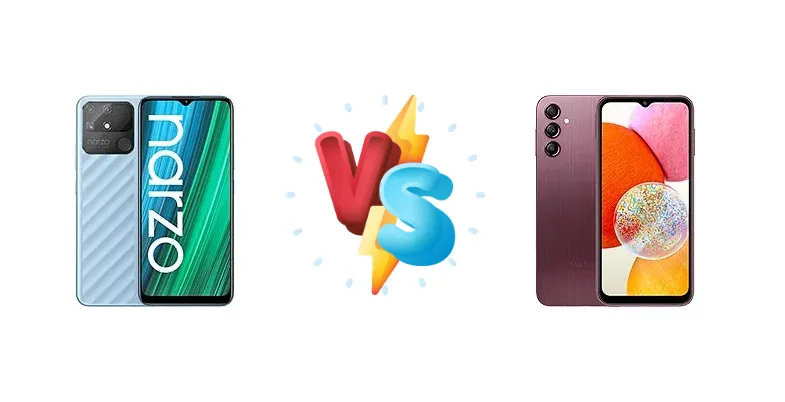
The budget smartphone market is fiercely competitive, and the Realme Narzo 50A and Samsung Galaxy A14 are two strong contenders. Both offer compelling features at an affordable price, but which one delivers the best overall experience? Let's dive into a detailed comparison to help you decide.
🏆 Quick Verdict
The Samsung Galaxy A14 generally edges out the Narzo 50A thanks to its potentially more efficient Exynos chipset (Version B), improved display, and Samsung's software support. However, the Narzo 50A offers reverse charging and might be slightly more affordable depending on regional pricing.
| Network |
|---|
| 2G bands | GSM 850 / 900 / 1800 / 1900 | GSM 850 / 900 / 1800 / 1900 |
| 3G bands | HSDPA 850 / 900 / 2100 | HSDPA 850 / 900 / 2100 |
| 4G bands | 1, 3, 5, 8, 38, 40, 41 | 1, 3, 5, 7, 8, 20, 28, 38, 40, 41 |
| Speed | HSPA, LTE | HSPA, LTE |
| Technology | GSM / HSPA / LTE | GSM / HSPA / LTE |
| Launch |
|---|
| Announced | 2021, September 24 | 2023, February 28 |
| Status | Available. Released 2021, October 07 | Available. Released 2023, March 27 |
| Body |
|---|
| Build | - | Glass front, plastic back, plastic frame |
| Dimensions | 164.5 x 75.9 x 9.6 mm (6.48 x 2.99 x 0.38 in) | 167.7 x 78 x 9.1 mm (6.60 x 3.07 x 0.36 in) |
| SIM | Nano-SIM + Nano-SIM | · Nano-SIM· Nano-SIM + Nano-SIM |
| Weight | 207 g (7.30 oz) | 201 g (7.09 oz) |
| Display |
|---|
| Resolution | 720 x 1600 pixels, 20:9 ratio (~270 ppi density) | 1080 x 2408 pixels, 20:9 ratio (~400 ppi density) |
| Size | 6.5 inches, 102.0 cm2 (~81.7% screen-to-body ratio) | 6.6 inches, 104.9 cm2 (~80.2% screen-to-body ratio) |
| Type | IPS LCD, 570 nits (HBM) | PLS LCD |
| Platform |
|---|
| CPU | Octa-core (2x2.0 GHz Cortex-A75 & 6x1.8 GHz Cortex-A55) | Octa-core (2x2.0 GHz Cortex-A75 & 6x1.8 GHz Cortex-A55) - Version AOcta-core (4x2.0 GHz Cortex-A55 & 4x2.0 GHz Cortex-A55) - Version B |
| Chipset | Mediatek MT6769Z Helio G85 (12 nm) | Mediatek MT6769 Helio G80 (12 nm) - Version AExynos 850 (8 nm) - Version B |
| GPU | Mali-G52 MC2 | Mali-G52 MC2 |
| OS | Android 11, Realme UI 2.0 | Android 13, upgradable to Android 15, One UI 7 |
| Memory |
|---|
| Card slot | microSDXC (dedicated slot) | microSDXC (dedicated slot) |
| Internal | 64GB 4GB RAM, 128GB 4GB RAM | 64GB 4GB RAM, 128GB 4GB RAM, 128GB 6GB RAM |
| Main Camera |
|---|
| Features | LED flash, HDR, panorama | LED flash, panorama, HDR |
| Single | 8 MP, f/2.0, 26mm (wide), 1/4", 1.12µm | 13 MP, f/2.0, (wide) |
| Triple | 50 MP, f/1.8, (wide), PDAF
2 MP (macro)
Auxiliary lens | 50 MP, f/1.8, 26mm (wide), 1/2.75", 0.64µm, PDAF
5 MP, f/2.2, 17mm (ultrawide), 1/5.0", 1.12µm
2 MP (macro) |
| Video | 1080p@30/60fps | 1080p@30fps |
| Selfie camera |
|---|
| Features | HDR, panorama | - |
| Single | 8 MP, f/2.0, 26mm (wide), 1/4.0", 1.12µm | 13 MP, f/2.0, 26mm (wide), 1/3.1", 1.12µm |
| Video | 1080p@30fps | 1080p@30fps |
| Sound |
|---|
| 3.5mm jack | Yes | Yes |
| 35mm jack | Yes | Yes |
| Loudspeaker | Yes | Yes |
| Comms |
|---|
| Bluetooth | 5.0, A2DP, LE | 5.1 or 5.3, A2DP, LE |
| NFC | No | Yes (market/region dependent) |
| Positioning | GPS, GLONASS, BDS | GPS, GALILEO, GLONASS, BDS, QZSS |
| Radio | Unspecified | Unspecified |
| USB | USB Type-C 2.0, OTG | USB Type-C 2.0 |
| WLAN | Wi-Fi 802.11 a/b/g/n/ac, dual-band, Wi-Fi Direct | Wi-Fi 802.11 a/b/g/n/ac, dual-band, Wi-Fi Direct |
| Features |
|---|
| Sensors | Fingerprint (rear-mounted), accelerometer, proximity, compass | Fingerprint (side-mounted), accelerometer, proximity, compass |
| Battery |
|---|
| Charging | 18W wired
5W reverse wired | 15W wired |
| Type | 6000 mAh | Li-Po 5000 mAh |
| Misc |
|---|
| Colors | Oxygen Blue, Oxygen Green | Black, Dark Red, Silver, Green |
| Models | RMX3430 | SM-A145F, SM-A145F/DSN, SM-A145M, SM-A145M/DS, SM-A145P, SM-A145R |
| Price | About 130 EUR | € 85.76 / $ 147.60 / £ 79.95 |
| SAR EU | - | 0.46 W/kg (head) 1.37 W/kg (body) |
Realme Narzo 50A
- Reverse charging capability
- Potentially lower price
- Decent gaming performance (Helio G85)
- Lower display quality
- Less refined software
- Camera performance not as strong
Samsung Galaxy A14
- Better display (Version B)
- More efficient chipset (Version B)
- Samsung's software support
- Versatile camera system
- Slower charging (15W)
- Potentially higher price
- Version A performance similar to Narzo 50A
Display Comparison
The Galaxy A14 (Version B) typically features a slightly better display with a higher resolution and potentially improved color accuracy compared to the Narzo 50A's standard LCD. Both offer a large screen size suitable for media consumption.
Camera Comparison
The Galaxy A14 generally boasts a more versatile camera system with potentially better image processing and low-light performance. While both phones offer decent cameras for the price, the A14 often produces more pleasing results.
Performance
The Narzo 50A's Helio G85 generally offers slightly better gaming performance due to its slightly more powerful GPU. However, the Galaxy A14's Exynos 850 (Version B) is often more efficient, leading to better overall responsiveness and multitasking, especially in the long run. Version A of the A14 with the Helio G80 will perform similarly to the Narzo 50A.
Battery Life
Both phones offer large batteries, providing all-day battery life for moderate usage. The Narzo 50A's reverse charging capability is a unique advantage, allowing it to act as a power bank for other devices.
Buying Guide
The Realme Narzo 50A is a good choice for users prioritizing reverse charging and potentially a lower price point. The Samsung Galaxy A14 is ideal for those seeking a smoother experience, a better display, and the reliability of Samsung's software ecosystem.
Frequently Asked Questions
❓ Which phone is better for gaming?
The Realme Narzo 50A's Helio G85 generally offers slightly better gaming performance, although both are suitable for casual gaming.
❓ Does the Samsung Galaxy A14 get software updates for longer?
Yes, Samsung typically provides longer software update support for its Galaxy A series devices compared to Realme.
❓ What does 'Version A' and 'Version B' mean for the Galaxy A14?
The Galaxy A14 is available with two different chipsets: Version A uses a Mediatek Helio G80, while Version B uses a Samsung Exynos 850. The Exynos version generally offers better efficiency and performance.