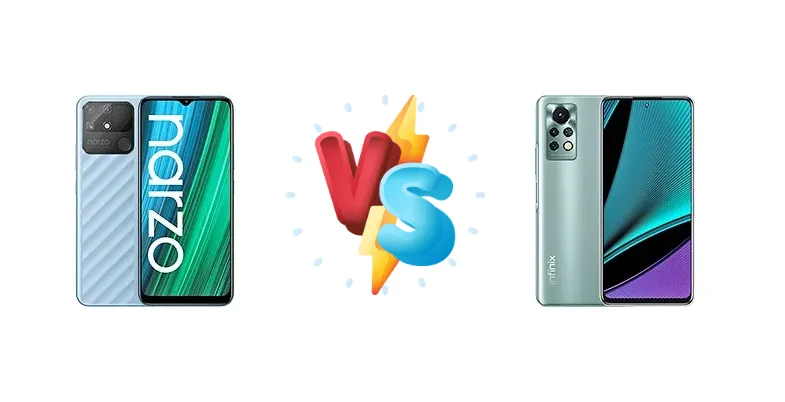
The sub-$200 smartphone market is fiercely competitive, and the Realme Narzo 50A and Infinix Note 11s are two strong contenders vying for your attention. Both aim to deliver a solid experience without breaking the bank, but they take different approaches to achieving that goal. This comparison dives deep into their specifications, performance, and features to determine which device offers the best overall package.
🏆 Quick Verdict
For most users, the Infinix Note 11s emerges as the better choice. Its Helio G96 chipset provides a noticeable performance uplift over the Narzo 50A’s Helio G85, and the significantly faster 33W charging dramatically improves usability. While the Narzo 50A remains a capable device, the Note 11s offers a more future-proof and convenient experience.
| Network |
|---|
| 2G bands | GSM 850 / 900 / 1800 / 1900 | GSM 850 / 900 / 1800 / 1900 |
| 3G bands | HSDPA 850 / 900 / 2100 | HSDPA 850 / 900 / 1700(AWS) / 1900 / 2100 |
| 4G bands | 1, 3, 5, 8, 38, 40, 41 | 1, 2, 3, 4, 5, 7, 8, 20, 28, 38, 41, 40 |
| Speed | HSPA, LTE | HSPA, LTE |
| Technology | GSM / HSPA / LTE | GSM / HSPA / LTE |
| | - | 1, 3, 7, 8, 20, 28 |
| Launch |
|---|
| Announced | 2021, September 24 | 2021, November 08 |
| Status | Available. Released 2021, October 07 | Available. Released 2021, November 08 |
| Body |
|---|
| Build | - | Glass front, plastic frame, plastic back |
| Dimensions | 164.5 x 75.9 x 9.6 mm (6.48 x 2.99 x 0.38 in) | 173.1 x 78.4 x 8.7 mm (6.81 x 3.09 x 0.34 in) |
| SIM | Nano-SIM + Nano-SIM | Nano-SIM + Nano-SIM |
| Weight | 207 g (7.30 oz) | - |
| Display |
|---|
| Resolution | 720 x 1600 pixels, 20:9 ratio (~270 ppi density) | 1080 x 2460 pixels (~387 ppi density) |
| Size | 6.5 inches, 102.0 cm2 (~81.7% screen-to-body ratio) | 6.95 inches, 114.7 cm2 (~84.5% screen-to-body ratio) |
| Type | IPS LCD, 570 nits (HBM) | IPS LCD, 120Hz |
| Platform |
|---|
| CPU | Octa-core (2x2.0 GHz Cortex-A75 & 6x1.8 GHz Cortex-A55) | Octa-core (2x2.05 GHz Cortex-A76 & 6x2.0 GHz Cortex-A55) |
| Chipset | Mediatek MT6769Z Helio G85 (12 nm) | Mediatek MT6781 Helio G96 (12 nm) |
| GPU | Mali-G52 MC2 | Mali-G57 MC2 |
| OS | Android 11, Realme UI 2.0 | Android 11, XOS 10 |
| Memory |
|---|
| Card slot | microSDXC (dedicated slot) | microSDXC (dedicated slot) |
| Internal | 64GB 4GB RAM, 128GB 4GB RAM | 64GB 4GB RAM, 64GB 6GB RAM, 128GB 4GB RAM, 128GB 6GB RAM, 128GB 8GB RAM |
| | - | UFS 2.2 |
| Main Camera |
|---|
| Features | LED flash, HDR, panorama | Quad-LED flash, HDR, panorama |
| Single | 8 MP, f/2.0, 26mm (wide), 1/4", 1.12µm | 16 MP |
| Triple | 50 MP, f/1.8, (wide), PDAF
2 MP (macro)
Auxiliary lens | 50 MP, f/1.6, (wide), PDAF
2 MP (macro)
Auxiliary lens |
| Video | 1080p@30/60fps | 1440p@30fps |
| Selfie camera |
|---|
| Features | HDR, panorama | - |
| Single | 8 MP, f/2.0, 26mm (wide), 1/4.0", 1.12µm | 16 MP |
| Video | 1080p@30fps | 1080p@30fps |
| Sound |
|---|
| 3.5mm jack | Yes | Yes |
| 35mm jack | Yes | Yes |
| Loudspeaker | Yes | Yes, with dual speakers |
| Comms |
|---|
| Bluetooth | 5.0, A2DP, LE | Yes |
| NFC | No | No |
| Positioning | GPS, GLONASS, BDS | GPS |
| Radio | Unspecified | FM radio |
| USB | USB Type-C 2.0, OTG | USB Type-C 2.0, OTG |
| WLAN | Wi-Fi 802.11 a/b/g/n/ac, dual-band, Wi-Fi Direct | Wi-Fi 802.11 a/b/g/n/ac, dual-band, Wi-Fi Direct |
| Features |
|---|
| Sensors | Fingerprint (rear-mounted), accelerometer, proximity, compass | Fingerprint (side-mounted), accelerometer, gyro, proximity, compass |
| Battery |
|---|
| Charging | 18W wired
5W reverse wired | 33W wired |
| Type | 6000 mAh | 5000 mAh |
| Misc |
|---|
| Colors | Oxygen Blue, Oxygen Green | Haze Green, Mithril Gray, Symphony Cyan |
| Models | RMX3430 | X698 |
| Price | About 130 EUR | About 180 EUR |
Realme Narzo 50A
- Potentially lower price point
- Clean and simple design
- Reverse charging not available
- Slower processor (Helio G85)
- Slower charging speed (18W)
- Less future-proof
Infinix Note 11s
- Faster processor (Helio G96)
- Significantly faster charging (33W)
- Reverse wired charging support
- May be slightly more expensive
- Potentially more aggressive software
- Design may be less understated
Display Comparison
Neither device boasts a standout display. Both likely utilize LCD panels, a common trait in this price bracket. However, detailed display specs (resolution, brightness, color gamut) are missing. The focus here is on processing power, not visual fidelity. Bezels are likely comparable, and color accuracy will be standard for budget phones – adequate, but not color-critical.
Camera Comparison
Without detailed camera specs beyond the chipsets, a direct comparison is limited. Both phones likely feature a multi-camera setup with a primary sensor, but the quality will heavily depend on sensor size and image processing. It’s safe to assume both will include a 2MP macro lens, which offers limited practical value. The G96’s ISP (Image Signal Processor) is likely more advanced, potentially leading to better image quality in challenging lighting conditions, but this is speculative without further data.
Performance
The core difference lies in the chipsets. The Infinix Note 11s features the Mediatek Helio G96, built on a 12nm process, with a CPU configuration of 2x2.05 GHz Cortex-A76 cores and 6x2.0 GHz Cortex-A55 cores. This represents an architectural upgrade over the Narzo 50A’s Helio G85 (also 12nm) with its 2x2.0 GHz Cortex-A75 and 6x1.8 GHz Cortex-A55 setup. The Cortex-A76 cores in the G96 offer improved single-core performance, translating to snappier app launches and smoother multitasking. While both use the same 12nm process, the architectural improvements in the G96 give the Note 11s a clear advantage in CPU-bound tasks. The GPU within the G96 also provides a boost for gaming, though neither phone will handle demanding titles at maximum settings.
Battery Life
The Narzo 50A supports 18W wired charging, while the Infinix Note 11s boasts a significantly faster 33W wired charging capability. This is a major differentiator. While battery capacity isn’t specified, the faster charging of the Note 11s drastically reduces downtime. A full charge on the Narzo 50A will take considerably longer than on the Note 11s. The Note 11s also includes 5W reverse wired charging, a feature absent on the Narzo 50A, allowing it to top up other devices.
Buying Guide
Buy the Realme Narzo 50A if you prioritize a slightly more conservative design and are on an extremely tight budget, willing to trade performance and charging speed for the lowest possible price. Buy the Infinix Note 11s if you value faster performance for gaming and multitasking, and appreciate the convenience of significantly quicker 33W charging, making it ideal for users who are always on the go.
Frequently Asked Questions
❓ Will the Infinix Note 11s overheat during prolonged gaming sessions?
The Helio G96 is generally efficient, but sustained gaming will generate heat. The Note 11s likely incorporates thermal management solutions, but throttling may occur during extended, demanding gameplay. The Narzo 50A, with its less powerful chipset, may experience less throttling but will also deliver lower frame rates.
❓ Is the 33W charging on the Infinix Note 11s compatible with all USB-C chargers?
While the Note 11s uses USB-C, to achieve the full 33W charging speed, you'll need a charger that supports Power Delivery (PD) or Quick Charge (QC) protocols. Using a standard 5W charger will still charge the phone, but at a significantly slower rate.
❓ How does the software experience differ between the Realme Narzo 50A and the Infinix Note 11s?
Realme UI is generally considered cleaner and closer to stock Android, while Infinix's XOS is more heavily customized. XOS often includes pre-installed apps (bloatware) and a more aggressive notification system. Users who prefer a minimalist experience may prefer the Narzo 50A, while those who enjoy customization options might find XOS appealing.