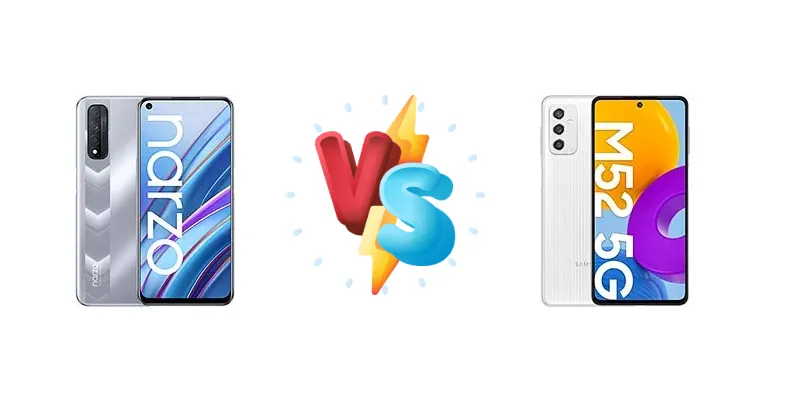
The Realme Narzo 30 and Samsung Galaxy M52 5G represent compelling options in the increasingly competitive mid-range 5G smartphone market. While both aim to deliver a balanced experience, they take distinctly different approaches to achieving it. The Narzo 30 focuses on delivering a solid gaming experience at a lower price point, while the M52 5G prioritizes a more refined overall experience with a stronger emphasis on display quality and processing power.
🏆 Quick Verdict
For the average user, the Samsung Galaxy M52 5G is the superior choice. Its Snapdragon 778G chipset provides a substantial performance uplift over the Narzo 30’s Helio G95, translating to smoother multitasking, faster app loading, and a better gaming experience. While the Narzo 30 offers faster charging, the M52 5G’s brighter display and more efficient processor make it the more well-rounded device.
| Network |
|---|
| 2G bands | GSM 850 / 900 / 1800 / 1900 | GSM 850 / 900 / 1800 / 1900 |
| 3G bands | HSDPA 850 / 900 / 1700(AWS) / 1900 / 2100 | HSDPA 850 / 900 / 1700(AWS) / 1900 / 2100 |
| 4G bands | 1, 2, 3, 4, 5, 7, 8, 20, 28, 38, 40, 41 | 1, 2, 3, 4, 5, 7, 8, 12, 17, 20, 26, 28, 38, 40, 41, 66 |
| 5G bands | - | SA/NSA/Sub6 |
| Speed | HSPA, LTE | HSPA, LTE, 5G |
| Technology | GSM / HSPA / LTE | GSM / HSPA / LTE / 5G |
| Launch |
|---|
| Announced | 2021, May 18 | 2021, September 24 |
| Status | Available. Released 2021, May 20 | Available. Released 2021, October 03 |
| Body |
|---|
| Build | - | Glass front (Gorilla Glass 5), plastic frame, plastic back |
| Dimensions | 162.3 x 75.4 x 9.4 mm (6.39 x 2.97 x 0.37 in) | 164.2 x 76.4 x 7.4 mm (6.46 x 3.01 x 0.29 in) |
| SIM | Nano-SIM + Nano-SIM | Nano-SIM + Nano-SIM |
| Weight | 192 g (6.77 oz) | 173 g (6.10 oz) |
| Display |
|---|
| Protection | - | Corning Gorilla Glass 5 |
| Resolution | 1080 x 2400 pixels, 20:9 ratio (~405 ppi density) | 1080 x 2400 pixels, 20:9 ratio (~393 ppi density) |
| Size | 6.5 inches, 102.0 cm2 (~83.4% screen-to-body ratio) | 6.7 inches, 108.4 cm2 (~86.4% screen-to-body ratio) |
| Type | IPS LCD, 90Hz, 580 nits (peak) | Super AMOLED Plus, 120Hz |
| Platform |
|---|
| CPU | Octa-core (2x2.05 GHz Cortex-A76 & 6x2.0 GHz Cortex-A55) | Octa-core (1x2.4 GHz Cortex-A78 & 3x2.2 GHz Cortex-A78 & 4x1.9 GHz Cortex-A55) |
| Chipset | Mediatek MT6785V/CD Helio G95 (12 nm) | Qualcomm SM7325 Snapdragon 778G 5G (6 nm) |
| GPU | Mali-G76 MC4 | Adreno 642L |
| OS | Android 11, Realme UI 2.0 | Android 11, upgradable to Android 13, One UI 5.1 |
| Memory |
|---|
| Card slot | microSDXC (dedicated slot) | microSDXC (uses shared SIM slot) |
| Internal | 64GB 4GB RAM, 64GB 6GB RAM, 128GB 4GB RAM, 128GB 6GB RAM | 128GB 6GB RAM, 128GB 8GB RAM |
| Main Camera |
|---|
| Features | LED flash, HDR, panorama | LED flash, panorama, HDR |
| Single | 16 MP, f/2.1, (wide), 1/3.06", 1.0µm | 32 MP, f/2.2, 26mm (wide) |
| Triple | 48 MP, f/1.8, 26mm (wide), PDAF
2 MP (macro)
Auxiliary lens | 64 MP, f/1.8, 26mm (wide), 1/1.97", 0.7um, PDAF
12 MP, f/2.2, 123˚, (ultrawide), 1/3.06", 1.12µm
5 MP (macro) |
| Video | 4K@30fps, 1080p@30/60/120fps, gyro-EIS | 4K@30fps, 1080p@30/60fps |
| Selfie camera |
|---|
| Features | HDR, panorama | - |
| Single | 16 MP, f/2.1, (wide), 1/3.06", 1.0µm | 32 MP, f/2.2, 26mm (wide) |
| Video | 1080p@30/120fps | 4K@30fps, 1080p@30fps |
| Sound |
|---|
| 3.5mm jack | Yes | No |
| 35mm jack | Yes | No |
| Loudspeaker | Yes | Yes |
| Comms |
|---|
| Bluetooth | 5.0, A2DP, LE | 5.0, A2DP, LE |
| NFC | Yes | Yes |
| Positioning | GPS, GLONASS, BDS | GPS, GLONASS, GALILEO, BDS, QZSS |
| Radio | No | Unspecified |
| USB | USB Type-C 2.0 | USB Type-C 2.0, OTG |
| WLAN | Wi-Fi 802.11 a/b/g/n/ac, dual-band, Wi-Fi Direct | Wi-Fi 802.11 a/b/g/n/ac/6, dual-band, Wi-Fi Direct |
| Features |
|---|
| Sensors | Fingerprint (side-mounted), accelerometer, gyro, proximity, compass | Fingerprint (side-mounted), accelerometer, gyro, proximity, compass |
| Battery |
|---|
| Charging | 30W wired, 100% in 65 min | 25W wired |
| Type | 5000 mAh | Li-Ion 5000 mAh |
| Misc |
|---|
| Colors | Racing Blue, Racing Silver | Icy Blue, Blazing Black, White |
| Models | RMX2156 | SM-M526BR, SM-M526BR/DS, SM-M526B, SM-M526B/DS |
| Price | About 460 EUR | About 300 EUR |
| SAR EU | - | 0.79 W/kg (head) 1.40 W/kg (body) |
| Tests |
|---|
| Battery life | - |
Endurance rating 123h
|
| Camera | - |
Photo / Video |
| Display | - |
Contrast ratio: Infinite (nominal) |
| Loudspeaker | - |
-30.0 LUFS (Average)
|
| Performance | - |
AnTuTu: 504424 (v9)
GeekBench: 2796 (v5.1)
GFXBench: 28fps (ES 3.1 onscreen) |
Realme Narzo 30
- Faster 30W charging for quicker top-ups.
- Potentially lower price point, offering better value for budget-conscious users.
- Helio G95 is still capable of handling most mobile games at medium settings.
- Less powerful Helio G95 chipset compared to the Snapdragon 778G.
- Likely a less refined overall user experience.
- Display specifications are less impressive than the M52 5G.
Samsung Galaxy M52 5G
- Significantly more powerful Snapdragon 778G chipset.
- Brighter and more vibrant display for better viewing experience.
- More efficient processor for longer battery life.
- Slower 25W charging compared to the Narzo 30.
- Potentially higher price point.
- May not offer the absolute lowest price for a 5G phone.
Display Comparison
The Samsung Galaxy M52 5G boasts a significantly brighter display, reaching a measured 777 nits, compared to the Narzo 30 (brightness data unavailable). This higher peak brightness translates to better visibility outdoors under direct sunlight. While both phones likely utilize LCD panels (based on market segment), the M52 5G’s ‘Infinite’ contrast ratio suggests a more optimized panel with deeper blacks. The Narzo 30’s display specifications are less detailed, suggesting a more basic implementation focused on cost savings.
Camera Comparison
Both devices offer 'Photo / Video' capabilities, but detailed camera specifications are limited. Without sensor size or aperture information, a direct comparison is difficult. However, Samsung generally employs more sophisticated image processing algorithms, potentially leading to better dynamic range and detail in photos. The Narzo 30’s camera system likely prioritizes affordability, while the M52 5G aims for a more balanced approach to image quality. The presence of OIS (Optical Image Stabilization) on the M52 5G, if present, would be a significant advantage for video recording and low-light photography.
Performance
The core difference lies in the chipsets. The Samsung Galaxy M52 5G’s Snapdragon 778G (6nm) is a clear upgrade over the Realme Narzo 30’s Helio G95 (12nm). The 778G features a more modern CPU architecture – a 1x2.4 GHz Cortex-A78 prime core alongside 3x2.2 GHz Cortex-A78 cores – compared to the Narzo 30’s 2x2.05 GHz Cortex-A76 and 6x2.0 GHz Cortex-A55 configuration. This architectural advantage, combined with the smaller 6nm process node, results in significantly improved performance and power efficiency. The Snapdragon 778G’s Adreno 642L GPU also outperforms the Helio G95’s Mali-G57 MC2, offering a smoother gaming experience.
Battery Life
Both phones achieve an endurance rating of 123 hours, suggesting similar real-world battery life despite the Narzo 30’s 30W charging versus the M52 5G’s 25W. The Snapdragon 778G’s superior power efficiency likely offsets the Narzo 30’s faster charging speed. The Narzo 30 can reach 100% charge in 65 minutes, while the M52 5G will take longer. However, the M52 5G’s more efficient processor means you may not need to charge it as frequently.
Buying Guide
Buy the Realme Narzo 30 if you are a mobile gamer on a strict budget and prioritize raw processing power for gaming over all other features. The 30W charging is a bonus for quick top-ups. Buy the Samsung Galaxy M52 5G if you value a brighter, more vibrant display, a smoother overall user experience, and a more efficient processor that will hold up better over time. It’s the better choice for everyday use and content consumption.
Frequently Asked Questions
❓ Does the Snapdragon 778G in the Galaxy M52 5G get hot during extended gaming sessions?
The Snapdragon 778G is known for its excellent thermal efficiency thanks to its 6nm process. While it will get warm during prolonged gaming, it's significantly less prone to throttling than the Helio G95 in the Narzo 30, maintaining higher frame rates for longer periods.
❓ Is the 30W charging on the Narzo 30 a significant advantage over the M52 5G's 25W charging?
While the Narzo 30 charges slightly faster (65 minutes to 100%), the difference isn't massive. The M52 5G’s more efficient processor means you may not need to charge as often, mitigating the slower charging speed. The convenience of faster charging is offset by the M52 5G’s overall efficiency.
❓ Can the Realme Narzo 30 handle demanding games like Genshin Impact?
The Narzo 30 can run Genshin Impact, but you'll likely need to lower the graphics settings to medium or low to achieve a playable frame rate. The Helio G95 struggles with consistently high frame rates in graphically intensive titles compared to the Snapdragon 778G.
❓ What kind of display technology does the Samsung Galaxy M52 5G use?
While Samsung doesn't explicitly state the panel type, it's highly likely the M52 5G uses an LCD panel given its price point. However, Samsung's display expertise ensures a high-quality LCD experience with excellent color accuracy and brightness.