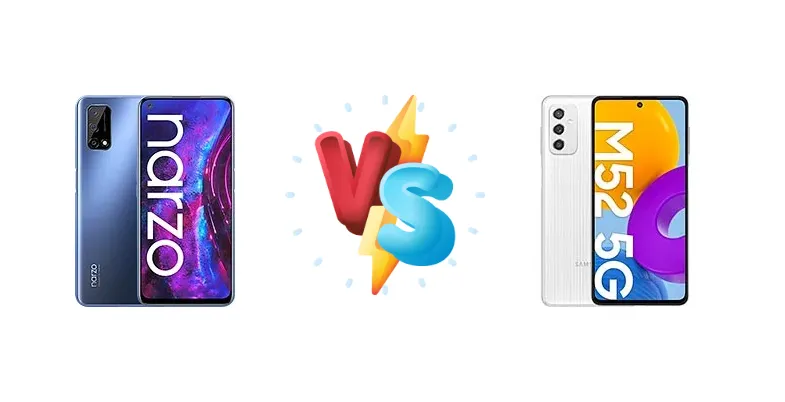
The Realme Narzo 30 Pro 5G and Samsung Galaxy M52 5G represent compelling options in the increasingly competitive mid-range 5G smartphone market. While both aim to deliver 5G connectivity at accessible price points, they diverge significantly in their core hardware choices, particularly in their respective chipsets. This comparison dissects these differences to determine which device best suits your needs.
🏆 Quick Verdict
For the average user prioritizing sustained performance and a brighter display, the Samsung Galaxy M52 5G emerges as the stronger choice. Its Snapdragon 778G chipset, built on a more efficient 6nm process, provides a noticeable advantage in demanding tasks, while the 777 nit display offers superior visibility. However, the Narzo 30 Pro 5G's faster 30W charging is a notable benefit.
| Network |
|---|
| 2G bands | GSM 850 / 900 / 1800 / 1900 | GSM 850 / 900 / 1800 / 1900 |
| 3G bands | HSDPA 800 / 850 / 900 / 1700(AWS) / 1900 / 2100 | HSDPA 850 / 900 / 1700(AWS) / 1900 / 2100 |
| 4G bands | 1, 2, 3, 4, 5, 7, 8, 34, 38, 39, 40, 41 | 1, 2, 3, 4, 5, 7, 8, 12, 17, 20, 26, 28, 38, 40, 41, 66 |
| 5G bands | 1, 41, 77, 78, 79 SA/NSA | SA/NSA/Sub6 |
| Speed | HSPA, LTE, 5G | HSPA, LTE, 5G |
| Technology | GSM / HSPA / LTE / 5G | GSM / HSPA / LTE / 5G |
| Launch |
|---|
| Announced | 2021, February 24 | 2021, September 24 |
| Status | Available. Released 2021, March 04 | Available. Released 2021, October 03 |
| Body |
|---|
| Build | - | Glass front (Gorilla Glass 5), plastic frame, plastic back |
| Dimensions | 162.2 x 75.1 x 9.1 mm (6.39 x 2.96 x 0.36 in) | 164.2 x 76.4 x 7.4 mm (6.46 x 3.01 x 0.29 in) |
| SIM | Nano-SIM + Nano-SIM | Nano-SIM + Nano-SIM |
| Weight | 196 g (6.91 oz) | 173 g (6.10 oz) |
| Display |
|---|
| Protection | Corning Gorilla Glass 3 | Corning Gorilla Glass 5 |
| Resolution | 1080 x 2400 pixels, 20:9 ratio (~405 ppi density) | 1080 x 2400 pixels, 20:9 ratio (~393 ppi density) |
| Size | 6.5 inches, 102.0 cm2 (~83.7% screen-to-body ratio) | 6.7 inches, 108.4 cm2 (~86.4% screen-to-body ratio) |
| Type | IPS LCD, 120Hz , 480 nits (typ), 600 nits (peak) | Super AMOLED Plus, 120Hz |
| Platform |
|---|
| CPU | Octa-core (2x2.4 GHz Cortex-A76 & 6x2.0 GHz Cortex-A55) | Octa-core (1x2.4 GHz Cortex-A78 & 3x2.2 GHz Cortex-A78 & 4x1.9 GHz Cortex-A55) |
| Chipset | Mediatek Dimensity 800U (7 nm) | Qualcomm SM7325 Snapdragon 778G 5G (6 nm) |
| GPU | Mali-G57 MC3 | Adreno 642L |
| OS | Android 10, Realme UI | Android 11, upgradable to Android 13, One UI 5.1 |
| Memory |
|---|
| Card slot | microSDXC (uses shared SIM slot) | microSDXC (uses shared SIM slot) |
| Internal | 64GB 6GB RAM, 128GB 8GB RAM | 128GB 6GB RAM, 128GB 8GB RAM |
| | UFS 2.1 | - |
| Main Camera |
|---|
| Features | LED flash, HDR, panorama | LED flash, panorama, HDR |
| Single | 16 MP, f/2.1, 26mm (wide), 1/3.09", 1.0µm | 32 MP, f/2.2, 26mm (wide) |
| Triple | 48 MP, f/1.8, 26mm (wide), 1/2.0", 0.8µm, PDAF
8 MP, f/2.3, 119˚ (ultrawide), 1/4.0", 1.12µm
2 MP (macro) | 64 MP, f/1.8, 26mm (wide), 1/1.97", 0.7um, PDAF
12 MP, f/2.2, 123˚, (ultrawide), 1/3.06", 1.12µm
5 MP (macro) |
| Video | 4K@30fps, 1080p@30/60/120fps, gyro-EIS | 4K@30fps, 1080p@30/60fps |
| Selfie camera |
|---|
| Features | HDR, panorama | - |
| Single | 16 MP, f/2.1, 26mm (wide), 1/3.09", 1.0µm | 32 MP, f/2.2, 26mm (wide) |
| Video | 1080p@30fps, gyro-EIS | 4K@30fps, 1080p@30fps |
| Sound |
|---|
| 3.5mm jack | Yes | No |
| 35mm jack | Yes | No |
| Loudspeaker | Yes | Yes |
| | 24-bit/192kHz audio | - |
| Comms |
|---|
| Bluetooth | 5.1, A2DP, LE | 5.0, A2DP, LE |
| NFC | No | Yes |
| Positioning | GPS, GLONASS, BDS, GALILEO | GPS, GLONASS, GALILEO, BDS, QZSS |
| Radio | No | Unspecified |
| USB | USB Type-C 2.0, OTG | USB Type-C 2.0, OTG |
| WLAN | Wi-Fi 802.11 a/b/g/n/ac, dual-band, Wi-Fi Direct | Wi-Fi 802.11 a/b/g/n/ac/6, dual-band, Wi-Fi Direct |
| Features |
|---|
| Sensors | Fingerprint (side-mounted), accelerometer, gyro, proximity, compass | Fingerprint (side-mounted), accelerometer, gyro, proximity, compass |
| Battery |
|---|
| Charging | 30W wired, PD, 50% in 25 min, 100% in 65 min | 25W wired |
| Type | 5000 mAh | Li-Ion 5000 mAh |
| Misc |
|---|
| Colors | Sword Black, Blade Silver | Icy Blue, Blazing Black, White |
| Models | RMX2117 | SM-M526BR, SM-M526BR/DS, SM-M526B, SM-M526B/DS |
| Price | About 200 EUR | About 300 EUR |
| SAR EU | - | 0.79 W/kg (head) 1.40 W/kg (body) |
| Tests |
|---|
| Battery life | - |
Endurance rating 123h
|
| Camera | - |
Photo / Video |
| Display | - |
Contrast ratio: Infinite (nominal) |
| Loudspeaker | - |
-30.0 LUFS (Average)
|
| Performance | - |
AnTuTu: 504424 (v9)
GeekBench: 2796 (v5.1)
GFXBench: 28fps (ES 3.1 onscreen) |
Realme Narzo 30 Pro 5G
- Faster 30W charging
- Potentially lower price point
- Decent performance for everyday tasks
- Less efficient chipset (7nm vs 6nm)
- Display brightness likely lower than M52
- Potentially more thermal throttling
Samsung Galaxy M52 5G
- More powerful Snapdragon 778G chipset
- Brighter 777 nit display
- More efficient 6nm process
- Slower 25W charging
- Potentially higher price point
- Similar battery endurance rating
Display Comparison
The Samsung Galaxy M52 5G boasts a significant advantage in display quality, achieving a measured peak brightness of 777 nits. This is crucial for outdoor visibility, a scenario where the Narzo 30 Pro 5G’s display specifications are not available for comparison. While the M52’s contrast ratio is listed as ‘Infinite (nominal)’ – a common marketing term – the higher peak brightness alone makes it the superior choice for users who consume content outdoors or in brightly lit environments. The absence of refresh rate information for the Narzo 30 Pro 5G further solidifies the M52’s display lead.
Camera Comparison
Both devices offer photo and video capabilities, but detailed camera specifications are limited. Without sensor size or aperture information, a direct comparison is difficult. However, the market positioning of Samsung generally suggests more refined image processing algorithms. The absence of details regarding OIS (Optical Image Stabilization) on either device suggests reliance on software stabilization. The usefulness of a 2MP macro camera, often found in this price segment, is questionable, as image quality is typically subpar. The M52's brand reputation suggests a more consistent camera experience.
Performance
The core difference between these two phones lies in their chipsets. The Samsung Galaxy M52 5G utilizes the Qualcomm SM7325 Snapdragon 778G 5G (6nm), featuring a 1x2.4 GHz Cortex-A78 prime core and 3x2.2 GHz Cortex-A78 performance cores, alongside 4x1.9 GHz Cortex-A55 efficiency cores. This contrasts with the Realme Narzo 30 Pro 5G’s Mediatek Dimensity 800U (7nm), which employs 2x2.4 GHz Cortex-A76 cores and 6x2.0 GHz Cortex-A55 cores. The Snapdragon 778G’s 6nm fabrication process offers improved power efficiency and thermal performance compared to the Dimensity 800U’s 7nm node, translating to less throttling during prolonged gaming sessions. The architectural differences in the core configurations also favor the Snapdragon 778G in multi-threaded workloads.
Battery Life
Both the Realme Narzo 30 Pro 5G and Samsung Galaxy M52 5G achieve an endurance rating of 123 hours, indicating similar overall battery life. However, the charging speeds differ significantly. The Narzo 30 Pro 5G supports 30W wired charging, achieving 50% charge in 25 minutes and 100% in 65 minutes. The M52 5G is limited to 25W wired charging. While the battery capacity isn't specified, the faster charging speed of the Narzo 30 Pro 5G provides a tangible benefit for users who frequently need to top up their battery quickly.
Buying Guide
Buy the Realme Narzo 30 Pro 5G if you prioritize rapid charging and are primarily focused on everyday tasks and casual gaming. Its 30W charging will get you back up and running quickly. Buy the Samsung Galaxy M52 5G if you value smoother performance in graphically intensive games, a brighter and more visible display, and a more efficient chipset for longer sustained workloads.
Frequently Asked Questions
❓ Will the Snapdragon 778G in the Galaxy M52 5G handle demanding games like Genshin Impact at high settings?
Yes, the Snapdragon 778G is a capable chipset for gaming. While it won't deliver flagship-level performance, it should handle Genshin Impact at medium to high settings with playable frame rates, benefiting from its 6nm efficiency to minimize throttling during extended gaming sessions. The Dimensity 800U in the Narzo 30 Pro 5G will struggle more with sustained performance in such titles.
❓ How significant is the difference in charging speed between 25W and 30W? Is the Narzo 30 Pro 5G's faster charging a game-changer?
The difference between 25W and 30W charging is noticeable, but not revolutionary. The Narzo 30 Pro 5G's 30W charging can add approximately 15-20 minutes of usage with a short 10-15 minute charge, and fully charges in 65 minutes compared to the M52's longer time. For users who frequently need a quick top-up, it's a valuable feature, but for those who charge overnight, the difference is less critical.
❓ Does the Samsung Galaxy M52 5G support VoWiFi (Wi-Fi Calling)?
Support for VoWiFi (Wi-Fi Calling) varies by carrier and region. While the Galaxy M52 5G *has* the hardware capabilities to support VoWiFi, you'll need to confirm with your specific mobile carrier whether they offer this service on the device.