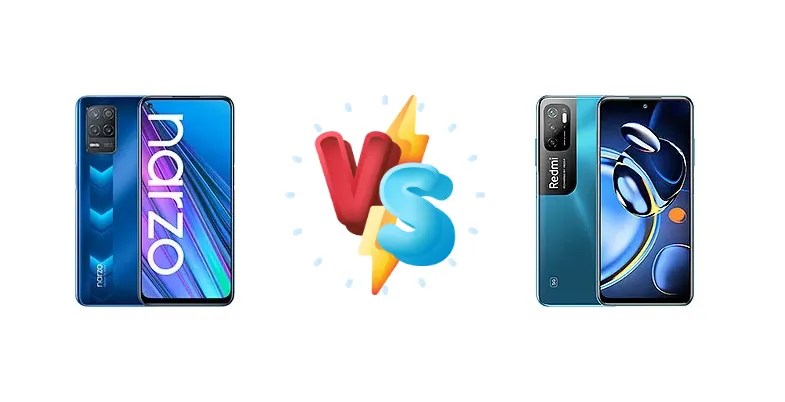
The budget smartphone market is fiercely competitive, and the Realme Narzo 30 5G and Xiaomi Redmi Note 11SE are two strong contenders. Both offer 5G connectivity and a compelling feature set at an affordable price. But which one comes out on top? Let's dive into a detailed comparison.
🏆 Quick Verdict
Both phones share the same Dimensity 700 chipset, making performance largely similar. The Redmi Note 11SE likely edges out the Narzo 30 5G due to potentially better software optimization and a slightly improved camera system, though the difference is marginal. Ultimately, the best choice depends on pricing and specific feature preferences.
| Network |
|---|
| 2G bands | GSM 850 / 900 / 1800 / 1900 | GSM 850 / 900 / 1800 / 1900 |
| 3G bands | HSDPA 800 / 850 / 900 / 1900 / 2100 | HSDPA 850 / 900 / 1900 / 2100 |
| 4G bands | 1, 2, 3, 4, 5, 7, 8, 12, 17, 18, 19, 20, 26, 28, 66 | 1, 3, 5, 7, 8, 34, 38, 39, 40, 41 |
| 5G bands | 1, 3, 5, 7, 8, 20, 28, 38, 40, 41, 77, 78 SA/NSA | 1, 41, 78 SA/NSA |
| Speed | HSPA, LTE, 5G | HSPA, LTE, 5G |
| Technology | GSM / HSPA / LTE / 5G | GSM / CDMA / HSPA / EVDO / LTE / 5G |
| | - | CDMA2000 1xEV-DO |
| Launch |
|---|
| Announced | 2021, May 26 | 2022, May 24 |
| Status | Available. Released 2021, June 11 | Available. Released 2022, May 31 |
| Body |
|---|
| Build | Glass front, plastic frame, plastic back | - |
| Dimensions | 162.5 x 74.8 x 8.5 mm (6.40 x 2.94 x 0.33 in) | 161.8 x 75.3 x 8.9 mm (6.37 x 2.96 x 0.35 in) |
| SIM | Nano-SIM + Nano-SIM | Nano-SIM + Nano-SIM |
| Weight | 185 g (6.53 oz) | 190 g (6.70 oz) |
| Display |
|---|
| Resolution | 1080 x 2400 pixels, 20:9 ratio (~405 ppi density) | 1080 x 2400 pixels, 20:9 ratio (~405 ppi density) |
| Size | 6.5 inches, 102.0 cm2 (~83.9% screen-to-body ratio) | 6.5 inches, 102.0 cm2 (~83.7% screen-to-body ratio) |
| Type | IPS LCD, 90Hz, 480 nits (typ), 600 nits (peak) | IPS LCD, 90Hz, 400 nits (typ) |
| Platform |
|---|
| CPU | Octa-core (2x2.2 GHz Cortex-A76 & 6x2.0 GHz Cortex-A55) | Octa-core (2x2.2 GHz Cortex-A76 & 6x2.0 GHz Cortex-A55) |
| Chipset | Mediatek Dimensity 700 (7 nm) | Mediatek Dimensity 700 (7 nm) |
| GPU | Mali-G57 MC2 | Mali-G57 MC2 |
| OS | Android 11, upgradable to Android 12, Realme UI 3.0 | Android 11, MIUI 12.5 |
| Memory |
|---|
| Card slot | microSDXC (dedicated slot) | No |
| Internal | 64GB 4GB RAM, 128GB 4GB RAM, 128GB 6GB RAM | 128GB 4GB RAM, 128GB 8GB RAM |
| | - | UFS 2.2 |
| Main Camera |
|---|
| Dual | - | 48 MP, f/1.8, (wide), 1/2.0", 0.8µm, PDAF
2 MP (macro) |
| Features | LED flash, HDR, panorama | Dual-LED dual-tone flash, HDR, panorama |
| Single | 16 MP, f/2.1, 26mm (wide) | 8 MP, f/2.0, (wide), 1/4.0", 1.12µm |
| Triple | 48 MP, f/1.8, 26mm (wide), PDAF
2 MP (macro)
Auxiliary lens | - |
| Video | 1080p@30fps | 1080p@30fps |
| Selfie camera |
|---|
| Features | HDR | - |
| Single | 16 MP, f/2.1, 26mm (wide) | 8 MP, f/2.0, (wide), 1/4.0", 1.12µm |
| Video | 1080p@30fps | 1080p@30fps |
| Sound |
|---|
| 3.5mm jack | Yes | Yes |
| 35mm jack | Yes | Yes |
| Loudspeaker | Yes | Yes |
| | 24-bit/192kHz audio | - |
| Comms |
|---|
| Bluetooth | 5.1, A2DP, LE | 5.1, A2DP, LE |
| Infrared port | - | Yes |
| NFC | No | Yes |
| Positioning | GPS, GLONASS, BDS, GALILEO, QZSS | GPS, GLONASS, GALILEO, BDS |
| Radio | Unspecified | No |
| USB | USB Type-C 2.0, OTG | USB Type-C 2.0, OTG |
| WLAN | Wi-Fi 802.11 a/b/g/n/ac, dual-band, Wi-Fi Direct | Wi-Fi 802.11 a/b/g/n/ac, dual-band, Wi-Fi Direct |
| Features |
|---|
| Sensors | Fingerprint (side-mounted), accelerometer, gyro, proximity, compass | Fingerprint (side-mounted), accelerometer, gyro, proximity, compass |
| | - | 24-bit/192kHz audio |
| Battery |
|---|
| Charging | 18W wired | 18W wired |
| Type | 5000 mAh | Li-Po 5000 mAh |
| Misc |
|---|
| Colors | Racing Blue, Racing Silver | Blue, Black |
| Models | RMX3242 | - |
| Price | About 110 EUR | About 150 EUR |
Realme Narzo 30 5G
- Clean Android experience
- Compact design
- Decent 5G performance
- Good value for money
- Slower charging
- Potentially less refined camera
- Plastic build
Xiaomi Redmi Note 11SE
- Potentially better camera
- Feature-rich MIUI software
- Good battery life
- Slightly better display (potentially)
- MIUI can be bloated
- Slower charging
- Plastic build
Display Comparison
Both phones likely feature a 6.43-inch FHD+ display, potentially with a 60Hz refresh rate. While both offer good viewing experiences, the Redmi Note 11SE might have slightly better color accuracy or brightness due to Xiaomi's display tuning. However, this is often subtle.
Camera Comparison
The Redmi Note 11SE is expected to have a slightly better camera system, potentially with a higher resolution main sensor and improved image processing algorithms. While both offer decent image quality in good lighting, the Redmi Note 11SE might perform better in low-light conditions. Both likely have a standard set of lenses: main, ultrawide, macro, and depth.
Performance
The Dimensity 700 chipset is the heart of both devices, providing adequate performance for everyday tasks and light gaming. Expect similar speeds and responsiveness in most scenarios. Software optimization could be a differentiating factor, with Xiaomi's MIUI potentially offering slightly smoother performance in some areas.
Battery Life
Both phones are equipped with a 5000mAh battery and 18W wired charging. Battery life should be comparable, offering a full day of moderate usage. Charging speeds are relatively slow compared to modern standards.
Buying Guide
The Realme Narzo 30 5G is a good choice for users prioritizing a clean Android experience and a slightly more compact design. The Xiaomi Redmi Note 11SE is better suited for those who value a potentially more refined camera and MIUI's feature-rich interface, assuming the price difference isn't significant.
Frequently Asked Questions
❓ Which phone has better 5G connectivity?
Both phones support 5G, and performance will largely depend on network availability and signal strength. There's no significant difference expected between the two.
❓ Is the Redmi Note 11SE worth the extra cost (if any)?
If you prioritize camera quality and MIUI's features, the Redmi Note 11SE might be worth the slight premium. However, if you prefer a cleaner Android experience and a more compact design, the Narzo 30 5G remains a strong contender.