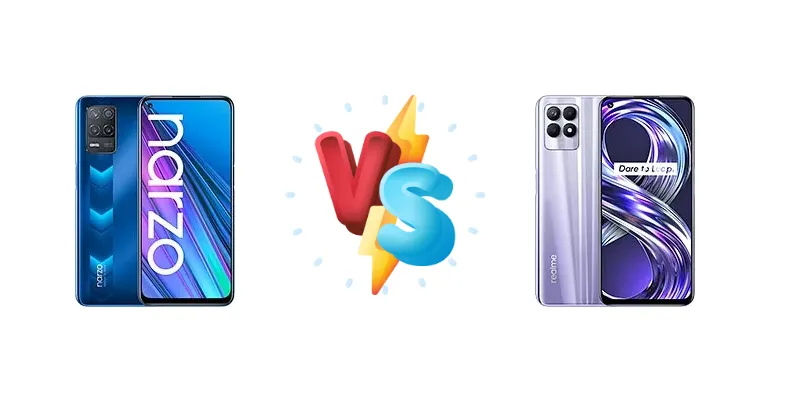
Choosing a budget smartphone can be tough. The Realme Narzo 30 5G and Realme 8i are both strong contenders, offering compelling features at affordable prices. But which one reigns supreme? This comprehensive comparison will help you decide.
🏆 Quick Verdict
The Realme 8i edges out the Narzo 30 5G thanks to its superior display, slightly better camera performance, and impressive battery life. While the Narzo 30 5G offers 5G connectivity, the 8i provides a more well-rounded experience for most users.
| Network |
|---|
| 2G bands | GSM 850 / 900 / 1800 / 1900 | GSM 850 / 900 / 1800 / 1900 |
| 3G bands | HSDPA 800 / 850 / 900 / 1900 / 2100 | HSDPA 850 / 900 / 2100 |
| 4G bands | 1, 2, 3, 4, 5, 7, 8, 12, 17, 18, 19, 20, 26, 28, 66 | 1, 3, 5, 8, 38, 40, 41 |
| 5G bands | 1, 3, 5, 7, 8, 20, 28, 38, 40, 41, 77, 78 SA/NSA | - |
| Speed | HSPA, LTE, 5G | HSPA, LTE |
| Technology | GSM / HSPA / LTE / 5G | GSM / HSPA / LTE |
| Launch |
|---|
| Announced | 2021, May 26 | 2021, September 09 |
| Status | Available. Released 2021, June 11 | Available. Released 2021, September 14 |
| Body |
|---|
| Build | Glass front, plastic frame, plastic back | Glass front, plastic frame, plastic back |
| Dimensions | 162.5 x 74.8 x 8.5 mm (6.40 x 2.94 x 0.33 in) | 164.1 x 75.5 x 8.5 mm (6.46 x 2.97 x 0.33 in) |
| SIM | Nano-SIM + Nano-SIM | Nano-SIM + Nano-SIM |
| Weight | 185 g (6.53 oz) | 194 g (6.84 oz) |
| Display |
|---|
| Resolution | 1080 x 2400 pixels, 20:9 ratio (~405 ppi density) | 1080 x 2412 pixels, 20:9 ratio (~400 ppi density) |
| Size | 6.5 inches, 102.0 cm2 (~83.9% screen-to-body ratio) | 6.6 inches, 104.8 cm2 (~84.6% screen-to-body ratio) |
| Type | IPS LCD, 90Hz, 480 nits (typ), 600 nits (peak) | IPS LCD, 120Hz, 600 nits (peak) |
| Platform |
|---|
| CPU | Octa-core (2x2.2 GHz Cortex-A76 & 6x2.0 GHz Cortex-A55) | Octa-core (2x2.05 GHz Cortex-A76 & 6x2.0 GHz Cortex-A55) |
| Chipset | Mediatek Dimensity 700 (7 nm) | Mediatek MT6781 Helio G96 (12 nm) |
| GPU | Mali-G57 MC2 | Mali-G57 MC2 |
| OS | Android 11, upgradable to Android 12, Realme UI 3.0 | Android 11, Realme UI 2.0 |
| Memory |
|---|
| Card slot | microSDXC (dedicated slot) | microSDXC (dedicated slot) |
| Internal | 64GB 4GB RAM, 128GB 4GB RAM, 128GB 6GB RAM | 64GB 4GB RAM, 128GB 4GB RAM, 128GB 6GB RAM |
| | - | UFS 2.1 |
| Main Camera |
|---|
| Features | LED flash, HDR, panorama | LED flash, HDR, panorama |
| Single | 16 MP, f/2.1, 26mm (wide) | 16 MP, f/2.1, (wide), 1/3.0", 1.0µm |
| Triple | 48 MP, f/1.8, 26mm (wide), PDAF
2 MP (macro)
Auxiliary lens | 50 MP, f/1.8, 26mm (wide), 1/2.76", 0.64µm, PDAF
2 MP (macro)
Auxiliary lens |
| Video | 1080p@30fps | 1080p@30fps |
| Selfie camera |
|---|
| Features | HDR | Panorama |
| Single | 16 MP, f/2.1, 26mm (wide) | 16 MP, f/2.1, (wide), 1/3.0", 1.0µm |
| Video | 1080p@30fps | 1080p@30fps |
| Sound |
|---|
| 3.5mm jack | Yes | Yes |
| 35mm jack | Yes | Yes |
| Loudspeaker | Yes | Yes |
| | 24-bit/192kHz audio | - |
| Comms |
|---|
| Bluetooth | 5.1, A2DP, LE | 5.1, A2DP, LE |
| NFC | No | Yes (market/region dependent) |
| Positioning | GPS, GLONASS, BDS, GALILEO, QZSS | GPS, GLONASS, GALILEO, BDS |
| Radio | Unspecified | No |
| USB | USB Type-C 2.0, OTG | USB Type-C 2.0, OTG |
| WLAN | Wi-Fi 802.11 a/b/g/n/ac, dual-band, Wi-Fi Direct | Wi-Fi 802.11 a/b/g/n/ac, dual-band |
| Features |
|---|
| Sensors | Fingerprint (side-mounted), accelerometer, gyro, proximity, compass | Fingerprint (side-mounted), accelerometer, gyro, proximity, compass |
| Battery |
|---|
| Charging | 18W wired | 18W wired |
| Type | 5000 mAh | 5000 mAh |
| Misc |
|---|
| Colors | Racing Blue, Racing Silver | Space Black, Space Purple |
| Models | RMX3242 | RMX3151 |
| Price | About 110 EUR | About 440 EUR |
| Tests |
|---|
| Battery life | - |
Endurance rating 131h
|
| Camera | - |
Photo / Video |
| Loudspeaker | - |
-28.4 LUFS (Average)
|
Realme Narzo 30 5G
- 5G Connectivity
- Slightly Faster Chipset
- Decent Performance for the Price
- Less Vibrant Display
- Shorter Battery Life
- Average Camera Performance
Realme 8i
- Excellent Battery Life
- Vibrant Display
- Better Camera Performance
- Good Value for Money
- Older Chipset (compared to Narzo 30 5G)
- No 5G
Display Comparison
The Realme 8i boasts a significant advantage with its 1244:1 contrast ratio and 540 nits of brightness, resulting in a more vivid and easily viewable screen, especially outdoors. The Narzo 30 5G's display is adequate but lacks the same level of vibrancy and brightness. Expect better color accuracy and overall visual appeal on the 8i.
Camera Comparison
While both phones offer decent camera capabilities, the Realme 8i generally produces slightly better photos and videos. The 8i's image processing tends to be more refined, resulting in more natural colors and better dynamic range. Both phones feature similar camera setups, but the 8i's software optimization gives it a slight edge.
Performance
The Narzo 30 5G's Dimensity 700 chipset, built on a 7nm process, generally offers slightly better raw performance than the Realme 8i's Helio G96 (12nm). However, in real-world usage, the difference is often negligible for everyday tasks. Gaming performance is comparable, though demanding titles may require lower settings on both devices.
Battery Life
The Realme 8i shines in the battery department, consistently delivering exceptional endurance with a reported 131h rating. The Narzo 30 5G's battery life is respectable, but falls short of the 8i's longevity. If battery life is a top priority, the 8i is the clear winner.
Buying Guide
The Realme Narzo 30 5G is ideal for users prioritizing 5G connectivity and a slightly faster chipset for basic tasks. The Realme 8i is a better choice for those who value a vibrant display, longer battery life, and a more refined camera system.
Frequently Asked Questions
❓ Does the Narzo 30 5G support 5G?
Yes, the Realme Narzo 30 5G is specifically designed for 5G connectivity, making it a good option if you want to take advantage of faster network speeds.
❓ Which phone has better gaming performance?
While both phones can handle casual games, the Narzo 30 5G's slightly more powerful chipset gives it a marginal edge in demanding games, though both may require adjusted graphics settings.