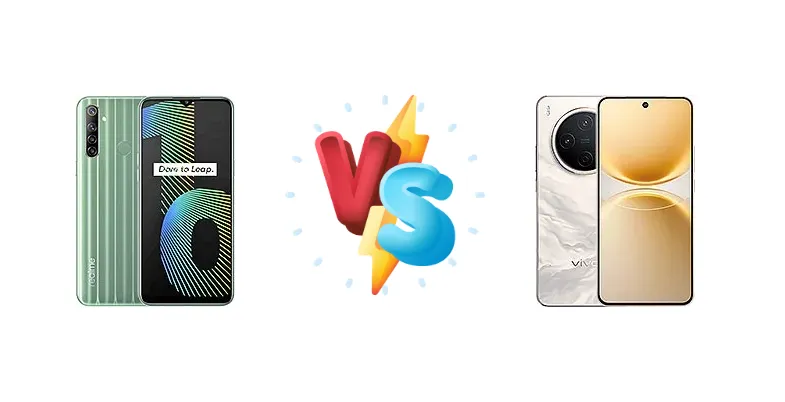
The Realme Narzo 10 represents a value-focused approach to the budget smartphone market, while the vivo Y500 Pro aims for a more premium experience with a newer chipset and significantly faster charging. This comparison dissects the core differences between these two devices, helping you determine which best suits your needs and budget.
🏆 Quick Verdict
For the average user prioritizing performance and future-proofing, the vivo Y500 Pro is the clear winner. Its Dimensity 7400 chipset and 90W charging offer a substantial upgrade over the Narzo 10's Helio G80 and 18W charging. However, the Narzo 10 remains a viable option for those on a very tight budget.
| Network |
|---|
| 2G bands | GSM 850 / 900 / 1800 / 1900 | GSM 850 / 900 / 1800 / 1900 |
| 3G bands | HSDPA 850 / 900 / 2100 | HSDPA 800 / 850 / 900 / 2100 |
| 4G bands | 1, 3, 5, 8, 38, 40, 41 | 1, 3, 5, 8, 19, 28, 34, 38, 39, 40, 41, 42, 48 |
| 5G bands | - | 1, 3, 5, 8, 28, 38, 40, 41, 48, 77, 78 SA/NSA |
| Speed | HSPA, LTE | HSPA, LTE, 5G |
| Technology | GSM / HSPA / LTE | GSM / CDMA / HSPA / LTE / 5G |
| Launch |
|---|
| Announced | 2020, May 11. Released 2020, May 18 | 2025, November 10 |
| Status | Discontinued | Available. Released 2025, November 14 |
| Body |
|---|
| Build | Glass front, plastic back, plastic frame | Glass front (Diamond Shield Glass), glass back, plastic frame |
| Dimensions | 164.4 x 75.4 x 9 mm (6.47 x 2.97 x 0.35 in) | 160.2 x 74.5 x 7.8 mm (6.31 x 2.93 x 0.31 in) |
| SIM | Nano-SIM + Nano-SIM | Nano-SIM + Nano-SIM |
| Weight | 199 g (7.02 oz) | 198.6 g (7.02 oz) |
| Display |
|---|
| Protection | Corning Gorilla Glass 3 | Diamond Shield Glass |
| Resolution | 720 x 1600 pixels, 20:9 ratio (~269 ppi density) | 1260 x 2800 pixels, 20:9 ratio (~460 ppi density) |
| Size | 6.5 inches, 102.8 cm2 (~82.9% screen-to-body ratio) | 6.67 inches, 107.4 cm2 (~90.0% screen-to-body ratio) |
| Type | IPS LCD, 480 nits (typ) | AMOLED, 1B colors, 120Hz, 3840 PWM, 800 nits (typ), 1600 nits (HBM) |
| Platform |
|---|
| CPU | Octa-core (2x2.0 GHz Cortex-A75 & 6x1.8 GHz Cortex-A55) | Octa-core (4x2.6 GHz Cortex-A78 & 4x2.0 GHz Cortex-A55) |
| Chipset | Mediatek MT6769V/CU Helio G80 (12 nm) | Mediatek Dimensity 7400 (4 nm) |
| GPU | Mali-G52 MC2 | Mali-G615 MC2 |
| OS | Android 10, Realme UI | Android 16, OriginOS 6 |
| Memory |
|---|
| Card slot | microSDXC (dedicated slot) | No |
| Internal | 128GB 4GB RAM | 128GB 8GB RAM, 256GB 8GB RAM, 256GB 12GB RAM, 512GB 12GB RAM |
| Main Camera |
|---|
| Dual | - | 200 MP, f/1.9, 23mm (wide), 1/1.56", 0.5µm, PDAF, OIS
Auxiliary lens |
| Features | LED flash, HDR, panorama | LED flash, panorama, HDR |
| Quad | 48 MP, f/1.8, 26mm (wide), 1/2.0", 0.8µm, PDAF
8 MP, f/2.3, 119˚ (ultrawide), 1/4.0", 1.12µm
2 MP (macro)
2 MP B/W, f/2.4 | - |
| Single | 8 MP, AF | - |
| Video | 1080p@30fps, gyro-EIS | 4K, 1080p, gyro-EIS |
| Selfie camera |
|---|
| Features | HDR, panorama | Panorama |
| Single | 16 MP, f/2.0, 26mm (wide), 1/3.06", 1.0µm | 32 MP, f/2.5, (wide) |
| Video | 1080p@30fps | 4K, 1080p |
| Sound |
|---|
| 3.5mm jack | Yes | - |
| 35mm jack | Yes | No |
| Loudspeaker | Yes | Yes |
| Comms |
|---|
| Bluetooth | 5.0, A2DP, LE | 5.4, A2DP, LE, aptX HD |
| Infrared port | - | Yes |
| NFC | No | Yes |
| Positioning | GPS, GLONASS, BDS | GPS (L1+L5), BDS (B1I+B1a), GALILEO (E1+E5a), QZSS (L1+L5), GLONASS |
| Radio | FM radio | No |
| USB | USB Type-C 2.0, OTG | USB Type-C 2.0, OTG |
| WLAN | Wi-Fi 802.11 b/g/n, Wi-Fi Direct | Wi-Fi 802.11 a/b/g/n/ac/6, dual-band |
| Features |
|---|
| Sensors | Fingerprint (rear-mounted), accelerometer, gyro, proximity, compass | Fingerprint (under display, optical), accelerometer, gyro, proximity, compass |
| Battery |
|---|
| Charging | 18W wired
5W reverse wired | 90W wired
Reverse wired |
| Type | 5000 mAh | Si/C Li-Ion 7000 mAh |
| Misc |
|---|
| Colors | That White, That Green | Black, Green, Pink, Gold |
| Models | RMX2040 | V2516A |
| Price | About 150 EUR | About 220 EUR |
| SAR | 0.86 W/kg (head) 0.61 W/kg (body) | - |
Realme Narzo 10
- More affordable price point
- 5W reverse wired charging
- Functional for basic smartphone tasks
- Significantly slower processor
- Slower charging speed
- Less future-proof
vivo Y500 Pro
- Much faster processor (Dimensity 7400)
- Ultra-fast 90W charging
- Improved thermal efficiency
- Higher price
- No reverse wired charging
- Potentially larger physical size
Display Comparison
While display specifications are absent from the provided data, it's reasonable to assume both devices utilize LCD panels given their market segments. The key difference will likely be in color accuracy and peak brightness. The Y500 Pro, being a newer device, may benefit from improved panel technology. However, without specific data, this remains speculative. Bezels are also likely to be larger on the Narzo 10, reflecting its older design.
Camera Comparison
Without sensor details, a direct camera comparison is difficult. However, the Y500 Pro’s newer chipset likely includes a more advanced image signal processor (ISP), enabling better image processing and potentially superior low-light performance. The Narzo 10’s camera system will likely focus on providing adequate results for social media sharing, while the Y500 Pro may offer more detail and dynamic range. It's important to note that the presence of a 2MP macro camera on either device is unlikely to significantly impact image quality.
Performance
The performance gap between these two devices is substantial. The vivo Y500 Pro’s Mediatek Dimensity 7400, built on a 4nm process, represents a significant leap forward in efficiency and power compared to the Realme Narzo 10’s 12nm Mediatek Helio G80. The Dimensity 7400’s CPU configuration – 4x2.6 GHz Cortex-A78 cores and 4x2.0 GHz Cortex-A55 cores – offers a noticeable advantage over the Narzo 10’s 2x2.0 GHz Cortex-A75 and 6x1.8 GHz Cortex-A55 setup, particularly in multi-threaded tasks and demanding applications. This translates to faster app launches, smoother multitasking, and a more responsive overall user experience. The 4nm process also contributes to better thermal management, reducing the likelihood of performance throttling during extended gaming sessions.
Battery Life
The charging capabilities are a defining difference. The vivo Y500 Pro’s 90W wired charging is a game-changer, potentially allowing a full charge from 0-100% in under 30 minutes. The Realme Narzo 10’s 18W charging is considerably slower, requiring significantly more time to reach a full charge. While battery capacity isn't specified, the faster charging of the Y500 Pro mitigates the impact of a potentially smaller battery, offering more convenient top-ups throughout the day. The Narzo 10 also offers 5W reverse wired charging, a feature absent from the Y500 Pro's specs, allowing it to charge other devices, albeit slowly.
Buying Guide
Buy the Realme Narzo 10 if you need a functional, affordable smartphone for basic tasks like calling, texting, and light social media use, and are willing to compromise on performance and charging speed. Buy the vivo Y500 Pro if you prioritize a smoother user experience, faster app loading times, better gaming performance, and the convenience of incredibly rapid charging, even if it means spending more upfront.
Frequently Asked Questions
❓ Will the Dimensity 7400 in the vivo Y500 Pro handle demanding games like Genshin Impact at high settings?
Yes, the Dimensity 7400 is a capable chipset that should handle Genshin Impact and other graphically intensive games at medium to high settings. The 4nm process and improved CPU/GPU architecture contribute to better sustained performance and reduced thermal throttling compared to the Helio G80.
❓ How long does it realistically take to charge the vivo Y500 Pro from 0% to 100% with the 90W charger?
While exact charging times vary, the vivo Y500 Pro with its 90W charging should reach 100% from 0% in approximately 30-45 minutes under ideal conditions. This is a significant improvement over the several hours required for the Narzo 10's 18W charging.
❓ Is the Realme Narzo 10 still a good option for basic users who primarily use their phone for calls, texts, and social media?
Absolutely. The Narzo 10 is perfectly adequate for basic smartphone tasks. Its Helio G80 processor is sufficient for everyday use, and the lower price point makes it an attractive option for users who don't require high performance.
❓ Does the vivo Y500 Pro support 5G connectivity?
The Mediatek Dimensity 7400 chipset *does* support 5G connectivity. This means the vivo Y500 Pro can take advantage of faster data speeds where 5G networks are available, offering a future-proofed experience compared to the Narzo 10 which likely only supports 4G.