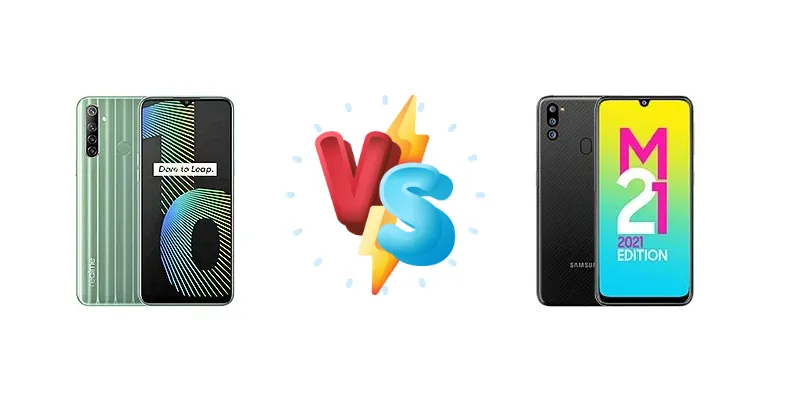
The Realme Narzo 10 and Samsung Galaxy M21 2021 represent compelling options in the crowded budget smartphone space. Both aim to deliver essential features without breaking the bank, but they take different approaches to achieving this. The Narzo 10 prioritizes gaming performance with its MediaTek Helio G80, while the M21 2021 leans towards a more balanced experience with Samsung’s Exynos 9611. This comparison will dissect their key differences to determine which phone best suits your needs.
🏆 Quick Verdict
For the average user prioritizing consistent performance and a slightly more refined software experience, the Samsung Galaxy M21 2021 emerges as the better choice. While the Narzo 10 boasts a newer chipset, the Exynos 9611’s Cortex-A73 cores provide a smoother overall experience, especially in multitasking and demanding applications.
| Network |
|---|
| 2G bands | GSM 850 / 900 / 1800 / 1900 | GSM 850 / 900 / 1800 / 1900 |
| 3G bands | HSDPA 850 / 900 / 2100 | HSDPA 850 / 900 / 1900 / 2100 |
| 4G bands | 1, 3, 5, 8, 38, 40, 41 | 1, 3, 5, 7, 8, 20, 38, 40, 41 |
| Speed | HSPA, LTE | HSPA, LTE |
| Technology | GSM / HSPA / LTE | GSM / HSPA / LTE |
| Launch |
|---|
| Announced | 2020, May 11. Released 2020, May 18 | 2021, July 21 |
| Status | Discontinued | Available. Released 2021, July 26 |
| Body |
|---|
| Build | Glass front, plastic back, plastic frame | Glass front, plastic back, plastic frame |
| Dimensions | 164.4 x 75.4 x 9 mm (6.47 x 2.97 x 0.35 in) | 159 x 75.1 x 9 mm (6.26 x 2.96 x 0.35 in) |
| SIM | Nano-SIM + Nano-SIM | Nano-SIM + Nano-SIM |
| Weight | 199 g (7.02 oz) | 192 g (6.77 oz) |
| Display |
|---|
| Protection | Corning Gorilla Glass 3 | - |
| Resolution | 720 x 1600 pixels, 20:9 ratio (~269 ppi density) | 1080 x 2340 pixels, 19.5:9 ratio (~403 ppi density) |
| Size | 6.5 inches, 102.8 cm2 (~82.9% screen-to-body ratio) | 6.4 inches, 100.5 cm2 (~84.2% screen-to-body ratio) |
| Type | IPS LCD, 480 nits (typ) | Super AMOLED, 420 nits (peak) |
| Platform |
|---|
| CPU | Octa-core (2x2.0 GHz Cortex-A75 & 6x1.8 GHz Cortex-A55) | Octa-core (4x2.3 GHz Cortex-A73 & 4x1.7 GHz Cortex-A53) |
| Chipset | Mediatek MT6769V/CU Helio G80 (12 nm) | Exynos 9611 (10 nm) |
| GPU | Mali-G52 MC2 | Mali-G72 MP3 |
| OS | Android 10, Realme UI | Android 11, One UI 3.1 Core |
| Memory |
|---|
| Card slot | microSDXC (dedicated slot) | microSDXC (dedicated slot) |
| Internal | 128GB 4GB RAM | 64GB 4GB RAM, 128GB 6GB RAM |
| Main Camera |
|---|
| Features | LED flash, HDR, panorama | LED flash, panorama, HDR |
| Quad | 48 MP, f/1.8, 26mm (wide), 1/2.0", 0.8µm, PDAF
8 MP, f/2.3, 119˚ (ultrawide), 1/4.0", 1.12µm
2 MP (macro)
2 MP B/W, f/2.4 | - |
| Single | 8 MP, AF | - |
| Triple | - | 48 MP, f/2.0, 26mm (wide), 1/2.0", 0.8µm, PDAF
8 MP, f/2.2, 123˚ (ultrawide), 1/4.0", 1.12µm
Auxiliary lens |
| Video | 1080p@30fps, gyro-EIS | 4K@30fps, 1080p@30fps, 720p@240fps, gyro-EIS |
| Selfie camera |
|---|
| Features | HDR, panorama | HDR |
| Single | 16 MP, f/2.0, 26mm (wide), 1/3.06", 1.0µm | 20 MP, f/2.2, 26mm (wide) |
| Video | 1080p@30fps | 1080p@30fps |
| Sound |
|---|
| 3.5mm jack | Yes | Yes |
| 35mm jack | Yes | Yes |
| Loudspeaker | Yes | Yes |
| Comms |
|---|
| Bluetooth | 5.0, A2DP, LE | 5.0, A2DP, LE |
| NFC | No | Yes (market/region dependent) |
| Positioning | GPS, GLONASS, BDS | GPS, GLONASS, GALILEO, BDS |
| Radio | FM radio | FM radio, RDS, recording |
| USB | USB Type-C 2.0, OTG | USB Type-C 2.0 |
| WLAN | Wi-Fi 802.11 b/g/n, Wi-Fi Direct | Wi-Fi 802.11 a/b/g/n/ac, dual-band, Wi-Fi Direct |
| Features |
|---|
| Sensors | Fingerprint (rear-mounted), accelerometer, gyro, proximity, compass | Fingerprint (rear-mounted), accelerometer, gyro, proximity, compass |
| Battery |
|---|
| Charging | 18W wired
5W reverse wired | 15W wired |
| Type | 5000 mAh | Li-Po 6000 mAh |
| Misc |
|---|
| Colors | That White, That Green | Charcoal Black, Arctic Blue |
| Models | RMX2040 | SM-M215G, SM-M215G/DS |
| Price | About 150 EUR | About 130 EUR |
| SAR | 0.86 W/kg (head) 0.61 W/kg (body) | 0.47 W/kg (head) |
Realme Narzo 10
- Faster charging (18W vs 15W)
- More powerful GPU for gaming
- Reverse wireless charging
- Potentially more thermal throttling
- Less efficient chipset
Samsung Galaxy M21 2021
- More efficient chipset (10nm)
- Potentially smoother multitasking
- Refined Samsung software experience
- Slower charging (15W)
- Less powerful GPU for demanding games
Display Comparison
Neither device boasts a standout display. Both likely feature LCD panels, a common trait in this price bracket. The key difference lies under the hood. While specific display specs are unavailable, the M21 2021’s Exynos 9611 likely has a more capable display controller, potentially leading to slightly better color reproduction and viewing angles. The Narzo 10’s focus is clearly elsewhere.
Camera Comparison
Camera performance is likely similar, with both phones targeting the budget segment. Without detailed sensor information, it’s difficult to make definitive claims. However, Samsung’s image processing algorithms are generally more refined, potentially resulting in more pleasing photos in various lighting conditions. The inclusion of a 2MP macro lens on both devices is largely a marketing gimmick and offers limited practical benefit. The primary sensor quality and software processing will be the deciding factors, and Samsung typically has an edge in software optimization.
Performance
The performance gap is the most significant differentiator. The Realme Narzo 10’s MediaTek Helio G80 (12nm) utilizes a dual-cluster configuration with two Cortex-A75 cores clocked at 2.0 GHz and six Cortex-A55 cores at 1.8 GHz. This is geared towards gaming. However, the Samsung Galaxy M21 2021’s Exynos 9611 (10nm) employs four Cortex-A73 cores at 2.3 GHz and four Cortex-A53 cores at 1.7 GHz. The 10nm process node of the Exynos 9611 offers better power efficiency, and the Cortex-A73 cores, while older, generally outperform the A75 in sustained workloads due to thermal management. This translates to less throttling during prolonged gaming or multitasking. The Narzo 10 will likely show higher peak performance in short bursts, but the M21 2021 will maintain a more consistent level of performance over time.
Battery Life
Both phones offer substantial battery life. The Realme Narzo 10 features 18W wired charging with 5W reverse wired charging, while the Samsung Galaxy M21 2021 supports 15W wired charging. While the Narzo 10 has faster charging on paper, the Exynos 9611’s superior power efficiency may offset this difference in real-world usage. Both phones should easily last a full day of moderate use, but the M21 2021 might edge out the Narzo 10 in longevity due to its more efficient chipset.
Buying Guide
Buy the Realme Narzo 10 if you are a mobile gamer on a tight budget and prioritize raw processing power for titles like PUBG Mobile and Call of Duty. The Helio G80 offers a performance edge in gaming scenarios. Buy the Samsung Galaxy M21 2021 if you value a more balanced experience with a focus on everyday usability, a potentially more efficient chipset, and Samsung’s established software ecosystem.
Frequently Asked Questions
❓ Does the Exynos 9611 in the Galaxy M21 2021 overheat during prolonged gaming sessions?
The Exynos 9611’s 10nm process and Cortex-A73 cores are designed for efficiency. While it won’t match flagship-level thermal performance, it’s less prone to significant throttling compared to the Narzo 10’s Helio G80, especially during extended gaming. You can expect a more consistent frame rate over longer periods.
❓ Is the 18W charging on the Realme Narzo 10 significantly faster than the 15W charging on the Samsung Galaxy M21 2021?
While 18W is technically faster, the difference in charging speed isn’t dramatic. The Exynos 9611’s power efficiency means the M21 2021 may not require as much time plugged in to reach a full charge, potentially minimizing the practical difference.
❓ Will I notice a significant difference in app loading times between the two phones?
The Samsung Galaxy M21 2021’s Cortex-A73 cores generally offer faster single-core performance, which impacts app loading times. You’ll likely experience slightly quicker app launches and smoother transitions on the M21 2021.