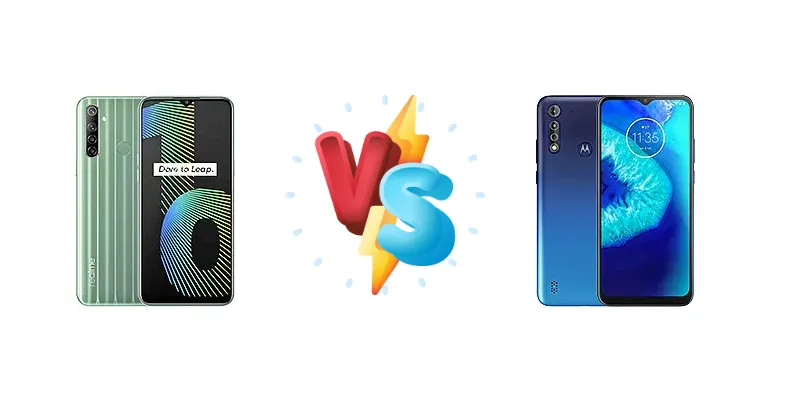
The Realme Narzo 10 and Motorola Moto G8 Power Lite represent two compelling options in the ultra-budget smartphone segment. Both aim to deliver essential features at a low price point, but they take different approaches. The Narzo 10 prioritizes processing power for light gaming and smoother multitasking, while the G8 Power Lite focuses on maximizing battery life for extended usage. This comparison dissects their key differences to help you choose the right device.
🏆 Quick Verdict
For most users, the Realme Narzo 10 is the better choice. Its Mediatek Helio G80 chipset provides a significantly more responsive experience, particularly for gaming and app loading, justifying the slight trade-off in battery longevity compared to the Moto G8 Power Lite. The 18W charging is also a substantial advantage.
| Network |
|---|
| 2G bands | GSM 850 / 900 / 1800 / 1900 | GSM 850 / 900 / 1800 / 1900 |
| 3G bands | HSDPA 850 / 900 / 2100 | HSDPA 850 / 900 / 1900 / 2100 |
| 4G bands | 1, 3, 5, 8, 38, 40, 41 | LTE |
| Speed | HSPA, LTE | HSPA, LTE |
| Technology | GSM / HSPA / LTE | GSM / HSPA / LTE |
| Launch |
|---|
| Announced | 2020, May 11. Released 2020, May 18 | 2020, April 03. Released 2020, April 03 |
| Status | Discontinued | Discontinued |
| Body |
|---|
| Build | Glass front, plastic back, plastic frame | Glass front, plastic back, plastic frame |
| Dimensions | 164.4 x 75.4 x 9 mm (6.47 x 2.97 x 0.35 in) | 164.9 x 75.8 x 9.2 mm (6.49 x 2.98 x 0.36 in) |
| SIM | Nano-SIM + Nano-SIM | · Nano-SIM· Nano-SIM + Nano-SIM |
| Weight | 199 g (7.02 oz) | 200 g (7.05 oz) |
| | - | Water-repellent coating |
| Display |
|---|
| Protection | Corning Gorilla Glass 3 | - |
| Resolution | 720 x 1600 pixels, 20:9 ratio (~269 ppi density) | 720 x 1600 pixels, 20:9 ratio (~269 ppi density) |
| Size | 6.5 inches, 102.8 cm2 (~82.9% screen-to-body ratio) | 6.5 inches, 102.8 cm2 (~82.2% screen-to-body ratio) |
| Type | IPS LCD, 480 nits (typ) | IPS LCD |
| Platform |
|---|
| CPU | Octa-core (2x2.0 GHz Cortex-A75 & 6x1.8 GHz Cortex-A55) | Octa-core (4x2.3 GHz Cortex-A53 & 4x1.8 GHz Cortex-A53) |
| Chipset | Mediatek MT6769V/CU Helio G80 (12 nm) | Mediatek MT6765 Helio P35 (12 nm) |
| GPU | Mali-G52 MC2 | PowerVR GE8320 |
| OS | Android 10, Realme UI | Android 9.0 (Pie) |
| Memory |
|---|
| Card slot | microSDXC (dedicated slot) | microSDXC (dedicated slot) |
| Internal | 128GB 4GB RAM | 64GB 4GB RAM |
| | - | eMMC 5.1 |
| Main Camera |
|---|
| Features | LED flash, HDR, panorama | LED flash, HDR, panorama |
| Quad | 48 MP, f/1.8, 26mm (wide), 1/2.0", 0.8µm, PDAF
8 MP, f/2.3, 119˚ (ultrawide), 1/4.0", 1.12µm
2 MP (macro)
2 MP B/W, f/2.4 | - |
| Single | 8 MP, AF | - |
| Triple | - | 16 MP, f/2.0, (wide), 1.0µm, PDAF
2 MP (macro)
Auxiliary lens |
| Video | 1080p@30fps, gyro-EIS | 1080p@30fps |
| Selfie camera |
|---|
| Features | HDR, panorama | HDR |
| Single | 16 MP, f/2.0, 26mm (wide), 1/3.06", 1.0µm | 8 MP, f/2.0, (wide), 1.12µm |
| Video | 1080p@30fps | 1080p@30fps |
| Sound |
|---|
| 3.5mm jack | Yes | Yes |
| 35mm jack | Yes | Yes |
| Loudspeaker | Yes | Yes |
| Comms |
|---|
| Bluetooth | 5.0, A2DP, LE | 4.2, A2DP, LE |
| NFC | No | No |
| Positioning | GPS, GLONASS, BDS | GPS, GLONASS, GALILEO |
| Radio | FM radio | FM radio |
| USB | USB Type-C 2.0, OTG | microUSB 2.0 |
| WLAN | Wi-Fi 802.11 b/g/n, Wi-Fi Direct | Wi-Fi 802.11 b/g/n, Wi-Fi Direct |
| Features |
|---|
| Sensors | Fingerprint (rear-mounted), accelerometer, gyro, proximity, compass | Fingerprint (rear-mounted), accelerometer, gyro, proximity |
| Battery |
|---|
| Charging | 18W wired
5W reverse wired | 10W wired |
| Type | 5000 mAh | Li-Po 5000 mAh |
| Misc |
|---|
| Colors | That White, That Green | Arctic Blue, Royal Blue |
| Models | RMX2040 | XT2055-2 |
| Price | About 150 EUR | About 160 EUR |
| SAR | 0.86 W/kg (head) 0.61 W/kg (body) | - |
Realme Narzo 10
- Significantly faster processor for smoother performance
- 18W fast charging for quicker top-ups
- Better suited for casual gaming
- Potentially shorter battery life compared to the G8 Power Lite
- May be slightly more expensive
Motorola Moto G8 Power Lite
- Likely longer battery life for extended usage
- More affordable price point
- Simple and user-friendly interface
- Slow processor struggles with demanding tasks
- 10W charging is significantly slower
- Poor gaming performance
Display Comparison
Neither device boasts a standout display. Both likely utilize LCD panels, common in this price bracket. The focus here isn't on visual fidelity, but on functionality. While specific display specs are unavailable, the Narzo 10’s slightly more powerful GPU suggests it *could* handle higher resolution content more smoothly, though both are likely capped at 720p+. Bezels are expected to be substantial on both, reflecting their budget nature.
Camera Comparison
Camera performance is likely to be similar in real-world usage, with both phones relying on budget sensors. The absence of detailed sensor information necessitates a focus on processing. Both will likely feature a primary camera, potentially accompanied by depth or macro sensors of limited utility. The Narzo 10’s more powerful ISP (Image Signal Processor) within the Helio G80 *could* offer slightly better image processing, resulting in more detailed photos in good lighting conditions. However, low-light performance will likely be a weakness on both devices.
Performance
The core difference lies in the chipsets. The Realme Narzo 10’s Mediatek Helio G80, built on a 12nm process, features a dual-core Cortex-A75 setup alongside six Cortex-A55 cores, clocked at 2.0 GHz and 1.8 GHz respectively. This architecture provides a noticeable performance boost over the Motorola Moto G8 Power Lite’s Helio P35. The P35 utilizes a quad-core Cortex-A53 cluster at 2.3 GHz, paired with another quad-core A53 cluster at 1.8 GHz. While the P35’s higher clock speed *sounds* better, the older A53 architecture and lack of performance cores mean it struggles with demanding tasks. The G80’s architecture translates to faster app launches, smoother scrolling, and a more enjoyable gaming experience, even if limited to lighter titles. The Narzo 10 will handle PUBG Mobile on lower settings, while the G8 Power Lite will likely struggle.
Battery Life
The Motorola Moto G8 Power Lite’s name emphasizes its battery focus. While the exact capacity isn’t specified, it’s reasonable to assume a larger battery than the Narzo 10, given the G8 Power series’ reputation. However, the Narzo 10 compensates with 18W wired charging, a significant advantage over the G8 Power Lite’s slower 10W charging. This means the Narzo 10 can replenish its battery much faster, minimizing downtime. While the G8 Power Lite may offer longer screen-on time, the Narzo 10’s faster charging mitigates the battery capacity difference for many users.
Buying Guide
Buy the Realme Narzo 10 if you need a phone capable of handling casual gaming, streaming video, and multitasking without significant lag. It’s ideal for users who prioritize performance and faster charging. Buy the Motorola Moto G8 Power Lite if your primary concern is maximizing battery life and you primarily use your phone for basic tasks like calls, texts, and light social media. It’s a good fit for users who rarely game or run demanding applications.
Frequently Asked Questions
❓ Will the Realme Narzo 10 overheat during extended gaming sessions?
The Helio G80 is a relatively efficient chipset. While it may get warm during prolonged gaming, it’s unlikely to experience significant thermal throttling, especially at lower graphics settings. The phone’s plastic build also helps dissipate heat.
❓ Is the 10W charging on the Moto G8 Power Lite painfully slow?
Yes, 10W charging is considerably slower than the 18W charging on the Narzo 10. Expect a full charge to take several hours, making it best suited for overnight charging. It's a trade-off for the extended battery life.
❓ Can the Realme Narzo 10 handle popular social media apps like TikTok and Instagram smoothly?
Yes, the Helio G80’s processing power is more than sufficient for running social media apps like TikTok and Instagram without noticeable lag. Scrolling through feeds and recording videos should be a smooth experience.
❓ Does the Moto G8 Power Lite support USB-C charging?
While not explicitly stated in the provided data, Motorola typically uses Micro-USB on devices in this price range. It's highly probable the Moto G8 Power Lite utilizes Micro-USB, unlike many newer phones with USB-C.