
Realme GT8 (China) vs Xiaomi Redmi K60 Ultra: A Deep Dive into Flagship Performance
| Phones Images | |||||
|---|---|---|---|---|---|
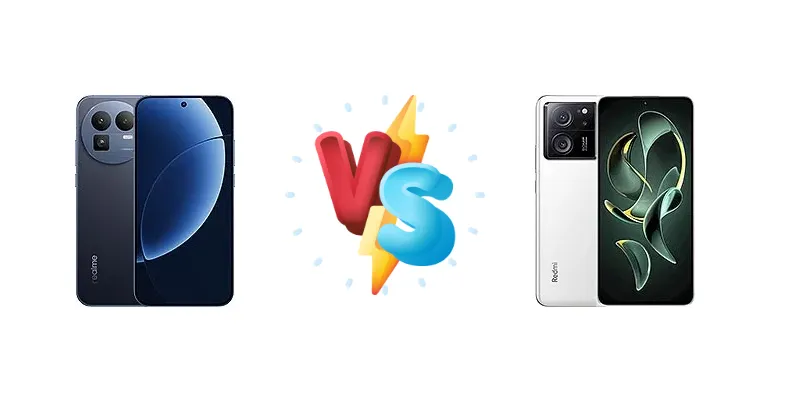
|
🏆 Quick Verdict
For users prioritizing raw processing power and sustained performance, the Realme GT8 (China) with its Snapdragon 8 Elite is the superior choice. However, the Xiaomi Redmi K60 Ultra’s significantly faster 120W charging and competitive Dimensity 9200+ performance make it a strong contender, especially for those valuing convenience.
| PHONES | ||
|---|---|---|
| Phone Names | Realme GT8 (China) | Xiaomi Redmi K60 Ultra |
| Network | ||
|---|---|---|
| 2G bands | GSM 850 / 900 / 1800 / 1900 | GSM 850 / 900 / 1800 / 1900 |
| 3G bands | HSDPA 800 / 850 / 900 / 1700(AWS) / 1900 / 2100 | HSDPA 800 / 850 / 900 / 1700(AWS) / 2100 |
| 4G bands | 1, 3, 4, 5, 8, 18, 19, 20, 26, 28, 34, 38, 39, 40, 41, 42, 48, 66 | 1, 3, 4, 5, 8, 18, 19, 26, 34, 38, 39, 40, 41, 42, 66 |
| 5G bands | 1, 3, 5, 8, 18, 20, 26, 28, 38, 40, 41, 48, 66, 77, 78 SA/NSA | 1, 3, 5, 8, 28, 38, 41, 66, 77, 78 SA/NSA |
| Speed | HSPA, LTE, 5G | HSPA, LTE, 5G |
| Technology | GSM / HSPA / LTE / 5G | GSM / CDMA / HSPA / CDMA2000 / LTE / 5G |
| Launch | ||
|---|---|---|
| Announced | 2025, October 21 | 2023, August 15 |
| Status | Available. Released 2025, October 21 | Available. Released 2023, August 15 |
| Body | ||
|---|---|---|
| Build | Glass front, aluminum frame, fiber-reinforced plastic back or silicone polymer (eco leather) back | - |
| Dimensions | 161.8 x 76.9 x 8.2 mm (6.37 x 3.03 x 0.32 in) | 162.2 x 75.7 x 8.5 mm (6.39 x 2.98 x 0.33 in) |
| SIM | Nano-SIM + Nano-SIM | Nano-SIM + Nano-SIM |
| Weight | 209 g or 214 g (7.37 oz) | 204 g (7.20 oz) |
| Display | ||
|---|---|---|
| Protection | - | Unspecified |
| Resolution | 1440 x 3136 pixels, 19.5:9 ratio (~508 ppi density) | 1220 x 2712 pixels, 20:9 ratio (~446 ppi density) |
| Size | 6.79 inches, 112.8 cm2 (~90.7% screen-to-body ratio) | 6.67 inches, 107.4 cm2 (~87.5% screen-to-body ratio) |
| Type | AMOLED, 144Hz, HDR, 1000 nits (typ), 2000 nits (HBM), 7000 nits (peak) | OLED, 68B colors, 144Hz, Dolby Vision, HDR10+, 2600 nits (peak) |
| Platform | ||
|---|---|---|
| CPU | Octa-core (2x4.32 GHz Oryon V2 Phoenix L + 6x3.53 GHz Oryon V2 Phoenix M) | Octa-core (1x3.35 GHz Cortex-X3 & 3x3.0 GHz Cortex-A715 & 4x2.0 GHz Cortex-A510) |
| Chipset | Qualcomm SM8750-AB Snapdragon 8 Elite (3 nm) | Mediatek Dimensity 9200+ (4 nm) |
| GPU | Adreno 830 | Immortalis-G715 MC11 |
| OS | Android 16, up to 4 major Android upgrades, Realme UI 7.0 | Android 13, MIUI 14 |
| Memory | ||
|---|---|---|
| Card slot | No | No |
| Internal | 256GB 12GB RAM, 256GB 16GB RAM, 512GB 16GB RAM, 1TB 16GB RAM | 256GB 12GB RAM, 256GB 16GB RAM, 512GB 16GB RAM, 1TB 16GB RAM, 1TB 24GB RAM |
| Main Camera | ||
|---|---|---|
| Features | Ricoh lens, Color spectrum sensor, LED flash, HDR, panorama | Color spectrum sensor, Dual-LED dual-tone flash, HDR, panorama |
| Triple | 50 MP, f/1.8, 22mm (wide), 1/1.56", 1.0µm, multi-directional PDAF, OIS 50 MP, f/2.8, 80mm, (periscope telephoto), PDAF, OIS, 3.5x optical zoom 8 MP, f/2.2, 16mm, 112˚ (ultrawide), 1/4.0", 1.12µm | 50 MP, f/1.7, (wide), 1/1.49", 1.0µm, PDAF, OIS 8 MP, 119˚ (ultrawide), 1/4.0", 1.12µm 2 MP (macro) |
| Video | 8K@30fps, 4K@30/60/120fps, 1080p@30/60/120/240fps, gyro-EIS, HDR | 8K@24fps, 4K@30/60fps, 1080p@30/60/120/240/960fps, gyro-EIS, HDR10+, 10-bit |
| Selfie camera | ||
|---|---|---|
| Features | Panorama | HDR |
| Single | 16 MP, f/2.4, 23mm (wide), 1/3.09", 1.0µm | 20 MP, (wide), 1/2.0", 0.8µm |
| Video | Yes | 1080p@30/120fps |
| Sound | ||
|---|---|---|
| 35mm jack | No | No |
| Loudspeaker | Yes, with stereo speakers | Yes, with stereo speakers |
| Comms | ||
|---|---|---|
| Bluetooth | 6.0, A2DP, LE, aptX HD, LHDC 5 | 5.4, A2DP, LE |
| Infrared port | Yes | Yes |
| NFC | Yes | Yes |
| Positioning | GPS (L1+L5), BDS (B1I+B1c+B2a), GALILEO (E1+E5a), QZSS (L1+L5), GLONASS | GPS (L1+L5), GLONASS (G1), BDS (B1I+B1C+B2a+B2b), GALILEO (E1+E5a), QZSS (L1+L5), NavIC |
| Radio | No | Unspecified |
| USB | USB Type-C, OTG | USB Type-C, OTG |
| WLAN | Wi-Fi 802.11 a/b/g/n/ac/6/7, dual-band | Wi-Fi 802.11 a/b/g/n/ac/6e, dual-band, Wi-Fi Direct |
| Features | ||
|---|---|---|
| Sensors | Fingerprint (under display, ultrasonic), accelerometer, gyro, proximity, compass | Fingerprint (under display, optical), accelerometer, gyro, proximity, compass |
| Battery | ||
|---|---|---|
| Charging | 100W wired, 14.4W PD, 45 min to 100% | 120W wired, PD3.0, 100% in 19 min |
| Type | Si/C Li-Ion 7000 mAh | Li-Po 5000 mAh |
| Misc | ||
|---|---|---|
| Colors | Blue, Green, White | Black, White, Green |
| Models | - | 23078RKD5C |
| Price | About 350 EUR | About 330 EUR |
Realme GT8 (China)
- Potentially superior CPU performance with Snapdragon 8 Elite
- More efficient 3nm process for potentially better thermal management
- Likely access to advanced display features
- Slower 100W charging compared to the K60 Ultra
- Limited availability (China only)
Xiaomi Redmi K60 Ultra
- Incredibly fast 120W charging (19 minutes to 100%)
- Competitive Dimensity 9200+ performance
- Wider availability (likely global)
- Less efficient 4nm process compared to Snapdragon 8 Elite
- Potentially lower peak CPU performance
Display Comparison
While specific display details are absent, both devices likely feature high refresh rate AMOLED panels typical of their price segment. The key difference will be in calibration and peak brightness. The Realme GT8, benefiting from a newer chipset, *may* have access to more advanced display controllers for features like variable refresh rate (VRR) and potentially higher peak brightness. However, without concrete data, it's difficult to definitively state which offers a superior visual experience. Bezels are expected to be minimal on both, reflecting current design trends.
Camera Comparison
Without detailed camera specifications, a direct comparison is challenging. However, both brands typically prioritize strong camera performance in their flagship models. The Redmi K60 Ultra, given Xiaomi’s history, may lean towards a more saturated, vibrant image processing style, while Realme often aims for a more natural look. Sensor size will be a critical factor; a larger sensor generally captures more light and results in better low-light performance. The presence of Optical Image Stabilization (OIS) on the main sensor is also crucial for sharp, stable photos and videos. We can assume both phones will have a multi-camera setup, but the quality of the auxiliary lenses (ultrawide, macro) will likely vary.
Performance
The core battleground is the chipset. The Realme GT8’s Snapdragon 8 Elite, built on a 3nm process, promises significant gains in both performance and efficiency compared to the Redmi K60 Ultra’s 4nm Dimensity 9200+. The Snapdragon 8 Elite’s Oryon V2 Phoenix CPU architecture (2x4.32 GHz + 6x3.53 GHz) is designed for sustained peak performance, potentially outperforming the Dimensity 9200+'s (1x3.35 GHz Cortex-X3 + 3x3.0 GHz Cortex-A715 + 4x2.0 GHz Cortex-A510) in multi-threaded workloads. The 3nm node allows for higher transistor density and reduced power consumption, potentially leading to less thermal throttling during extended gaming sessions. However, MediaTek’s optimizations with the Dimensity 9200+ are substantial, and real-world performance differences may be less dramatic than the raw specs suggest. Both devices will likely feature LPDDR5x RAM, ensuring ample memory bandwidth.
Battery Life
The Xiaomi Redmi K60 Ultra takes a clear lead in charging speed with its 120W wired charging, capable of reaching 100% in just 19 minutes. The Realme GT8’s 100W charging is still fast, but significantly slower, taking 45 minutes for a full charge. While battery capacity isn’t specified, the faster charging of the K60 Ultra mitigates the impact of a potentially smaller battery. The K60 Ultra also supports PD3.0, offering wider compatibility with chargers. The Snapdragon 8 Elite’s 3nm efficiency *could* translate to better battery life during typical usage, but the K60 Ultra’s charging advantage is a significant convenience factor.
Buying Guide
Buy the Realme GT8 (China) if you demand the absolute best CPU performance for demanding tasks like video editing, emulation, or consistently high frame rates in graphically intensive games. Buy the Xiaomi Redmi K60 Ultra if you prioritize incredibly fast charging speeds, a balanced user experience, and don't necessarily need the peak performance offered by the Snapdragon 8 Elite.